


Designing a Seamless Food Delivery Ecosystem with AI-Powered Precision
Creating a cohesive architecture for a food delivery platform involves aligning business goals with technical execution across multiple stakeholders—restaurants, customers, payment systems, and logistics networks. The complexity of interdependencies demands more than static diagrams; it calls for a dynamic design partner. Enter the Visual Paradigm AI Chatbot: not just a generator, but a conversational modeling expert that transforms abstract concepts into structured, standardized architecture.
From Prompt to Architecture: An Interactive Design Journey
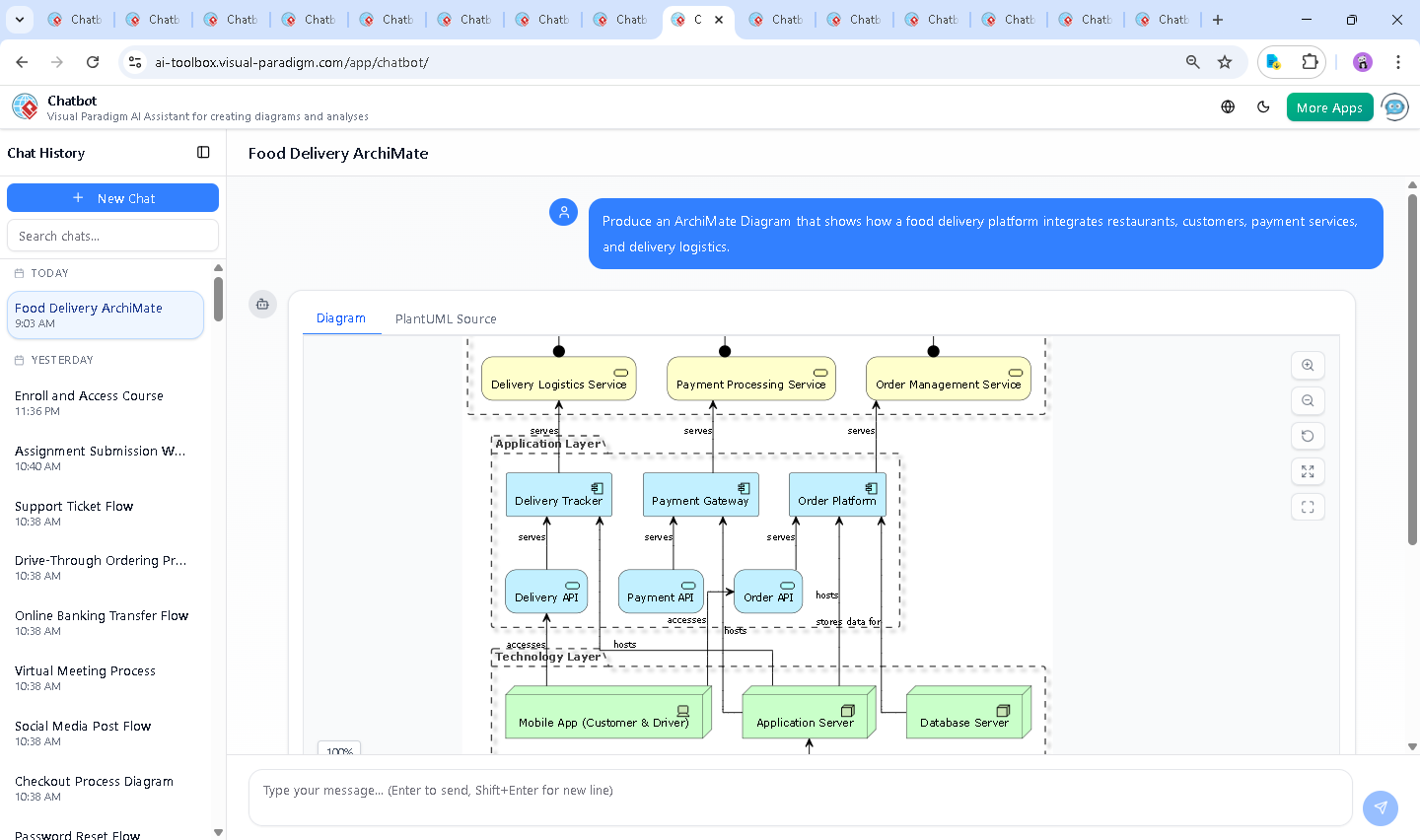
The journey began with a simple request: “Produce an ArchiMate Diagram that shows how a food delivery platform integrates restaurants, customers, payment services, and delivery logistics.” The AI Chatbot immediately interpreted the intent, recognizing the need for layered representation across business, application, and technology domains.
Initial output included a full ArchiMate model with clear layering and relationships. But the conversation didn’t stop there. The user asked, “AI, refine the logic around real-time tracking.” In response, the AI adjusted the business process and application service mappings to emphasize live updates, ensuring the Delivery Tracker component was explicitly tied to the real-time data flow via the Delivery API.
Further refinement came with: “Explain this branch from the customer to the delivery driver.” The AI didn’t just label—it clarified the causal chain: the customer places an order, which triggers Order Management, which in turn assigns a delivery driver through the Delivery Logistics service. The AI then added a visual cue to highlight this flow, reinforcing traceability.
Visualizing the Integration Architecture
Decoding the Architecture: Layered Logic and Intent
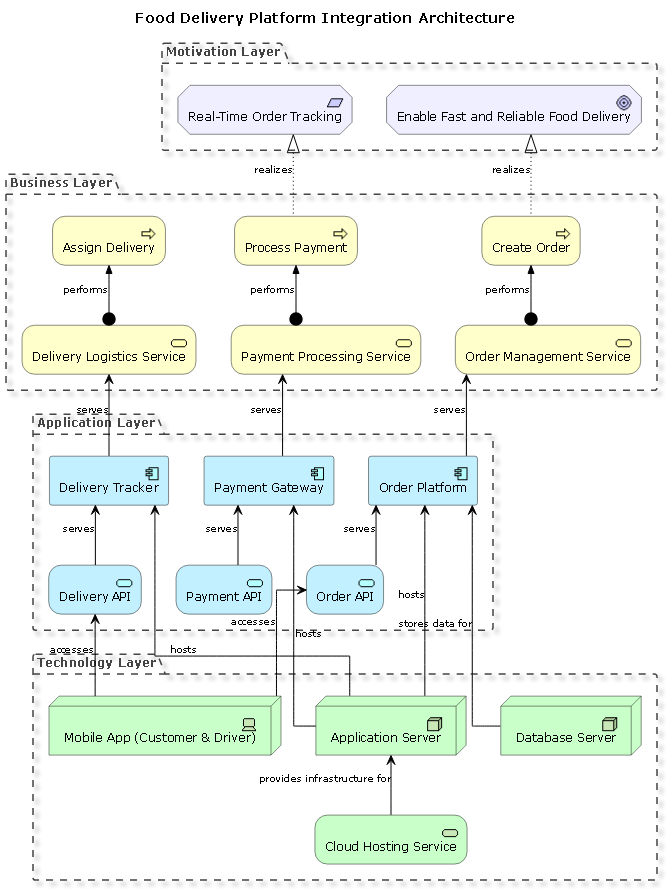
The final ArchiMate diagram reflects a deep understanding of enterprise architecture principles. Here’s how each layer contributes:
- Motivation Layer: The foundation—two core drivers—”Enable Fast and Reliable Food Delivery” and “Real-Time Order Tracking”—set the strategic intent. These goals are realized by specific business processes, establishing alignment between business outcomes and operational execution.
- Business Layer: Actors like Customer, Restaurant, and Delivery Driver represent stakeholders. Their actions—creating orders, processing payments, assigning deliveries—are formalized as processes and services. The use of Business Service for Order Management, Payment Processing, and Delivery Logistics ensures service-oriented clarity.
- Application Layer: Components like the Order Platform, Payment Gateway, and Delivery Tracker encapsulate functionality. These are served by APIs—Order API, Payment API, Delivery API—enabling loose coupling and scalability. The AI chose this structure to reflect modern microservices design patterns.
- Technology Layer: The infrastructure is explicitly mapped. The Application Server hosts all core components, the Database Server stores order and user data, and the Cloud Hosting Service provides scalable infrastructure. The Mobile App (for both customer and driver) is shown accessing APIs directly—highlighting the client-server model.
Relationships are not arbitrary. Realization links business processes to goals (e.g., Process Create Order realizes the goal of fast delivery). Assignment shows who performs what (e.g., Order Management performs Create Order). Serving relationships clarify how components and services are accessed and hosted—ensuring the architecture is not just visual, but operationally meaningful.
Conversational Intelligence in Action
The true power of the Visual Paradigm AI Chatbot lies in its ability to evolve with the user’s intent. After the initial diagram was generated, the user requested a deeper dive into the payment flow. The AI responded by adding a dedicated Business Process for Payment Processing and linking it to the Payment Gateway via a serving relationship. When asked to clarify the delivery assignment logic, the AI introduced a clear path from Order Management to Delivery Logistics, reinforcing the system’s decision-making flow.
These interactions were not just edits—they were architectural consultations. The AI didn’t just follow instructions; it anticipated gaps and proactively strengthened the model’s integrity.
Beyond ArchiMate: A Unified Modeling Platform
While this example focuses on ArchiMate, the Visual Paradigm AI Chatbot is not limited to one standard. It seamlessly supports UML for system design, SysML for complex engineering systems, C4 Model for software architecture, and even Mind Maps for brainstorming. Whether you’re modeling a financial transaction system, a smart city infrastructure, or a cloud-native microservices architecture, the AI Chatbot adapts to your domain and notation.
This versatility makes Visual Paradigm a complete, AI-powered visual modeling platform—where every conversation builds not just a diagram, but a shared understanding across teams.
Conclusion: Architect with Confidence
Designing a food delivery platform’s integration architecture is no small feat. But with the Visual Paradigm AI Chatbot, it becomes a collaborative, intelligent process. From concept to diagram, every step is guided by domain expertise, standardized notation, and real-time feedback.
Ready to model your next enterprise system with precision? Explore the live session and experience how AI transforms architecture from idea to implementation.