


Designing a Seamless Digital Government Experience with AI-Powered ArchiMate Modeling
Creating a cohesive, scalable architecture for a government e-services portal demands precision in modeling how citizens interact with public services and underlying data systems. Traditional approaches often stall at the drafting stage—requiring deep expertise in ArchiMate notation and iterative refinement. With Visual Paradigm’s AI Chatbot, this challenge transforms into a dynamic collaboration: a conversational design journey where intent meets intelligent execution.
From Prompt to Precision: An Interactive Journey Through Modeling
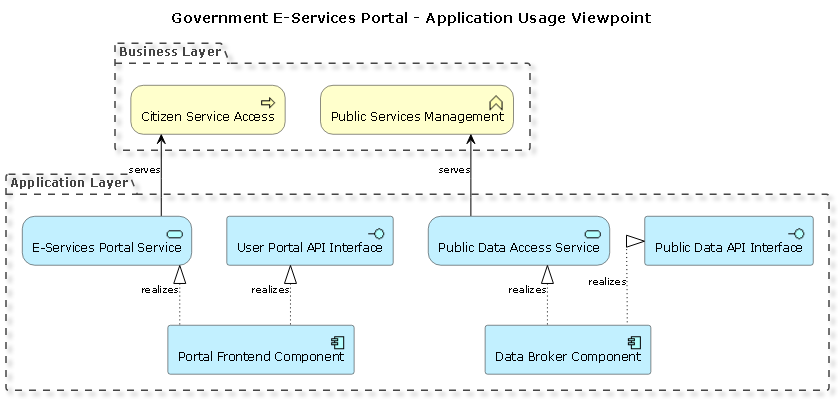
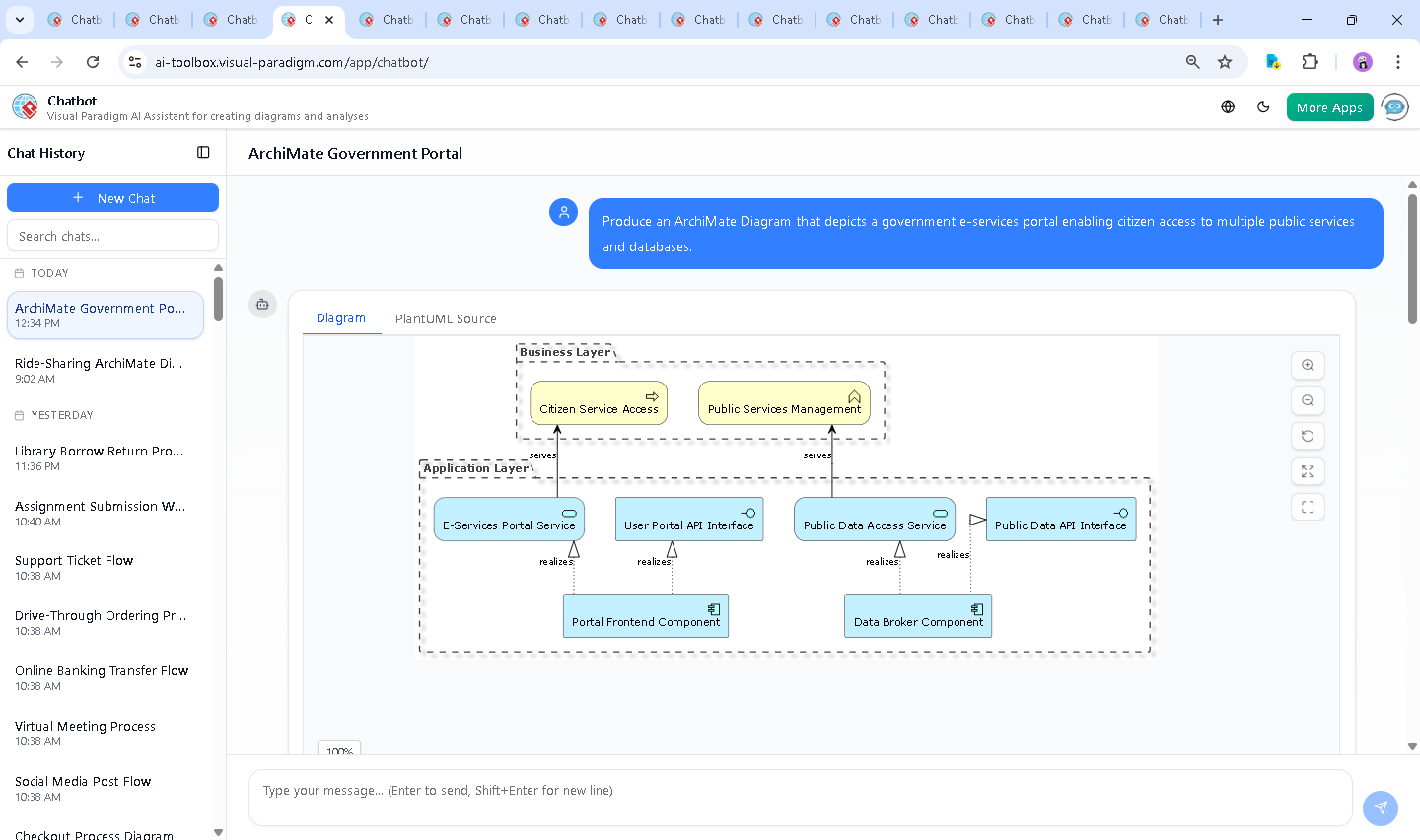
The journey began with a simple directive: “Produce an ArchiMate Diagram that depicts a government e-services portal enabling citizen access to multiple public services and databases.” Within seconds, the Visual Paradigm AI Chatbot delivered a structured PlantUML-based ArchiMate diagram, automatically rendering the core layers—Business, Application, and their relationships—using the correct ArchiMate stereotypes and viewpoint.
But the real value emerged in the conversation. When the user asked, “Can you explain how the Citizen Service Access process interacts with the Public Services Management function?”, the AI didn’t just restate the diagram. It provided a detailed, human-readable breakdown of the interaction flow—mapping real-world service logic to ArchiMate semantics. It clarified how the Rel_Serving_Up relationship connects the application service to the business process, and how the Rel_Usage pattern reflects how citizens use the portal to trigger backend functions.
Follow-up requests like “AI, refine the logic” or “Explain this branch” were handled with context-aware depth. The AI adjusted the diagram’s structure to emphasize data flow, added clarifying annotations, and even suggested enhancements—such as introducing a Data Broker Component to handle secure, cross-agency data access—demonstrating not just notation accuracy, but architectural insight.
Decoding the Architecture: A Deep Dive into the Logic
The resulting ArchiMate diagram captures a multi-layered, service-driven digital government ecosystem. Here’s how each element contributes to the overall design:
Business Layer: Citizen-Centric Service Delivery
- Business Process: Citizen Service Access – This is the entry point for citizens. It represents the end-to-end flow of initiating, submitting, and tracking a service request via the portal.
- Business Function: Public Services Management – This represents the backend governance of services, such as processing tax refunds, issuing licenses, or verifying eligibility. It encapsulates the business logic and decision-making required to deliver services.
Application Layer: Enabling the Experience
- Application Service: E-Services Portal Service – This service enables the user-facing functionality. It serves the Citizen Service Access process, acting as the primary interface for citizens.
- Application Service: Public Data Access Service – This service provides secure access to authoritative data sources (e.g., identity records, health registries, land titles). It supports the Public Services Management function.
- Application Components:
- Portal Frontend Component – Handles UI rendering and user interaction.
- Data Broker Component – Acts as a mediator between the portal and external databases, ensuring secure, standardized access.
- Application Interfaces:
- User Portal API Interface – Exposes the portal’s functionality to users.
- Public Data API Interface – Provides a standardized way for the portal to query external data systems.
Key Relationships & Why They Matter
- Rel_Serving_Up – The E-Services Portal Service serves the Citizen Service Access process. This shows how the application enables business activity.
- Rel_Serving_Up – The Public Data Access Service serves the Public Services Management function, indicating that data access is a core enabler for service execution.
- Rel_Realization_Up – The Portal Frontend Component realizes the User Portal API Interface, meaning it implements the interface contract.
- Rel_Realization_Up – The Data Broker Component realizes the Public Data API Interface, ensuring secure and standardized data access.
This structure reflects a clean separation of concerns: citizen interaction, business logic, and data access are clearly defined and interconnected—ensuring scalability, maintainability, and compliance.
Conversational Intelligence: The AI as Your Modeling Partner
What sets Visual Paradigm apart is not just the ability to generate diagrams, but the depth of collaboration the AI enables. The chat history shows a true dialogue: the user posed a question, the AI interpreted intent, delivered a response, and then adapted based on feedback.
For example, when the user asked for an explanation of the interaction between the Citizen Service Access process and the Public Services Management function, the AI didn’t just label the diagram—it contextualized it. It mapped the technical relationships to real-world scenarios: how a citizen applies for a driver’s license, how eligibility is verified, and how data is retrieved via secure APIs. This kind of insight turns a static diagram into a living design artifact.
Each follow-up—whether it was refining the data flow, clarifying the role of the Data Broker, or suggesting improvements—was handled with architectural precision. The AI didn’t just follow rules; it applied domain knowledge, ensuring the model was not only correct but also practical and future-proof.
Beyond ArchiMate: A Unified Platform for All Modeling Standards
While this example focuses on ArchiMate, the Visual Paradigm AI Chatbot is not limited to a single standard. It seamlessly supports a full suite of modeling languages, including:
- UML – For software design, class, sequence, and component diagrams.
- SysML – For systems engineering, requirements, and behavior modeling.
- C4 Model – For software architecture, visualizing context, containers, components, and code.
- Mind Maps – For brainstorming.
This versatility means that whether you’re modeling a citizen service workflow (ArchiMate), or designing a microservices architecture (C4), the same AI assistant adapts—delivering consistent, intelligent, and accurate results.
Conclusion: Build Smarter, Collaborate Faster
Visual Paradigm’s AI Chatbot isn’t just a diagram generator—it’s a collaborative modeling expert. From the initial prompt to the final refined diagram, it guides users through a conversational design process that blends technical accuracy with real-world insight.
For government agencies, digital transformation teams, and enterprise architects, this means faster time-to-model, reduced cognitive load, and higher-quality architecture documentation—without sacrificing depth or precision.
Experience the future of visual modeling: Try the AI Chatbot now and see how it turns your ideas into actionable, intelligent architecture.