


Designing a Cohesive Healthcare Ecosystem: AI-Powered ArchiMate Modeling for Hospital Information Systems
Designing a robust hospital information system requires clarity across patient registration, clinical workflows, and medical records management—three pillars that must interact seamlessly. Traditional modeling approaches often struggle with capturing these interdependencies without extensive manual effort. With Visual Paradigm’s AI Chatbot, this challenge transforms into a collaborative dialogue. The AI doesn’t just generate diagrams—it acts as a modeling consultant, interpreting intent, refining logic, and adapting to feedback in real time.
From Prompt to Precision: The Interactive Evolution of the ArchiMate Diagram
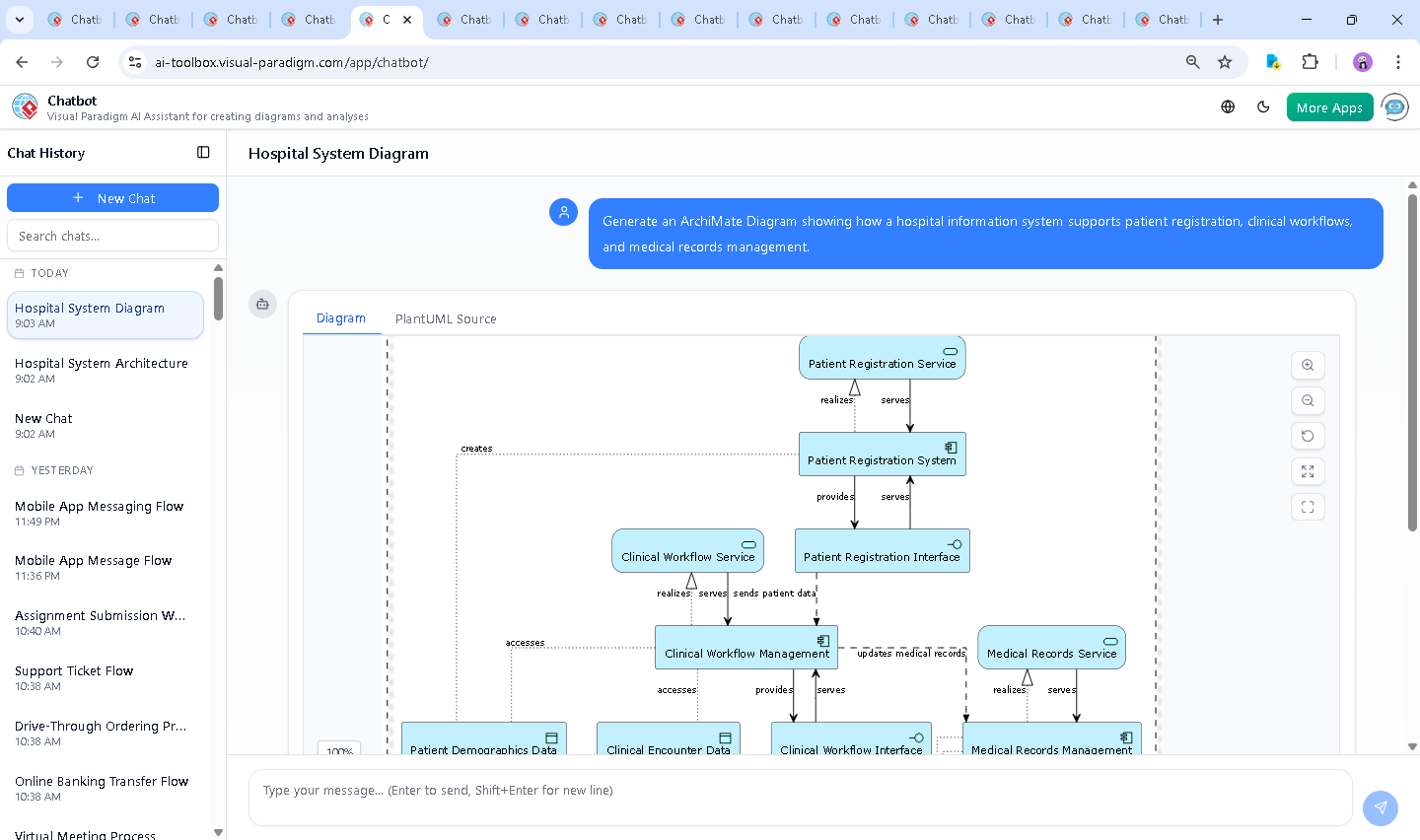
The journey began with a simple request: “Generate an ArchiMate Diagram showing how a hospital information system supports patient registration, clinical workflows, and medical records management.” The AI Chatbot immediately responded with a structured PlantUML script, rendering a clean, layered view of the application components, services, data objects, and their interactions.
But the conversation didn’t stop there. The user refined the scope by asking, “AI, refine the logic to show how clinical workflows access patient data during appointments.” In response, the AI adjusted the model to include precise Rel_Access relationships between the ClinicalWorkflowApp and PatientData, reinforcing data flow and access control. Another follow-up—”Explain this branch”—prompted the AI to annotate the role of MedicalRecordsService in synchronizing updates from clinical encounters to the EMR, demonstrating contextual awareness.
These iterative exchanges highlight the AI’s ability to function as a design partner. It doesn’t just output diagrams—it validates assumptions, suggests improvements, and ensures architectural integrity through conversational refinement.
Decoding the Diagram: The Architecture Behind the Flow
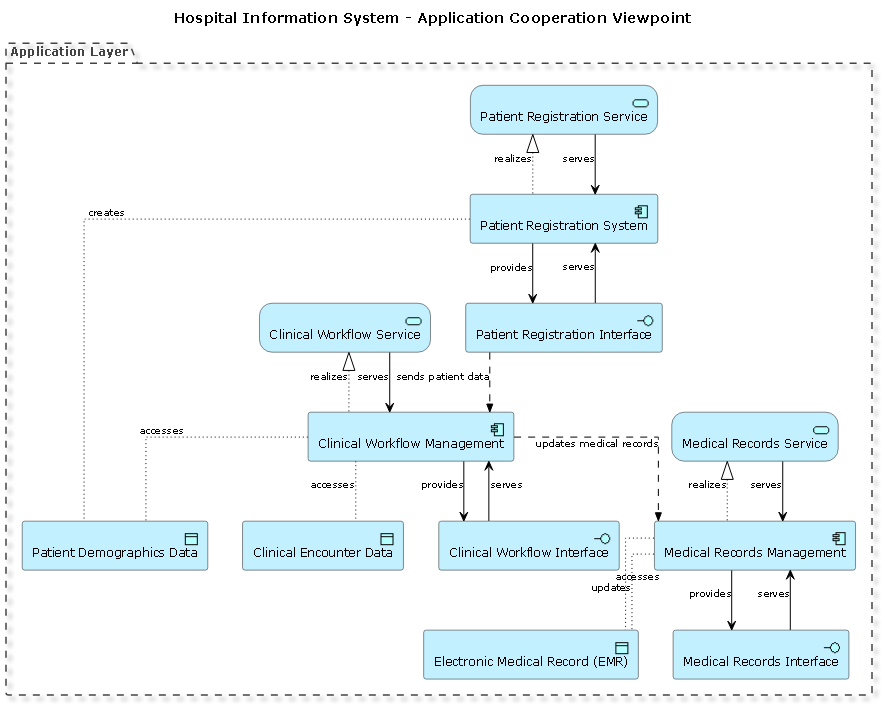
The final ArchiMate diagram presents a clear Application Cooperation Viewpoint, organized into logical layers and relationships that reflect real-world system behavior:
- Application Components: Three core systems—Patient Registration System, Clinical Workflow Management, and Medical Records Management—form the backbone of the hospital’s digital operations.
- Application Services: These act as the functional layer, with each service realizing its respective application (e.g., PatientRegistrationService realizes PatientRegistrationApp), ensuring a clear separation between implementation and functionality.
- Data Objects: Critical data entities like Patient Demographics Data, Clinical Encounter Data, and Electronic Medical Record (EMR) are explicitly modeled to show where data is created, accessed, and updated.
- Interfaces and Flows: The provides and sends relationships illustrate how the system exposes capabilities (e.g., PatientRegistrationInterface serves the registration app) and shares data across components (e.g., patient data flows from registration to clinical workflows).
- Access and Realization: The accesses relationships (e.g., ClinicalWorkflowApp accesses PatientData) ensure that data access is traceable and aligned with business processes. The realizes relationships clarify how services enable application functionality.
Each notation choice—from the use of Application_Component to Rel_Flow—is grounded in ArchiMate’s standard semantics, ensuring the model is both accurate and interoperable with enterprise architecture frameworks.
Conversational Intelligence in Action
What sets this process apart is the depth of interaction. The AI Chatbot didn’t just render a diagram—it guided the user through architectural decisions. When asked to clarify data ownership, it highlighted that MedicalRecordsApp updates MedicalRecordData, reinforcing data consistency. When the user questioned the flow from clinical workflows to records, the AI added a Rel_Flow with the label “updates medical records”, making the intent unambiguous.
These exchanges demonstrate the AI’s role as an intelligent collaborator—interpreting natural language, maintaining context, and enhancing model fidelity through iterative feedback.
Beyond ArchiMate: A Unified Modeling Platform
While this example focuses on ArchiMate, the Visual Paradigm AI Chatbot is not limited to a single standard. It seamlessly supports UML for software design, SysML for systems engineering, C4 for software architecture, and even Mind Maps for conceptual brainstorming. This versatility makes it an indispensable tool for architects, developers, and business analysts working across domains.
Whether you’re modeling a healthcare system, a financial transaction platform, or a smart city infrastructure, the AI Chatbot adapts to your needs—understanding your language, refining your models, and delivering precise, standards-compliant diagrams in minutes.
Empower Your Design with AI-Driven Clarity
Creating enterprise-grade architecture doesn’t have to be slow or error-prone. With Visual Paradigm’s AI Chatbot, you gain a dynamic, intelligent partner that turns ideas into well-structured, shareable models—fast, accurate, and collaborative.
Explore how your next system design can be shaped through conversation. Try the interactive session now and experience the future of visual modeling.