


Designing a Seamless Claims Experience: How AI Transforms Insurance Architecture
Building a clear, scalable architecture for an insurance claims processing system demands precision in modeling how customer interactions, agent workflows, policy data, and backend services align. Traditional modeling tools often slow down this process with rigid syntax and steep learning curves. With Visual Paradigm’s AI Chatbot, this challenge transforms into a collaborative design journey—where natural language prompts generate accurate, standards-compliant ArchiMate diagrams in seconds.
From Prompt to Precision: A Conversational Design Journey
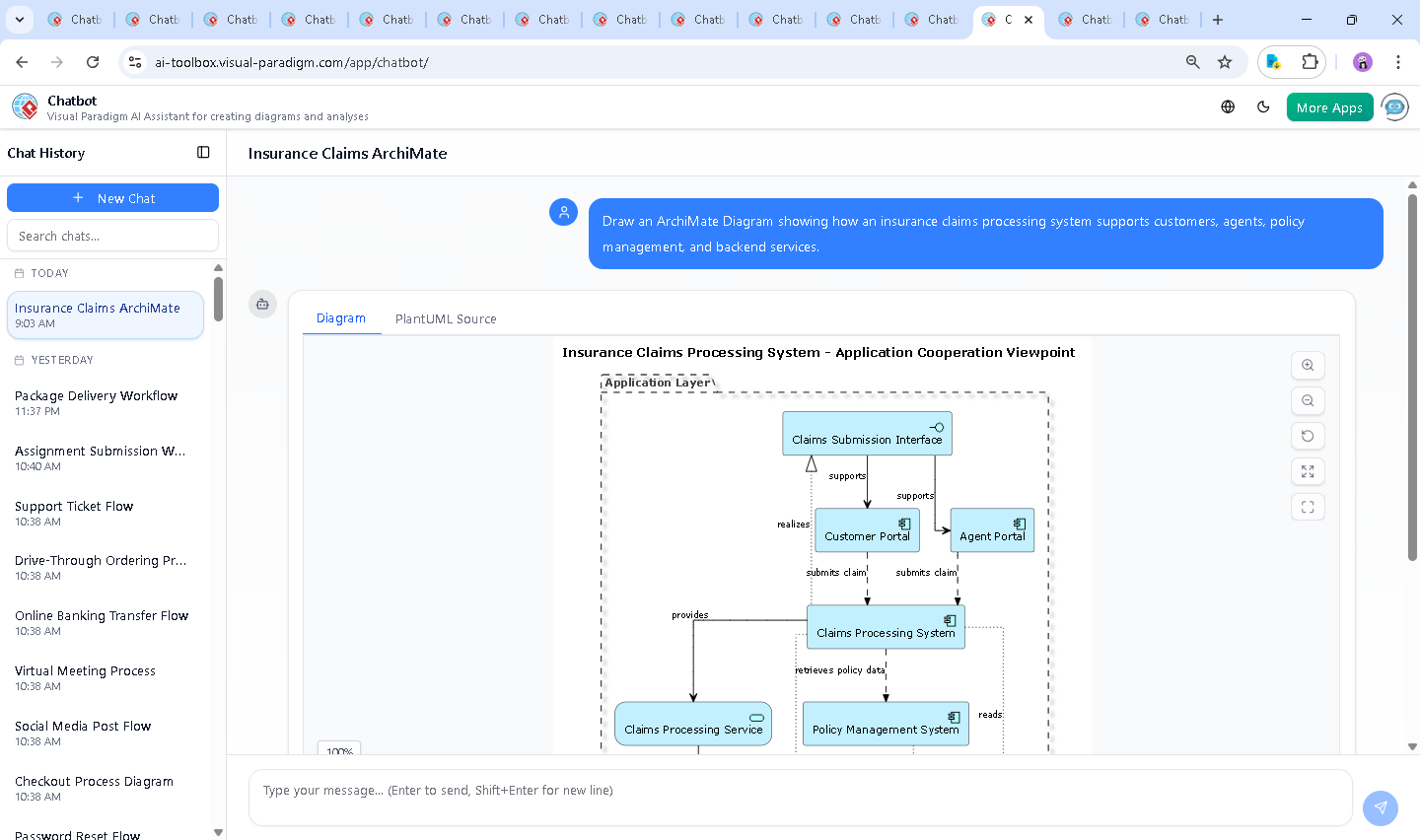
The process began with a simple request: “Draw an ArchiMate Diagram showing how an insurance claims processing system supports customers, agents, policy management, and backend services.” The AI Chatbot instantly interpreted the intent and delivered a PlantUML-based ArchiMate diagram using the Archimate.puml standard library. But the real value emerged in the conversation that followed.
When the initial output was generated, the user asked, “AI, refine the logic to show how the Claims Assessment Service interacts with policy data.” The AI responded by strengthening the Rel_Access relationships between the ClaimsAssessmentService and PolicyData, ensuring the diagram correctly reflects that assessments depend on policy context.
Next, the user queried: “Explain this branch—why is the Claims Processing Service serving the Assessment Service?” The AI clarified that the ClaimsService acts as a coordination layer, orchestrating the assessment workflow, while the ClaimsAssessmentService handles the actual evaluation logic—highlighting the separation of concerns in service design.
These iterative exchanges demonstrate the AI Chatbot’s role not just as a diagram generator, but as a modeling consultant—understanding architectural intent and refining it with domain expertise.
Visualizing the System: The Core ArchiMate Diagram
Decoding the Architecture: A Breakdown of the Model
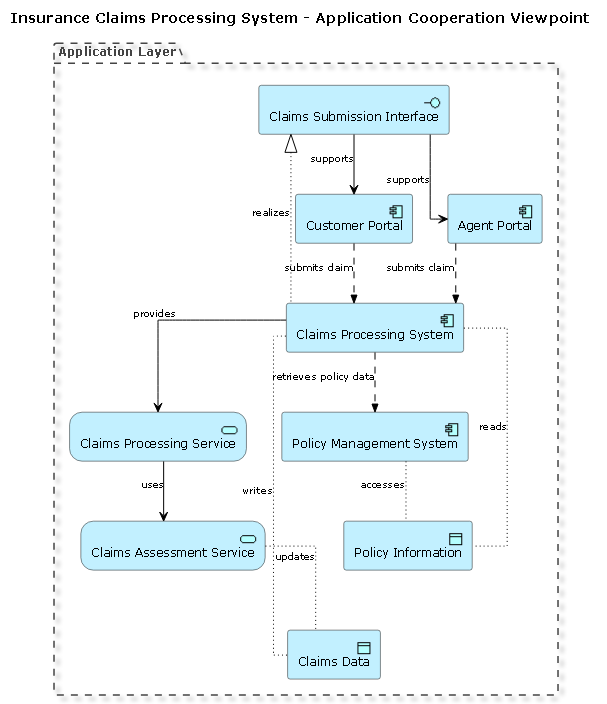
The final ArchiMate diagram reflects a layered application architecture focused on clarity and service interaction. Here’s how each component contributes:
- Application Layer: The core of the system is structured into four key components—
ClaimsProcessingApp,CustomerPortal,AgentPortal, andPolicyManagementSystem. These represent the digital touchpoints and backend systems involved in claims lifecycle management. - Service Collaboration: The
ClaimsServiceis positioned as a central orchestrator, serving theClaimsAssessmentService. This reflects a real-world pattern where a claims engine manages workflow, while specialized services handle risk evaluation. - Interface Realization: The
ClaimsInterfaceis realized by theClaimsProcessingApp, indicating that the application implements the interface used by both the customer and agent portals. - Data Flow and Access: The
ClaimsProcessingAppaccessesPolicyDatato validate claims against policy terms, and writes toClaimsDataas claims progress. TheClaimsAssessmentServiceupdates the same data, ensuring consistency. - Support Relationships: The
ClaimsInterfacesupports both theCustomerPortalandAgentPortal, illustrating how a shared interface enables multiple user roles to submit claims.
The choice of ArchiMate’s Application Cooperation Viewpoint ensures the diagram emphasizes how systems collaborate—not just what they do. This aligns with enterprise architecture best practices, where clarity on interaction patterns prevents siloed development.
AI as Architectural Partner: The Power of Conversational Refinement
What sets Visual Paradigm apart is not just the ability to generate diagrams—but to evolve them through dialogue. The AI Chatbot doesn’t stop at rendering. It anticipates the next question, explains its design decisions, and adapts in real time.
For instance, when the user asked to clarify the relationship between the ClaimsProcessingApp and PolicyManagementSystem, the AI added a Rel_Flow arrow showing data retrieval, reinforcing the dependency on up-to-date policy information.
These exchanges are not scripted. They’re dynamic, context-aware, and grounded in ArchiMate semantics. The AI’s ability to interpret phrases like “supports”, “realizes”, and “accesses” with precision demonstrates deep modeling intelligence.
Beyond ArchiMate: A Unified Modeling Platform
While this example centers on ArchiMate, the Visual Paradigm AI Chatbot is built to handle a full spectrum of modeling standards. Whether you’re designing a UML component diagram, a SysML block definition for complex systems, or a C4 Model for software architecture, the AI adapts to your language and delivers accurate, standardized output.
This versatility means teams can use a single platform for all visual modeling needs—from business strategy to technical design—without switching tools or relearning syntax. The AI Chatbot becomes a consistent partner across projects, reducing onboarding time and improving modeling consistency.
Turning Vision into Action
Creating a robust insurance claims processing system isn’t just about functionality—it’s about clarity, traceability, and alignment across teams. With Visual Paradigm’s AI-powered visual modeling platform, that clarity emerges naturally through conversation.
Explore the full diagram and experience the conversation for yourself at this shared session. See how the AI Chatbot turns ideas into structured, collaborative models—fast, accurate, and built for real-world complexity.