


Designing End-to-End Shipment Visibility with AI-Driven Architectural Clarity
Creating a logistics tracking system that delivers real-time shipment visibility demands more than just technical components—it requires a structured, layered architectural view. Traditional modeling approaches often stall at the conceptual stage, leaving teams to interpret abstract diagrams without clear rationale. With Visual Paradigm’s AI Chatbot, this challenge transforms into a collaborative design journey. The AI doesn’t just generate a diagram—it acts as a modeling partner, interpreting intent, refining logic, and adapting to evolving requirements in real time.
From Prompt to Precision: The Evolution of a Logistics Tracking Architecture
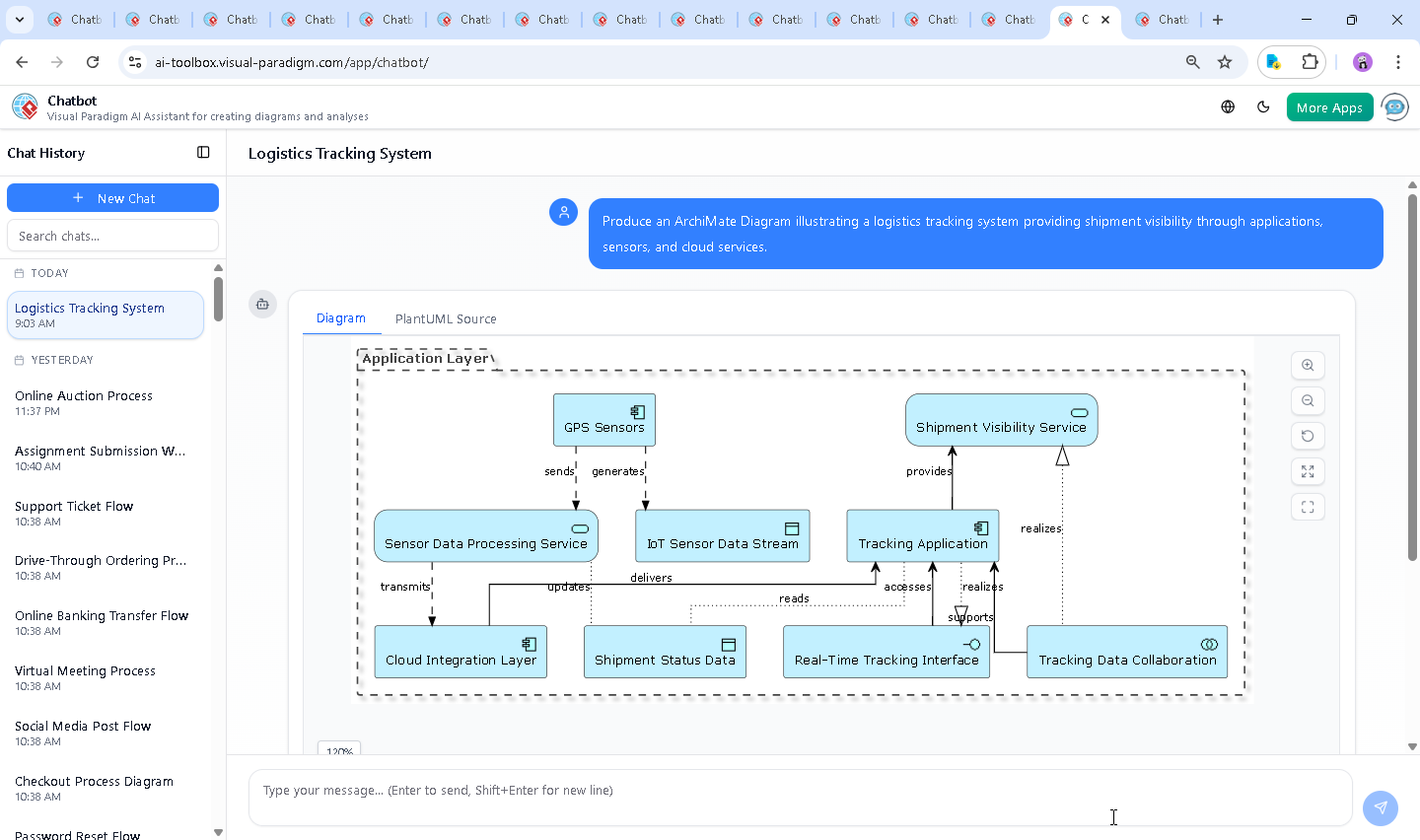
The journey began with a simple request: “Produce an ArchiMate Diagram illustrating a logistics tracking system providing shipment visibility through applications, sensors, and cloud services.” The AI Chatbot immediately parsed the intent and responded with a structured ArchiMate diagram using PlantUML syntax, capturing the core elements: tracking applications, sensor data flows, cloud integration, and service collaborations.
But the conversation didn’t stop there. The user asked, “AI, refine the logic to show how sensor data is processed before reaching the tracking application.” In response, the AI restructured the flow, introducing a dedicated “Sensor Data Processing Service” and clarifying the data flow from GPS Sensors to the processing layer, then to the central “Shipment Status Data” object. This adjustment demonstrated the AI’s ability to interpret implicit requirements and enhance architectural fidelity.
Further refinement came when the user requested: “Explain this branch—how does the Cloud Integration Layer support the application?” The AI not only clarified the “delivers” relationship between the Cloud Integration Layer and the Tracking Application, but also added context: the layer serves as a bridge between on-premise systems and cloud-hosted services, enabling secure, scalable data exchange.
Decoding the Architecture: Why This Design Works
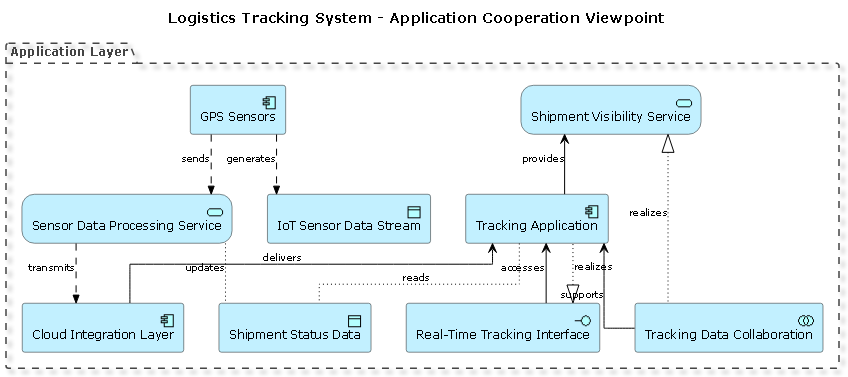
The final ArchiMate diagram reflects a layered, service-oriented approach to logistics tracking. Here’s a breakdown of the core components and their relationships:
- Application Layer: Houses the Tracking Application and its supporting services, including Shipment Visibility Service and Real-Time Tracking Interface. These form the user-facing and internal logic layer.
- Sensor Integration: GPS Sensors generate raw IoT data, which flows into the IoT Data Stream and is processed by the Sensor Data Processing Service. This ensures data is cleaned, validated, and enriched before use.
- Data Flow & Storage: The Shipment Status Data object is both read by the Tracking Application and updated by the Sensor Data Processing Service—ensuring consistency and traceability.
- Cloud Integration: The Cloud Integration Layer acts as a central hub, delivering processed data to the Tracking Application and enabling scalability and remote access.
- Collaboration & Realization: The Tracking Data Collaboration entity realizes the Shipment Visibility Service and supports the Tracking Application, illustrating how cross-functional components work together.
Each relationship—provides, realizes, accesses, transmits, updates—was selected to reflect real-world interactions. The use of Application Components for services, Application Data Objects for shared data, and Application Interfaces for access points ensures the diagram aligns with ArchiMate’s standard notation and communicates clearly to stakeholders.
The AI Chatbot in Action: Conversational Intelligence at Work
What sets Visual Paradigm apart isn’t just the diagram output—it’s the depth of conversation that shapes it. The AI Chatbot doesn’t generate static images; it evolves the design through dialogue. The user’s follow-up requests weren’t just queries—they were design prompts that led to more precise modeling.
For example, when the user asked to “explain this branch,” the AI didn’t just repeat the diagram—it contextualized it, linking the Cloud Integration Layer to data delivery and security concerns. This level of insight transforms the chatbot from a tool into a design consultant.
Moreover, the AI’s ability to switch between diagram types and standards was evident. After the ArchiMate diagram was finalized, the user asked, “Can you also show this as a C4 Model for system context?” The AI seamlessly adapted, generating a C4 diagram that mapped the same system from a developer and architectural context—proof of its versatility.
One Platform, Multiple Standards: The Power of Unified Modeling
Visual Paradigm’s AI Chatbot isn’t limited to ArchiMate. It supports a full suite of modeling standards, including UML for software design, SysML for systems engineering, C4 Model for software architecture, and Mind Maps for brainstorming. This means teams can use a single platform to model across domains—whether designing a logistics system, a cloud-native application, or a business transformation strategy.
By integrating these standards into a conversational interface, Visual Paradigm eliminates the need to switch between tools. The AI understands the intent behind each request and delivers the right diagram type with the right notation, ensuring consistency and accuracy across projects.
Conclusion: Build Smarter, Collaborate Faster
Creating a logistics tracking system with full shipment visibility isn’t just about technology—it’s about clarity, collaboration, and precision. Visual Paradigm’s AI Chatbot turns architectural design into a dialogue, where every question refines the model, and every response deepens the insight.
Whether you’re an enterprise architect, a software designer, or a logistics planner, the platform empowers you to model with confidence. Try the shared session and experience how the AI Chatbot transforms your ideas into actionable, standards-compliant architecture.