


Designing a Scalable Online Marketplace: An AI-Powered ArchiMate Blueprint
Building a modern online marketplace requires more than just connecting buyers and sellers—it demands a clear, structured view of how business goals, application logic, and technology infrastructure align. The challenge lies in visualizing complex interactions across layers while ensuring real-time accuracy and scalability. Enter the Visual Paradigm AI Chatbot: not just a diagram generator, but a collaborative modeling expert that turns high-level concepts into precise, multi-layered ArchiMate diagrams through natural conversation.
From Concept to Clarity: The Interactive Design Journey
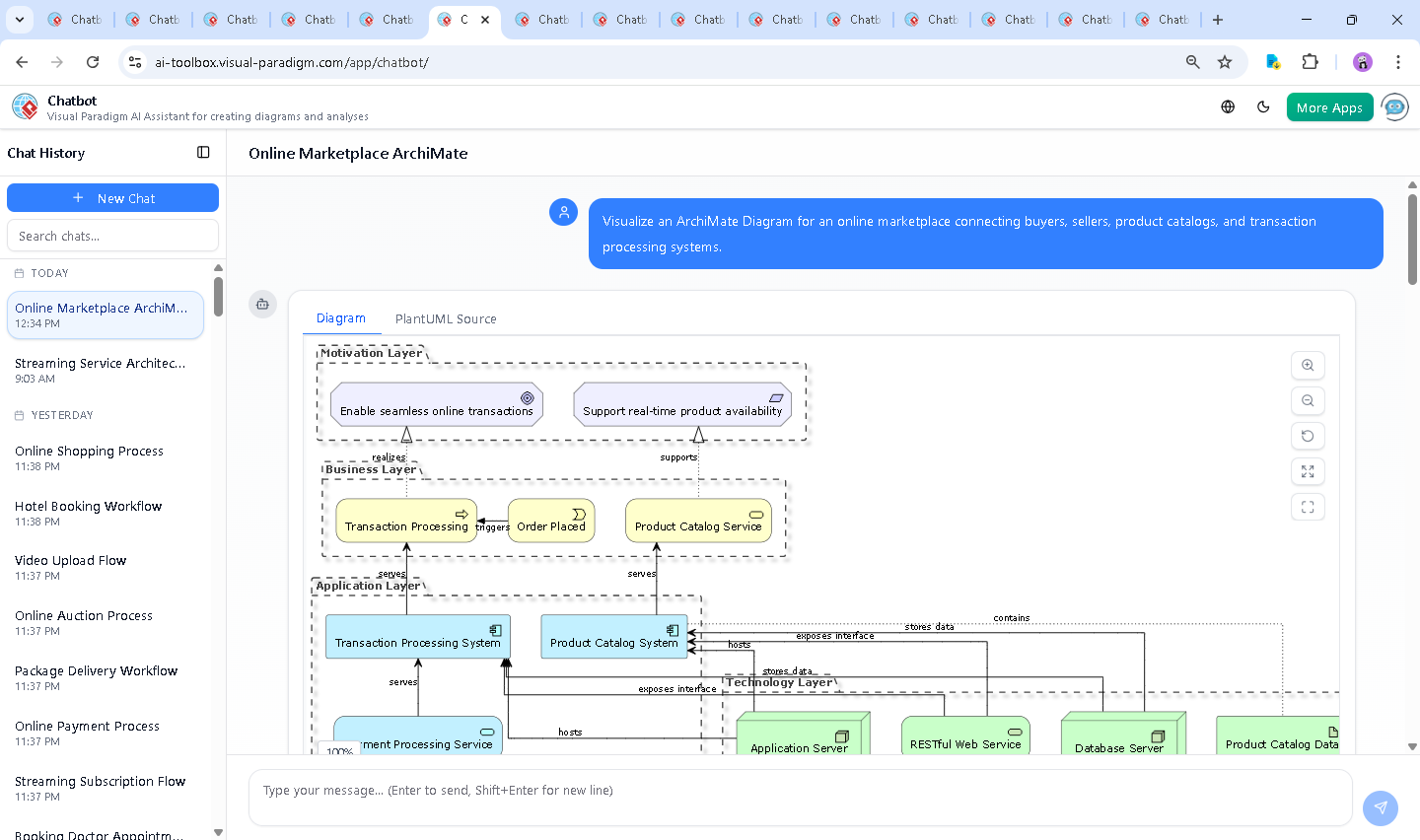
It began with a simple prompt: “Visualize an ArchiMate Diagram for an online marketplace connecting buyers, sellers, product catalogs, and transaction processing systems.” Within seconds, the AI Chatbot responded with a fully structured ArchiMate diagram in PlantUML syntax, complete with layered architecture and relationship semantics.
But the real value emerged in the conversation that followed. When asked, “Can you explain how the Product Catalog Service ensures real-time product availability?”, the AI didn’t just restate the diagram—it delivered a detailed technical breakdown, revealing the underlying mechanisms that make the system trustworthy and responsive.
The AI explained how real-time updates from sellers, caching with TTL, event-driven synchronization, and pre-checks during checkout collectively ensure that buyers see accurate stock levels. It didn’t stop there: it offered a full scenario walk-through and even suggested a follow-up SysML or C4 diagram for deeper architectural insight.
This back-and-forth wasn’t just Q&A—it was a co-design session. The AI acted as a modeling consultant, refining logic, clarifying relationships, and validating design decisions through natural language. This is the power of an AI-powered visual modeling platform: it doesn’t just draw diagrams—it thinks with you.
Decoding the Architecture: How the Diagram Works
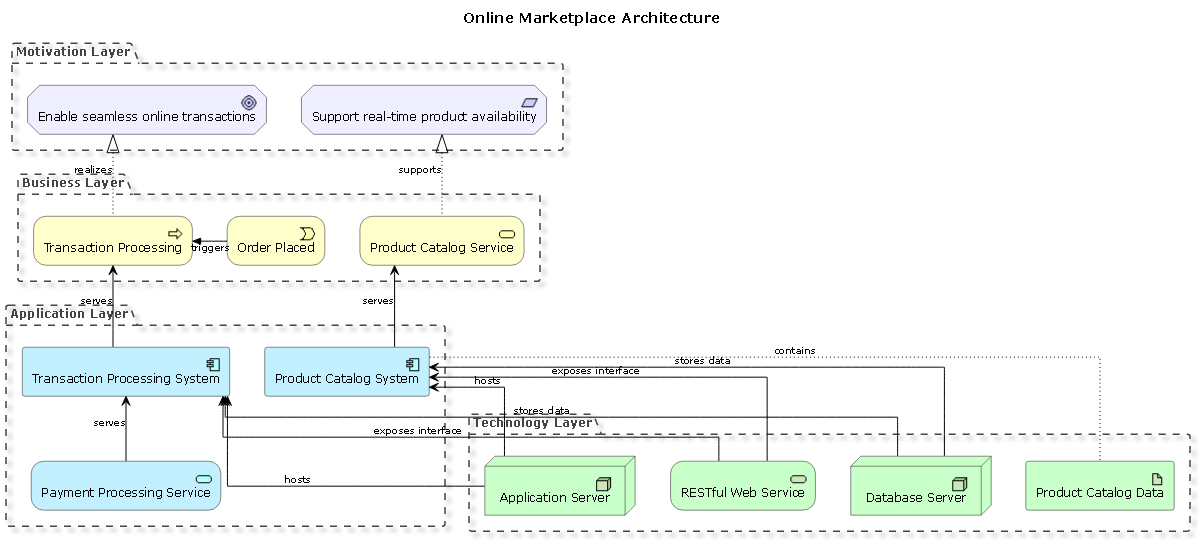
The final ArchiMate diagram captures a layered, goal-driven architecture. Here’s a breakdown of its core logic and the reasoning behind each design choice:
Layered Structure: Aligning Business Goals with Technical Execution
Visual Paradigm’s ArchiMate implementation follows the standard four-layer model—Motivation, Business, Application, and Technology—each serving a distinct purpose:
- Motivation Layer: Defines the purpose—“Enable seamless online transactions” and “Support real-time product availability”. These goals anchor the entire design, ensuring every component serves a strategic intent.
- Business Layer: Represents the human and functional actors—Buyer, Seller, and key services like Product Catalog Service and Transaction Processing. The Order Placed event triggers the transaction process, establishing a clear cause-and-effect flow.
- Application Layer: Breaks down the software components—Product Catalog System, Transaction Processing System, and Payment Processing Service. These are the engines that execute business functions.
- Technology Layer: Shows the physical and logical infrastructure—Application Server, Database Server, RESTful Web Service, and Product Catalog Data. This layer reveals where and how the software runs.
Relationships That Tell the Story
Each line in the diagram is a deliberate statement of intent:
- Realization (e.g., Transaction Process realizes Goal): Shows how business processes fulfill strategic objectives.
- Triggering (e.g., Order Placed triggers Transaction Process): Highlights event-driven workflows.
- Serving (e.g., Application Component serves Business Service): Maps software components to their functional roles.
- Hosting and Storing (e.g., Server hosts Catalog System): Clarifies deployment and data ownership.
- Access (e.g., ProductData contains data): Establishes data lineage and persistence.
These relationships are not arbitrary—they reflect real-world integration patterns used in scalable marketplaces. The AI chose them based on industry-standard ArchiMate semantics, ensuring the diagram is both accurate and interpretable by architects, developers, and stakeholders.
Conversational Intelligence in Action
What sets Visual Paradigm apart is how the AI Chatbot evolves with the conversation. After the initial diagram, the user asked for clarification on a critical component—how the Product Catalog Service ensures real-time availability. Instead of a static response, the AI delivered a structured, technical explanation with:
- Real-time data synchronization from sellers
- Caching strategies with TTL
- Event-driven updates via Kafka/RabbitMQ
- Pre-checks during transaction processing
This wasn’t just documentation—it was architectural insight. The AI didn’t just answer the question; it deepened the model’s credibility by revealing the why behind the design.
Why Visual Paradigm Stands Out: Beyond ArchiMate
While this example focuses on ArchiMate, the Visual Paradigm AI Chatbot is built to support a full suite of modeling standards. Whether you’re designing a UML class diagram for object-oriented systems, a SysML block diagram for complex engineering systems, or a C4 model for software architecture, the AI adapts to your needs.
For instance, after discussing the marketplace architecture, the AI offered to generate a SysML block diagram to model the internal structure of the Transaction Processing System—or a C4 model to show how the system fits into the broader organizational context. This versatility makes Visual Paradigm the only platform where one AI assistant can guide you from business strategy to technical design across multiple standards.
Conclusion: Design with Confidence, Not Guesswork
Creating a robust online marketplace architecture is complex. But with Visual Paradigm’s AI Chatbot, you’re not alone. It transforms abstract ideas into actionable, layered diagrams through natural conversation—delivering clarity, accuracy, and depth at every step.
Ready to model your next architecture? Explore the live session and experience how AI-powered modeling turns vision into structure—fast, smart, and collaborative.