


Designing a Seamless Streaming Experience: An AI-Powered ArchiMate View of Application Cooperation
Creating a clear, accurate architecture for an online streaming service involves aligning user experience, intelligent content delivery, and scalable infrastructure. The complexity of interdependencies between application components—especially when recommendation engines, user interfaces, and cloud systems must work in harmony—demands a structured approach. Enter the Visual Paradigm AI Chatbot: not just a diagram generator, but a collaborative modeling partner that translates high-level intent into precise, standards-compliant ArchiMate diagrams through natural conversation.
From Idea to Diagram: A Collaborative Design Dialogue
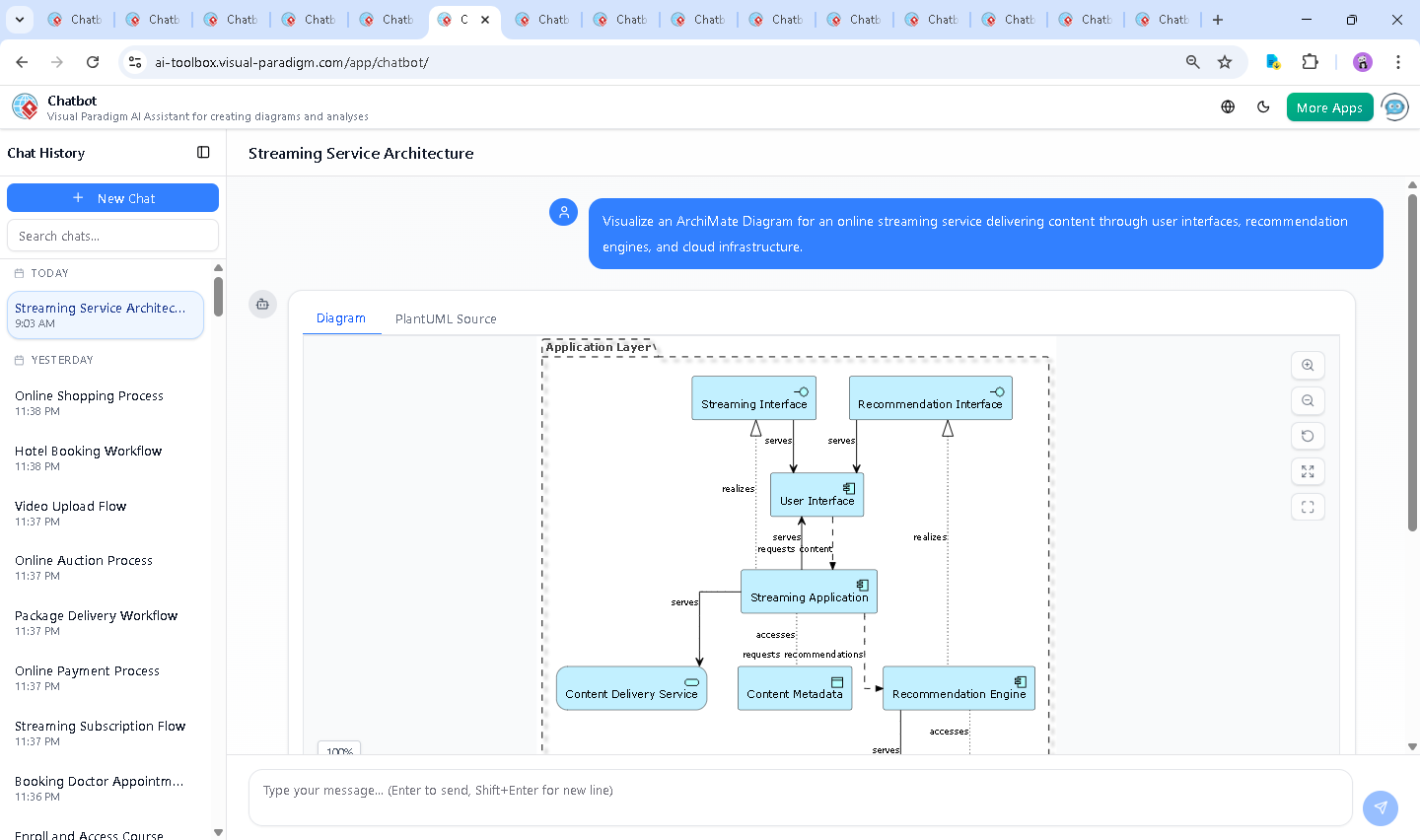
The journey began with a simple prompt: “Visualize an ArchiMate Diagram for an online streaming service delivering content through user interfaces, recommendation engines, and cloud infrastructure.” Within seconds, the AI Chatbot responded with a fully structured PlantUML script, rendering a clear Application Layer view of the system. But the process didn’t stop there.
As the diagram took shape, the user refined the vision. “AI, refine the logic to show how the recommendation engine feeds into personalization and how the user interface consumes both,” came the next request. The AI adjusted the relationships—adding Rel_Serving and Rel_Flow links to clarify data and service dependencies—ensuring that the flow from recommendation generation to UI presentation was explicitly modeled.
Further, when asked to “Explain this branch: why is the Personalization Service realized by the Recommendation Engine?”, the AI didn’t just respond with a definition—it contextualized it: “The Personalization Service is realized by the Recommendation Engine because it uses algorithmic logic derived from user behavior data to dynamically adjust content presentation. The engine provides the computational core; the service exposes the outcome to the UI.”
This back-and-forth demonstrates the AI Chatbot’s role as an intelligent design consultant—interpreting intent, validating assumptions, and enriching the model with architectural reasoning.
Visualizing the Architecture
Decoding the Source Logic: Why This Architecture Works
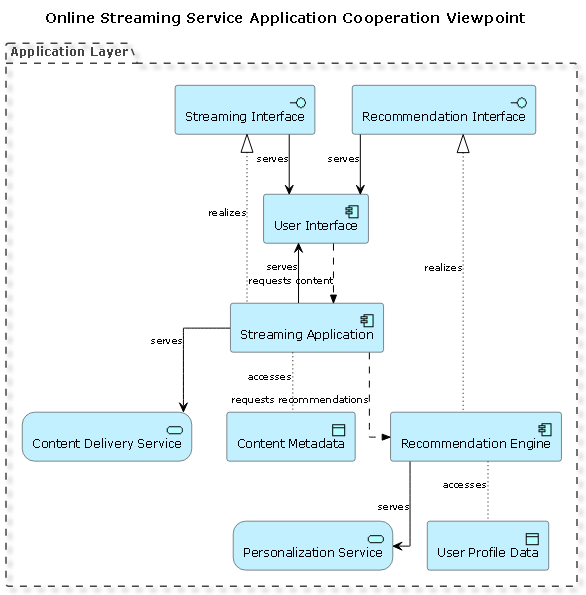
The generated ArchiMate diagram captures the core dynamics of a modern streaming platform through precise modeling conventions:
- Application Components:
StreamingApp,RecommendationEngine, andUserInterfacerepresent the primary functional units. TheStreamingAppacts as the central orchestrator, while theRecommendationEnginespecializes in content personalization. - Application Services:
ContentDeliveryServiceandPersonalizationServiceare business-capable services. TheContentDeliveryServicehandles video streaming logistics, whilePersonalizationServicemanages dynamic content adaptation. - Application Interfaces:
StreamingInterfaceandRecommendationInterfacedefine how services are consumed. TheStreamingInterfaceis realized by theStreamingApp, showing it as the technical implementation layer. - Relationships:
Rel_Servingclarifies which components provide functionality to others. For example,StreamingApp serves UserInterface, indicating that the app delivers the UI experience.Rel_Flowcaptures data or request exchanges—such as theStreamingApp requesting recommendations—which reflects real-time interaction patterns. - Data Objects:
UserProfileDataandContentMetadatarepresent persistent data sources. TheRecommendationEngine accesses UserProfileDatato tailor suggestions, and theStreamingApp accesses ContentMetadatato deliver accurate content details.
Each notation choice follows ArchiMate standards to ensure clarity and interoperability. The use of Rel_Realization_Up for interface realization ensures that implementation details are linked to their corresponding services, while Rel_Access emphasizes data dependency without implying direct execution.
Conversational Intelligence in Action
The true power of the Visual Paradigm AI Chatbot lies in its ability to evolve the model through dialogue. The initial diagram was a solid foundation, but the real value emerged during refinement. When the user asked, “Can we show how the UI interacts with both the streaming and recommendation services?”, the AI added Rel_Serving links from both StreamingInterface and RecommendationInterface to the UserInterface, making the integration explicit.
Further, the chatbot proactively suggested adding ContentMetadata as a data object, recognizing that metadata is critical for content discovery and recommendation accuracy—something the original prompt didn’t specify but was essential to the architecture.
More Than ArchiMate: A Unified Modeling Platform
While this example focuses on ArchiMate, the Visual Paradigm AI Chatbot is not limited to one standard. It supports a full suite of modeling languages, including UML for software design, SysML for complex system engineering, and C4 Model for software architecture visualization. Whether you’re designing a microservices ecosystem, a business process flow, or a cloud-native application, the AI Chatbot adapts to your modeling needs.
This versatility means that teams can maintain a single, intelligent modeling environment across disciplines—from enterprise architects to software developers and system engineers—ensuring consistency, reducing context switching, and accelerating delivery.
Conclusion: Architect with Confidence, Not Guesswork
Building a scalable, user-centric streaming platform requires more than just technology—it demands architectural clarity. With the Visual Paradigm AI Chatbot, you don’t need to be a modeling expert to create precise, standards-compliant ArchiMate diagrams. The platform turns conversations into models, and feedback into better design.
Explore how your next architecture can be crafted using the Visual Paradigm AI Chatbot—where every question leads to a smarter, more accurate model.