


Designing a Secure Payroll System: How AI Transforms Architectural Vision into Precision Models
Modernizing a payroll system isn’t just about updating software—it’s about reimagining how employee data, financial logic, and compliance interlock across layers of technology and governance. The complexity of aligning data integrity, regulatory standards, and external integrations demands more than static diagrams. It calls for a collaborative design environment where ideas evolve through intelligent dialogue.
That’s where the Visual Paradigm AI Chatbot steps in—not as a passive tool, but as a modeling partner. By responding to natural language prompts, it translates high-level requirements into structured ArchiMate diagrams, then iteratively refines them based on follow-up questions. This isn’t automation; it’s co-creation.
From Prompt to Precision: The Evolution of the Payroll Architecture
The journey began with a simple request: “Create an ArchiMate Diagram representing how a payroll system processes employee data, salary calculations, and financial integrations.” Within seconds, the AI Chatbot delivered a fully formed ArchiMate diagram in PlantUML syntax, structured across three layers—Implementation, Application, and Technology—each with precise relationships.
But the real value emerged in the conversation. When the user asked, “How does the payroll system ensure secure and compliant financial data integration with external systems?”, the AI didn’t just provide a textual answer. It expanded the architectural narrative, enriching the original diagram with deeper context—adding security, compliance, and governance dimensions that were implied but not yet visualized.
For example, the AI introduced:
• Encryption in transit and at rest (TLS 1.3, AES-256)
• Role-based access control (RBAC) and MFA enforcement
• API gateways with rate limiting and OAuth 2.0 authentication
• Audit logging and SOX compliance mechanisms
These weren’t just bullet points—they were architectural decisions that could be mapped into the diagram. The AI then suggested, “Would you like this in a diagram format?”, and delivered a refined version that visually represented the security and compliance layers as part of the system’s structure.
Visualizing the Modern Payroll System
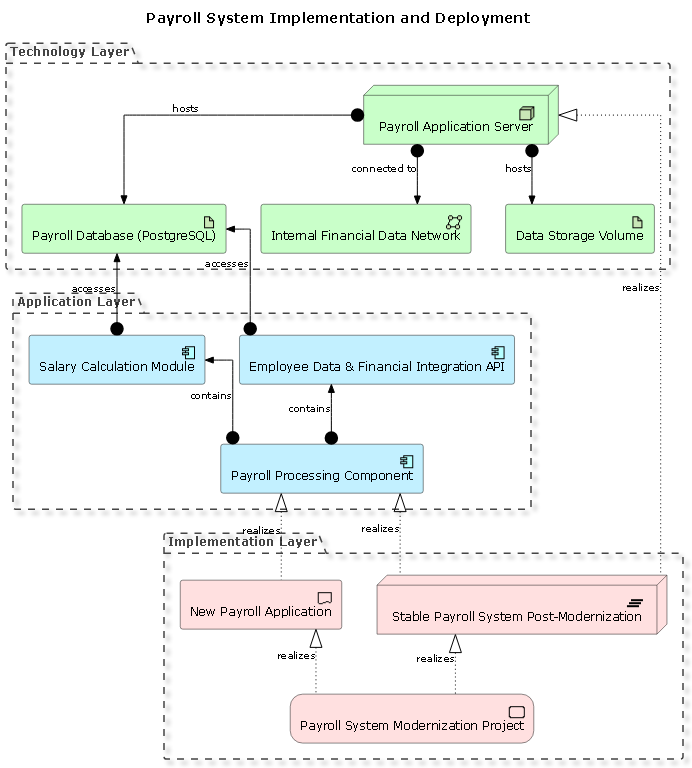
The final ArchiMate diagram reflects a layered, secure, and compliant system. It shows how the Payroll System Modernization Project (Implementation Layer) realizes the New Payroll Application, which in turn contains the Salary Calculation Module and Employee Data & Financial Integration API. The technology layer hosts the Payroll Database (PostgreSQL) and Payroll Application Server, which connects to the Internal Financial Data Network—a key enabler for secure external integration.
Relationships are not arbitrary. The realizes and contains relations show how capabilities are built and composed. The accesses and hosts relationships clarify data flow and deployment logic. Every line in the diagram is a decision—crafted with intent, not guesswork.
Decoding the Logic: Why This Architecture Works
The diagram’s structure is grounded in ArchiMate’s core principles of separation of concerns and layered abstraction. Here’s how each layer contributes:
- Implementation Layer: Captures project scope and delivery milestones. The Payroll System Modernization Project is the driver, while Stable Payroll System Post-Modernization defines the target state.
- Application Layer: Houses the functional components. The Salary Calculation Module processes wages, deductions, and tax rules. The Integration API acts as a secure gateway to external financial systems.
- Technology Layer: Defines infrastructure. The Payroll Application Server hosts the application and database, while the Financial Network ensures secure communication with banks and payroll processors.
The use of realizes relations ensures traceability from project goals to technical delivery. The assignment relations clarify component ownership and data access. This design avoids monolithic architecture, enabling scalability, modularity, and compliance-by-design.
Conversational Intelligence in Action
What makes this process truly powerful is the ability to refine and deepen the model through conversation. The AI didn’t stop at the initial diagram. When asked to explain compliance mechanisms, it didn’t just list standards—it contextualized them within the architecture.
For instance, the AI explained how GDPR and SOX compliance are enforced through audit logs and data minimization, which were then mapped into the diagram as part of the Integration API and Payroll Database behaviors.
Even the “Would you like this as a compliance checklist?” prompt revealed the AI’s versatility—it’s not just generating diagrams, but adapting outputs to different formats based on user needs.
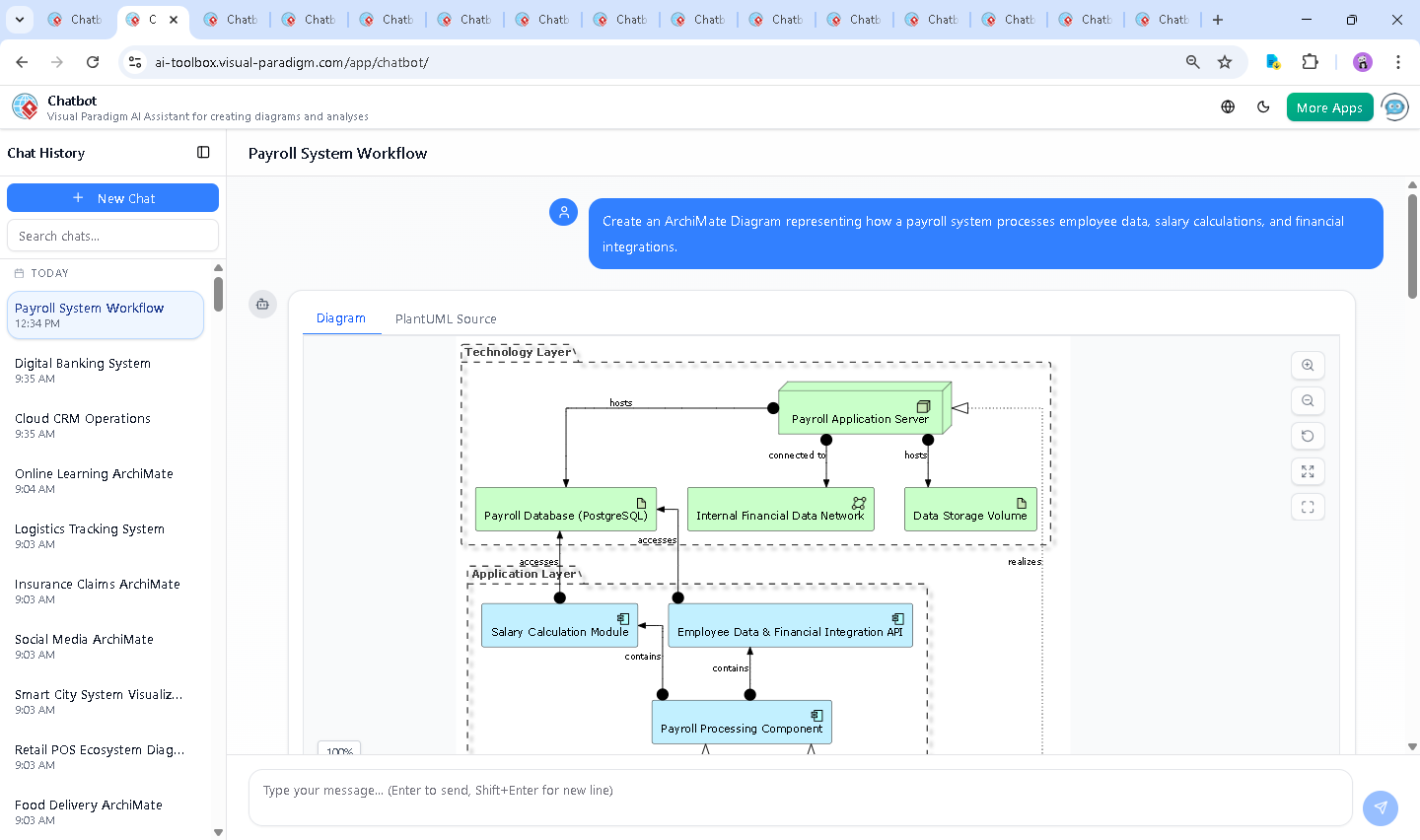
The chat history shows a true collaboration: the user poses a challenge, the AI delivers a model, the user probes deeper, and the AI responds with architectural insight. This loop isn’t just efficient—it’s intelligent.
Beyond ArchiMate: A Unified Modeling Platform
While this example focused on ArchiMate, the Visual Paradigm AI Chatbot is built for broader architectural needs. It supports UML for software design, SysML for systems engineering, and C4 Model for software architecture.
Whether you’re designing a microservices architecture, mapping a digital transformation journey, or modeling a regulatory compliance workflow, the AI Chatbot adapts. It understands context, applies best practices, and delivers diagrams that are not only accurate but also aligned with enterprise standards.
Conclusion: Where Vision Meets Architectural Reality
Creating a secure, compliant, and scalable payroll system requires more than technical skill—it demands clarity, foresight, and collaboration. The Visual Paradigm AI Chatbot turns architectural vision into executable design through a conversational, intelligent workflow.
With the ability to generate, refine, and explain complex models in natural language, it’s not just a diagram tool—it’s a modeling partner. Whether you’re a CTO, enterprise architect, or system designer, you’re no longer alone in the design process.