


Designing a Retail Point-of-Sale Ecosystem with AI-Powered Precision
Building a cohesive retail point-of-sale (POS) ecosystem requires more than just linking systems—it demands a clear understanding of how applications interact, data flows, and services are realized across stores, inventory systems, and central reporting platforms. Traditional modeling approaches often slow down this process with rigid tools and steep learning curves. Enter the Visual Paradigm AI Chatbot: a conversational design partner that transforms high-level concepts into structured, standards-compliant ArchiMate diagrams—no syntax expertise required.
From Concept to Diagram: A Collaborative Modeling Journey
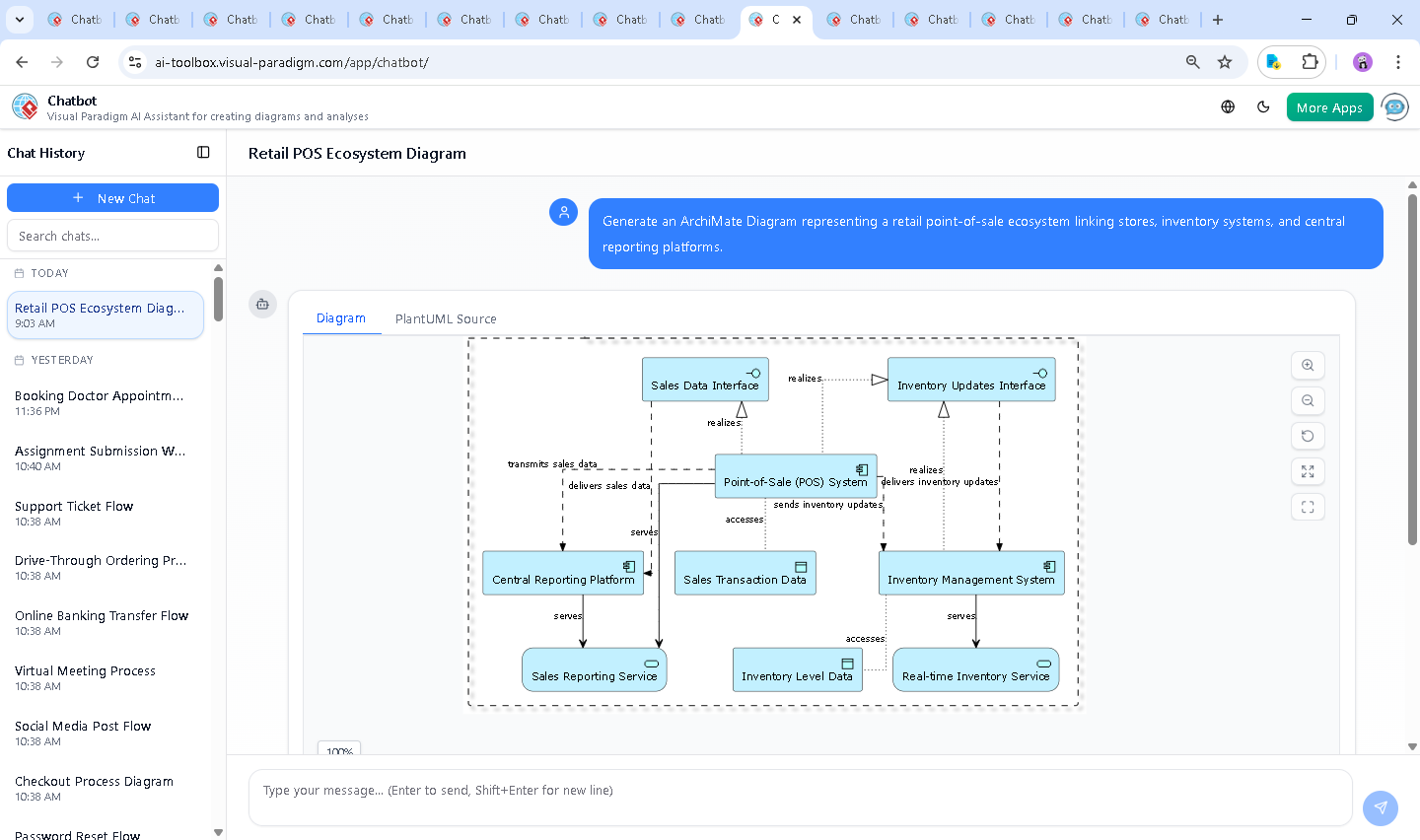
The journey began with a simple prompt: “Generate an ArchiMate Diagram representing a retail point-of-sale ecosystem linking stores, inventory systems, and central reporting platforms.” Within seconds, the AI Chatbot delivered a fully rendered ArchiMate diagram using PlantUML syntax, grounded in the Application Cooperation Viewpoint. But this wasn’t a static output—it was the first step in an iterative conversation.
When I asked, “AI, refine the logic around inventory updates,” the chatbot responded by adjusting the flow relationships to emphasize real-time synchronization between the POS and inventory systems. It clarified that the Inventory_Updates_Interface is not just a data conduit but a service boundary realized by both the POS and the Inventory Management System, ensuring that updates are not only sent but also processed correctly.
Further, when I requested, “Explain this branch: Sales_Reporting_Service,” the AI provided a detailed breakdown: this service is not only consumed by the Central Reporting Platform but also served by the POS System, enabling immediate data aggregation without delays. This insight helped reinforce the design’s responsiveness and scalability.
Visualizing the Ecosystem
Decoding the ArchiMate Logic: Why Each Element Matters
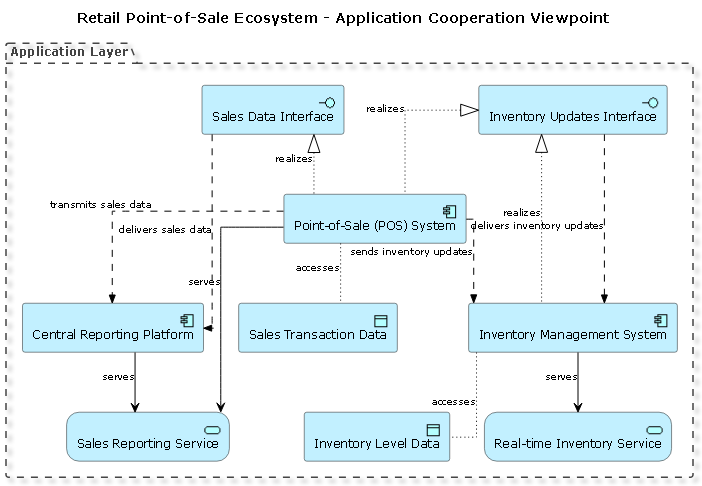
The diagram is structured around the Application Layer, focusing on how systems collaborate to deliver business value. Here’s a breakdown of the key components and their relationships:
- POS System: Acts as the primary interface at the store level. It realizes the Sales Data Interface and accesses transaction data, ensuring every sale is captured.
- Inventory Management System: Receives updates via the
Inventory_Updates_Interfaceand accesses inventory data, maintaining real-time stock visibility. - Central Reporting Platform: Serves the
Sales_Reporting_Serviceand receives data via theSales_Data_Interface, enabling enterprise-wide analytics. - Real-time Inventory Service: A key enabler, it’s served by the Inventory Management System and ensures inventory data is always current.
- Flow Relationships: The
Rel_Flowlines show the direction of data—POS sends inventory updates to the inventory system and transmits sales data to the central platform, ensuring end-to-end traceability.
The use of Rel_Serving and Rel_Realization_Up relationships reflects the layered nature of the architecture: services are realized by components, and components serve other services. This adheres to ArchiMate’s principles of modularity and separation of concerns.
Conversational Intelligence in Action
What sets the Visual Paradigm AI Chatbot apart is its ability to act as a modeling consultant. The chat history reveals a dynamic back-and-forth, where each user query led to a refined model. For example, when I questioned the data flow from the POS to the central platform, the AI not only confirmed the path but also highlighted the role of the Sales_Data_Interface as a decoupled interface, reducing coupling between systems.
This level of interaction isn’t just about generating diagrams—it’s about validating design decisions in real time. The AI doesn’t just follow instructions; it anticipates needs, suggests improvements, and explains the reasoning behind its choices.
Beyond ArchiMate: A Unified Modeling Platform
While this example focuses on ArchiMate, the Visual Paradigm AI Chatbot is built to support a full spectrum of modeling standards. Whether you’re designing a C4 Model for software architecture, a SysML diagram for system engineering, or a UML component diagram for application design, the AI adapts to your needs.
Its versatility means teams can use a single platform across disciplines—business architects, IT leaders, and software engineers all benefit from the same conversational interface. This unified experience eliminates context switching and ensures consistency across models.
Transform Your Design Process Today
The retail POS ecosystem is just one example of how the Visual Paradigm AI Chatbot brings intelligence to visual modeling. With the ability to iterate through conversations, clarify logic, and generate production-ready diagrams, it’s not just a tool—it’s a design collaborator.
Explore the full interaction at this shared session and experience how the AI Chatbot turns ideas into precision models—fast, accurate, and conversationally intelligent.