


Visualizing Telecom Service Management: From Vision to Architectural Reality
Designing a comprehensive architecture for a telecommunications provider involves aligning customer service delivery, billing accuracy, and network reliability — all underpinned by measurable outcomes. The challenge lies not just in modeling these components, but in expressing their interdependencies in a way that supports strategic decision-making, compliance, and continuous improvement.
Enter the Visual Paradigm AI Chatbot — not a passive diagram generator, but an active collaborator in the modeling process. It transforms natural language prompts into structured, standards-compliant ArchiMate diagrams while maintaining full context and enabling iterative refinement through conversation.
From Prompt to Precision: The Collaborative Modeling Journey
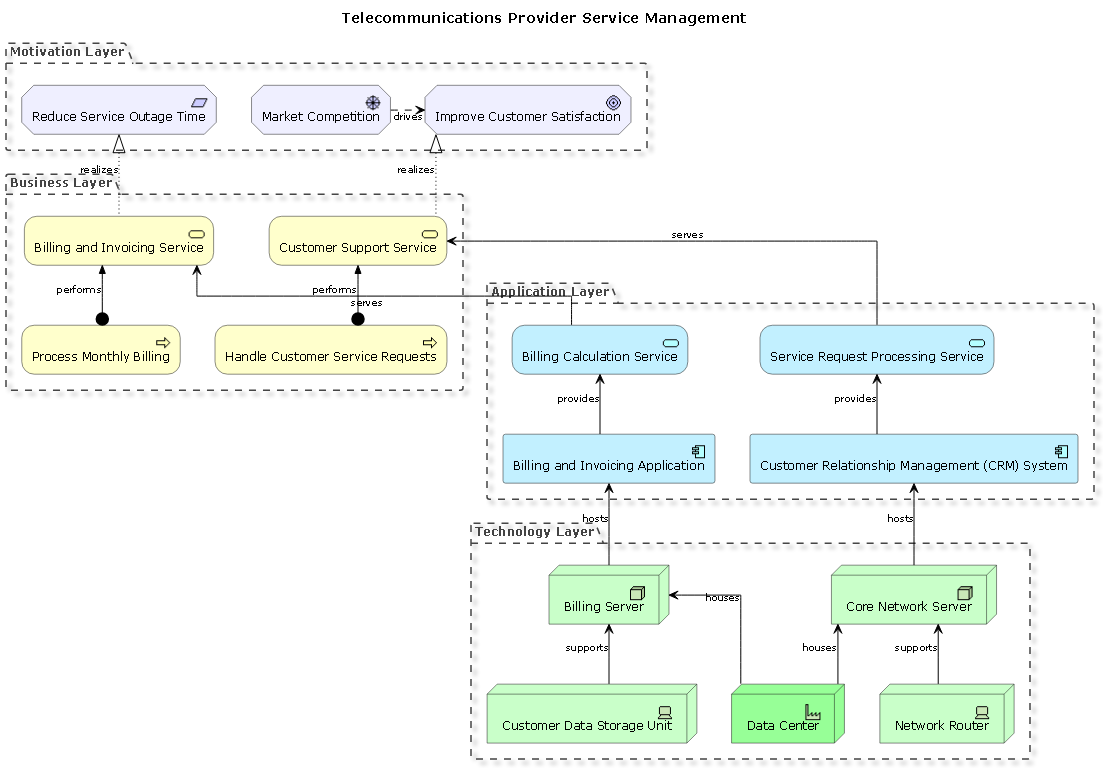
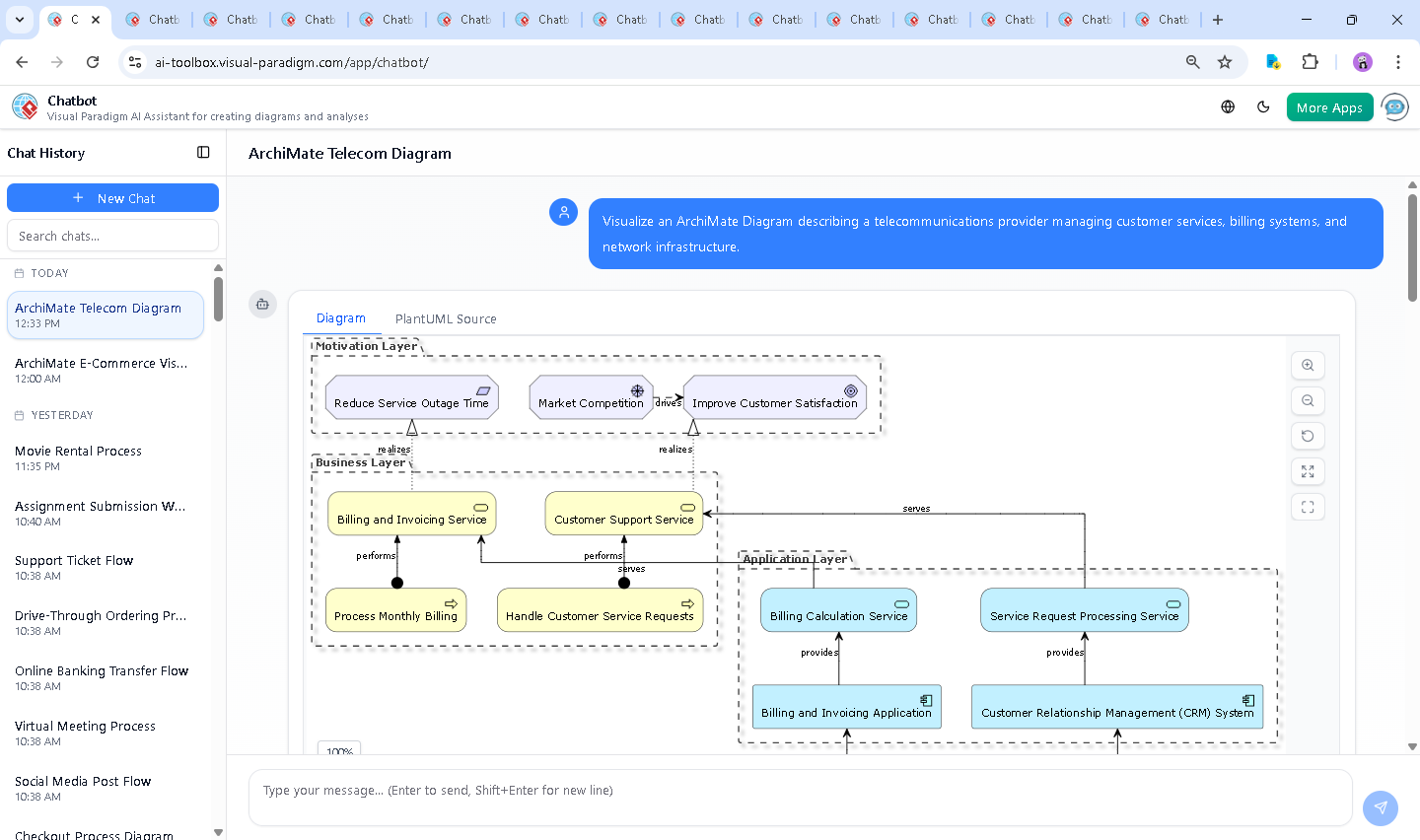
The journey began with a simple request: “Visualize an ArchiMate Diagram describing a telecommunications provider managing customer services, billing systems, and network infrastructure.” The AI Chatbot responded immediately with a fully structured PlantUML script, rendering a layered ArchiMate model that mapped the business, application, and technology layers with precision.
But the conversation didn’t stop there. The user followed up with a deeper question: “What specific metrics would be used to measure the reduction in service outage time mentioned in the motivation requirement?”
The AI didn’t just list KPIs — it delivered a strategic breakdown, linking technical performance to business outcomes. It defined MTTR, MTBF, Service Uptime, and Outage Duration as core metrics, illustrated their interplay with real-world examples, and even recommended dashboard integration for ongoing monitoring. This level of insight — turning a diagram element into a performance indicator — demonstrates the Chatbot’s role as a modeling consultant, not just a tool.
When asked to refine the logic further, the AI clarified how each relationship in the diagram (e.g., Realizes, Serves, Hosts) reflects real-world dependencies. It explained that the Business Process “Handle Customer Service Requests” performs the Customer Support Service, which in turn is realized by the CRM System. This contextual depth ensures the model isn’t just visually accurate — it’s semantically meaningful.
Decoding the Architecture: The Logic Behind the Diagram
The resulting ArchiMate model is structured across four layers, each reflecting a distinct level of abstraction in enterprise architecture:
1. Motivation Layer: The ‘Why’ Behind the System
At the top, the model anchors itself in strategic intent. The Motivation Goal “Improve Customer Satisfaction” is driven by the Motivation Driver “Market Competition,” creating a clear business imperative. The Motivation Requirement “Reduce Service Outage Time” is explicitly linked to this goal through a drives relationship, establishing traceability from strategy to execution.
2. Business Layer: Customer-Centric Operations
The Business Service “Customer Support Service” and “Billing and Invoicing Service” represent the core offerings. These are not abstract concepts — they are operationalized through Business Processes such as “Handle Customer Service Requests” and “Process Monthly Billing,” which are assigned to their respective services via performs relationships.
3. Application Layer: The Digital Backbone
Each business service is supported by application components. The CRM System and Billing and Invoicing Application serve as the digital engines, with their functions broken down into specific Application Services like “Service Request Processing” and “Billing Calculation.” These services are served by their respective components, showing the architectural decomposition.
4. Technology Layer: The Physical Foundation
At the base, the Technology Node “Core Network Server” and “Billing Server” host the application components. The Physical Facility “Data Center” houses both nodes, while Technology Devices like “Network Router” and “Customer Data Storage Unit” support the infrastructure. The supports and hosts relationships clarify how hardware enables software and service delivery.
Why This Structure Works
The use of Realizes (business service realized by application), Serves (application service supports a business service), and Hosts (technology node hosts an application) reflects the standard ArchiMate semantics. This ensures the diagram is not only readable but also compliant with enterprise architecture best practices, enabling integration with governance frameworks, compliance audits, and system modernization roadmaps.
Conversational Intelligence in Action
What sets Visual Paradigm apart is how the AI Chatbot turns a static diagram into a living design document. The ability to ask follow-up questions — like “What metrics measure outage reduction?” — triggers a dynamic response that enriches the model’s context. The AI doesn’t just answer; it enhances the model’s value by linking technical elements to performance indicators and business outcomes.
This iterative dialogue reflects the platform’s true strength: it’s not a one-way generator, but a collaborative partner in architecture design.
More Than ArchiMate: A Full-Spectrum AI Modeling Platform
The Visual Paradigm AI Chatbot isn’t limited to ArchiMate. It supports a full suite of modeling standards, including UML for software design, SysML for systems engineering, C4 Model for software architecture and Mind Maps for process and idea visualization.
Whether you’re designing a microservices architecture, mapping customer journeys, or modeling system behavior, the same intelligent assistant adapts to your needs. The consistency of the conversational interface means you can switch between standards without relearning workflows — all while maintaining model integrity and alignment with enterprise standards.
Conclusion: Architect with Confidence
Visualizing complex telecommunications systems requires more than diagramming skills — it demands strategic thinking, technical precision, and the ability to connect business goals with technical execution. The Visual Paradigm AI Chatbot delivers all three, turning abstract ideas into structured, actionable models through natural conversation.
With its ability to handle iterative refinement, support multi-standard modeling, and deliver expert-level insights on demand, Visual Paradigm isn’t just a tool — it’s your AI-powered modeling partner.