


Designing a Secure Telemedicine Platform: An AI-Powered ArchiMate Journey
Building a robust telemedicine platform demands more than just connecting patients and doctors—it requires a clear, layered architecture that ensures data security, regulatory compliance, and seamless user experience. The challenge lies in visualizing complex interactions across business, application, and technology layers while maintaining precision and clarity.
Enter the Visual Paradigm AI Chatbot: not just a diagram generator, but a collaborative modeling partner. By transforming natural language prompts into structured, standards-compliant ArchiMate diagrams, it enables architects and developers to rapidly prototype and refine system designs—without needing deep syntax expertise.
From Concept to Architecture: A Conversational Design Process
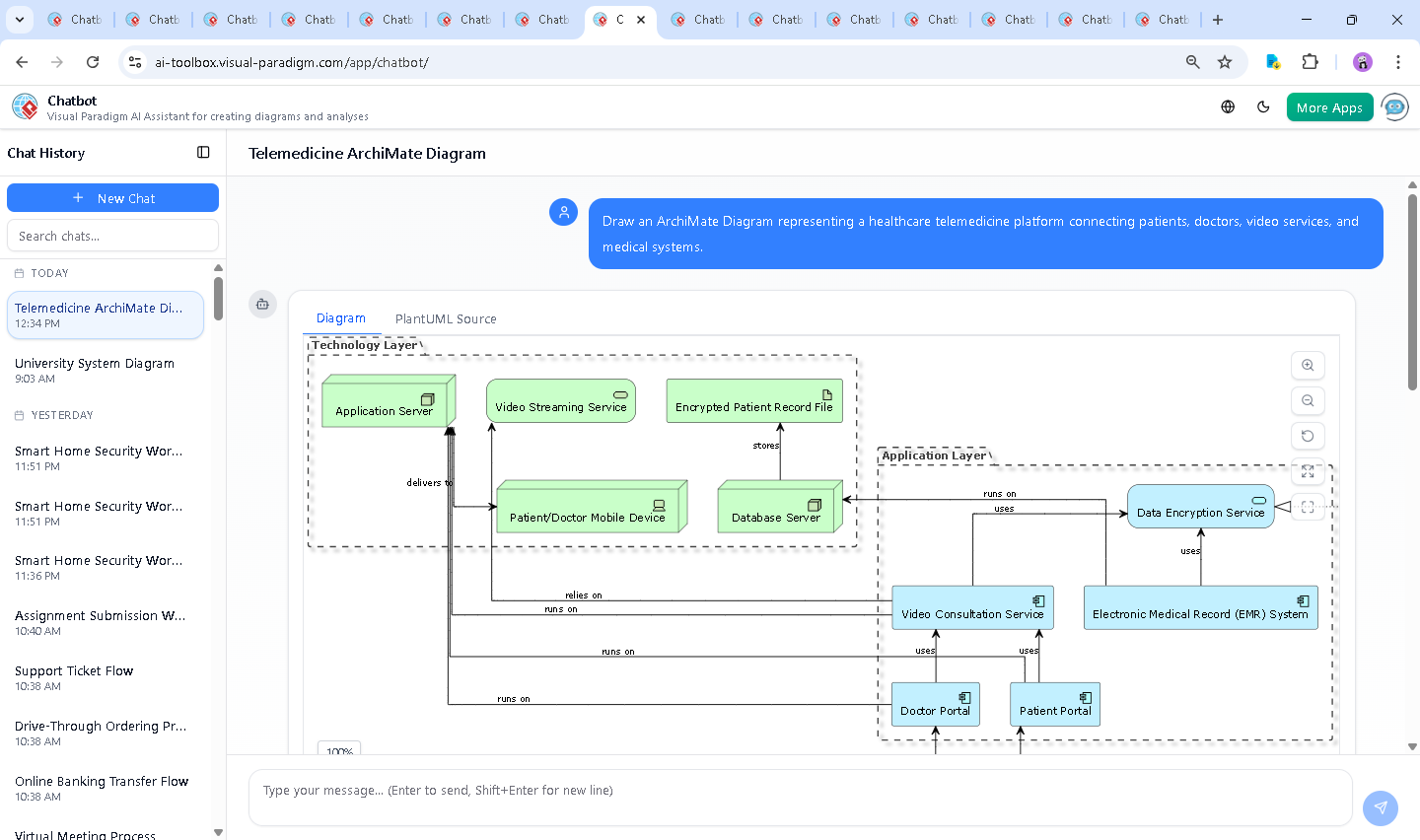
The journey began with a simple request: “Draw an ArchiMate Diagram representing a healthcare telemedicine platform connecting patients, doctors, video services, and medical systems.”
Within seconds, the AI Chatbot delivered a fully structured ArchiMate diagram using PlantUML syntax, organizing the platform into four core layers: Motivation, Business, Application, and Technology. The model included key elements like Business_Actor (Patient, Doctor), Business_Service (Teleconsultation Service), Application_Component (Patient Portal, EMR System), and Technology_Node (Server, Database).
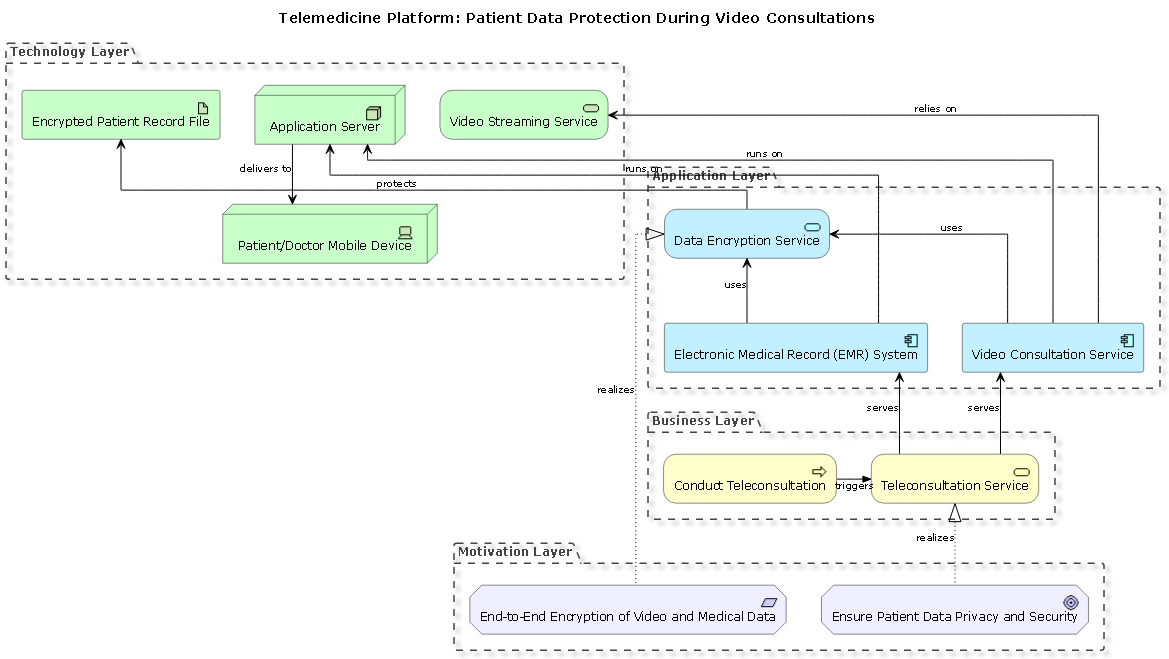
The AI didn’t stop at rendering. When asked, “How is patient data protected during video consultations?”, it immediately refined the model to highlight data security as a central concern. The updated diagram now features a dedicated Motivation_Goal for “Ensure Patient Data Privacy and Security” and a Motivation_Requirement for “End-to-End Encryption of Video and Medical Data.”
This wasn’t a static output—it was a dynamic conversation. The AI interpreted the follow-up query not as a request for a new diagram, but as an invitation to deepen the architectural rationale. It restructured the relationships, emphasizing how the Application_Service_DataEncryption realizes the security requirement and protects the Technology_Artifact_PatientRecordFile.
Unpacking the Logic: Why This ArchiMate Structure Works
The original diagram is built on ArchiMate’s layered approach, which aligns perfectly with enterprise architecture principles:
- Motivation Layer: Establishes the purpose—improving healthcare access and ensuring data security—anchoring the design in business intent.
- Business Layer: Defines actors (Patient, Doctor) and processes (Registration, Scheduling, Consultation), showing who does what.
- Application Layer: Maps the software components—Patient Portal, Doctor Portal, Video Service, EMR System—and how they serve or use each other.
- Technology Layer: Deploys the infrastructure—servers, databases, client devices—and shows how services rely on or deliver to physical resources.
Key relationships reveal the system’s logic:
Rel_Realization_Uplinks business goals to their technical realization—e.g., the Teleconsultation Service realizes the goal of better access.Rel_Serving_Upshows dependency: the Video Service uses the Data Encryption Service, which in turn protects the patient record file.Rel_Triggering_Rightcaptures workflow: scheduling triggers the actual consultation.Rel_Serving_Downillustrates delivery: the server delivers content to the patient or doctor’s device.
These relationships aren’t arbitrary—they reflect real-world constraints and compliance needs, such as HIPAA or GDPR, embedded into the model from the start.
Conversational Intelligence: The AI as a Modeling Consultant
What sets Visual Paradigm apart is how the AI Chatbot functions as an intelligent collaborator. It doesn’t just generate diagrams—it responds to context, adapts to follow-up questions, and enhances the model with architectural insight.
When the user asked about data protection, the AI didn’t just add a new element. It recontextualized the entire diagram around security, ensuring that the Application_Service_DataEncryption is not just present, but explicitly tied to the Motivation_Requirement and Technology_Artifact it protects.
This level of responsiveness demonstrates the AI’s understanding of ArchiMate semantics—knowing that realizes connects goals to services, and protects is the correct relationship to show data security.
More Than ArchiMate: A Unified AI Modeling Platform
While this example focuses on ArchiMate, the Visual Paradigm AI Chatbot is built to support a full spectrum of modeling standards. Whether you’re designing a system with UML for software design, SysML for complex engineering systems, or C4 for software architecture at scale, the AI adapts.
For instance, a developer could ask: “Show me a C4 model of the same telemedicine platform, focusing on the context and containers.” The AI would respond with a structured C4 diagram, using Context, Container, and Component layers—without requiring a change in interface or learning curve.
This versatility makes Visual Paradigm not just a diagramming tool, but a unified AI-powered visual modeling platform—where the same conversational intelligence applies across domains, standards, and use cases.
Conclusion: Design Smarter, Faster, with AI Guidance
Creating a secure, scalable telemedicine platform is no small feat. But with the Visual Paradigm AI Chatbot, architects can move from idea to visual model in minutes—supported by real-time feedback, contextual refinement, and deep domain knowledge.
Explore the full interaction at this shared session. Try asking your own questions—like “How would this change if we added AI diagnostics?”—and watch the model evolve.
Design with confidence. Build with clarity. Model with AI.