


Designing a Smart Video Streaming Platform with AI-Powered Precision
Building a robust video streaming platform demands more than just coding—it requires a clear, scalable architecture. The challenge lies in modeling complex interactions between components like content delivery, recommendation engines, and media storage while ensuring clarity and maintainability. That’s where the Visual Paradigm AI Chatbot steps in: not as a diagram generator, but as a collaborative modeling expert.
When a user requested a component diagram for a video streaming platform, the AI didn’t just draw shapes. It engaged in a real-time conversation—asking clarifying questions, refining logic, and adapting to feedback. This wasn’t automation; it was intelligent co-design.
From Prompt to Precision: The Interactive Design Journey
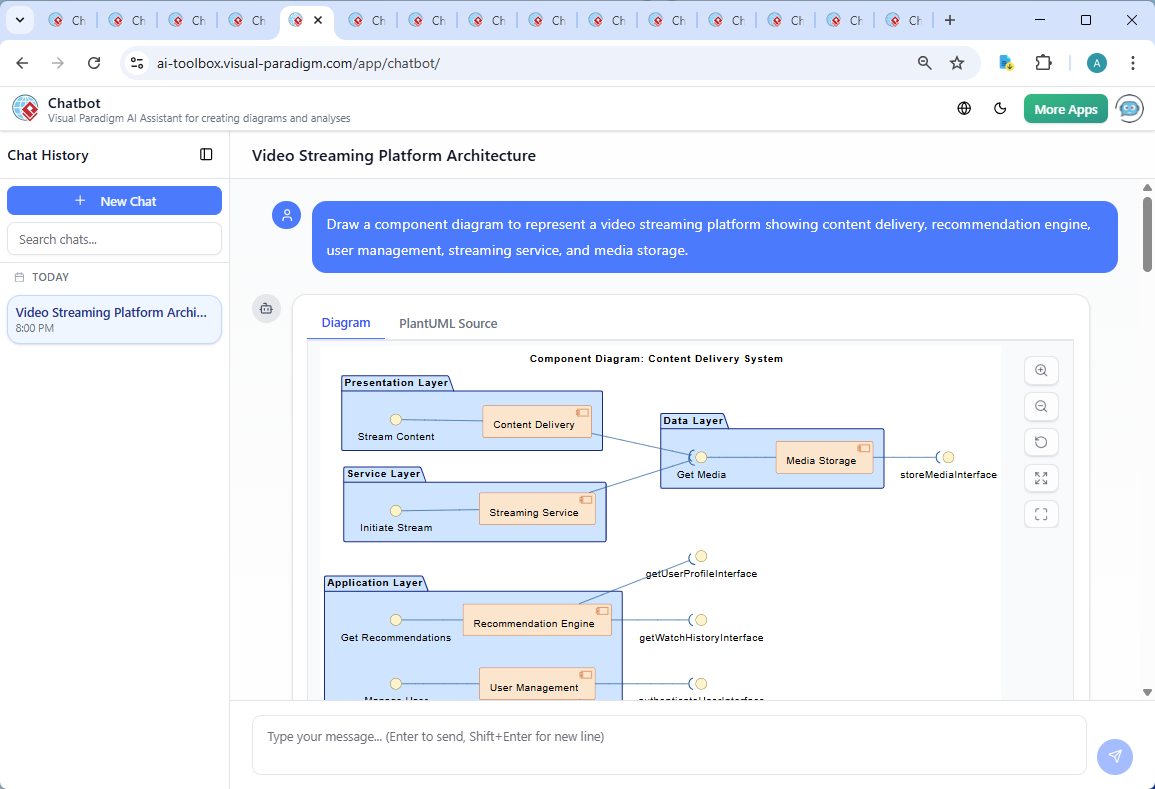
The session began with a straightforward request: “Draw a component diagram to represent a video streaming platform showing content delivery, recommendation engine, user management, streaming service, and media storage.”
Within seconds, the Visual Paradigm AI Chatbot delivered a fully formed PlantUML-based component diagram, structured into logical layers—Presentation, Application, Service, and Data—using standardized UML conventions. But the real value emerged in the conversation that followed.
When the user asked, “Can you explain how the ‘Get Recommendations’ interface interacts with the ‘Get Watch History’ and ‘Get User Profile’ interfaces in the Recommendation Engine?”, the AI didn’t default to a static explanation. Instead, it broke down the data flow with clear logic, role definitions, and real-world examples.
It didn’t stop there. The AI refined the diagram’s interface dependencies, clarified the data flow between components, and even suggested how the recommendation engine pulls from both behavioral and profile-based inputs. Each follow-up—like “Explain this branch” or “Refine the logic”—was met with a precise, context-aware response that deepened the architectural understanding.
Understanding the Component Diagram Logic
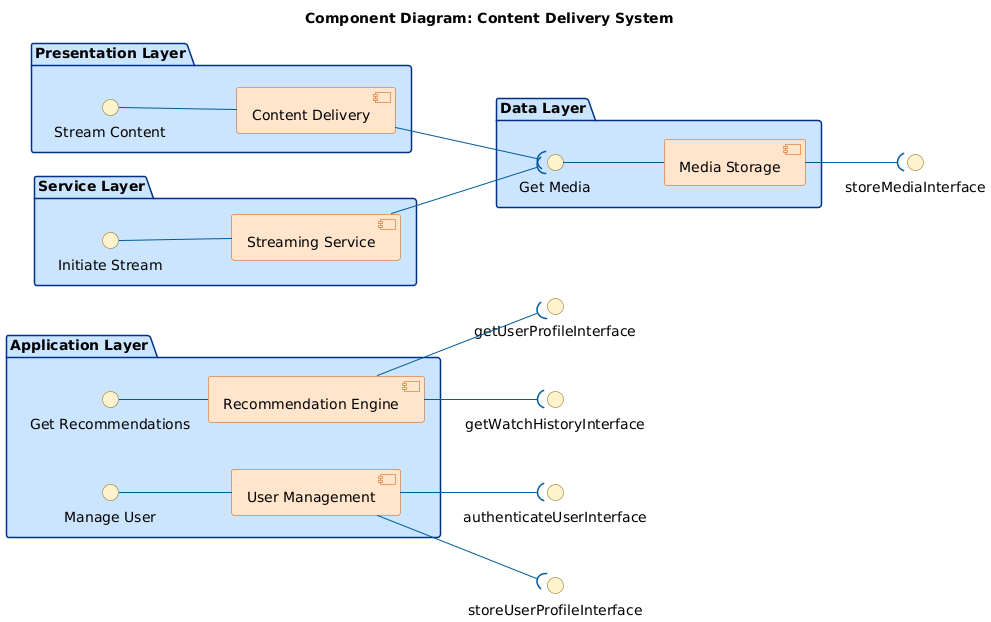
The resulting diagram reflects a well-structured, layered architecture optimized for scalability and maintainability. Here’s a breakdown of the key components and their relationships:
1. Presentation Layer – User Interaction
The Content Delivery component handles the final delivery of video streams to the user. It relies on the Stream Content interface, which acts as the entry point for playback requests.
2. Application Layer – Intelligence & Logic
- Recommendation Engine: The brain behind personalized content. It uses two key data sources:
- Get Watch History → Reveals past behavior (e.g., genres, duration, frequency).
- Get User Profile → Captures user-defined preferences (e.g., genre, age, location).
- User Management: Manages authentication, profile storage, and access control. It interacts with the Manage User interface and supports user lifecycle operations.
3. Service Layer – Core Functionality
The Streaming Service component handles stream initiation and session management. It depends on the Initiate Stream interface and pulls media content from the data layer.
4. Data Layer – Persistent Storage
The Media Storage component stores video files, metadata, and thumbnails. It exposes the Get Media interface for retrieval and the Store Media interface for uploads.
Why Component Diagrams? The Strategic Choice
Component diagrams are ideal for this use case because they:
- Visualize system modularity and responsibility.
- Clarify interface-based communication between high-level modules.
- Support future scalability—e.g., replacing the recommendation engine with an AI-driven model without affecting other components.
The AI’s choice of layered packaging (Presentation, Application, Service, Data) isn’t arbitrary—it reflects industry best practices in microservices and domain-driven design.
Conversational Intelligence in Action
What sets Visual Paradigm apart is the depth of insight the AI provides beyond the diagram itself. Each interaction was a learning moment—explaining not just what the components do, but why they’re structured this way.
For example, when asked to clarify the data flow, the AI didn’t just restate the diagram—it illustrated how the recommendation engine combines behavioral data (watch history) with profile data (preferences) to generate context-aware suggestions. It even provided a real-time flow example:
User opens app →
→ Recommendation Engine calls:
    → Get Watch History → returns: "Watched 3 crime dramas"
    → Get User Profile → returns: "Genre: Crime, Age: 30, Location: US"
→ Engine analyzes: "User likes crime → recommends new crime series"
→ Returns: “Top 5 Crime Series to Watch”
This level of detail turns a static diagram into a living design document.
Beyond Component Diagrams: A Full Modeling Suite
The Visual Paradigm AI Chatbot isn’t limited to component diagrams. It supports a full spectrum of modeling standards, making it the ultimate tool for enterprise architects and software engineers alike:
- UML: For detailed system design and behavior modeling. Explore UML Component Diagram Tutorial and Tool or see Component Diagram Software – Visual Paradigm Online.
- ArchiMate: For enterprise architecture, aligning IT with business strategy. Dive into the Comprehensive Tutorial: AI-Powered ArchiMate Diagram Generation or try Interactive ArchiMate Diagram Creation.
- SysML: For complex systems engineering and requirements modeling. See SysML Diagram Tool.
- C4 Model: For clear, context-aware software architecture documentation. Learn more with the C4 Diagram Tool by Visual Paradigm or explore C4 Diagram Solution by Visual Paradigm – Enterprise-Grade Architecture Visualization.
- Mind Maps, PERT Charts, Org Charts, SWOT, PEST: For strategic planning and team collaboration. Discover templates and examples via the Interaction Overview Diagram Example Gallery or Timing Diagram Examples in Visual Paradigm Gallery.
Whether you’re designing a cloud-native video platform or a government digital service, the AI Chatbot adapts to your modeling needs—understanding context, refining logic, and delivering precision.
Conclusion: Design with Intelligence, Not Guesswork
Visual Paradigm isn’t just a diagramming tool. It’s an AI-powered visual modeling platform where every interaction builds smarter, more accurate architectures. From the initial prompt to the final refinement, the AI acted as a modeling consultant—guiding, explaining, and evolving the design in real time.
Ready to build your next system with confidence? Try the shared session and experience how the AI Chatbot transforms ideas into intelligent, actionable models.
Related Links
- Component Diagram – Wikipedia: A UML diagram that illustrates the organization and dependencies of components in a software system.
- What is a Component Diagram? – Visual Paradigm: A detailed guide on UML component diagrams, showing how components interact and are structured in software design.
- Component Diagram Tutorial: Component Diagram Tutorial. Component diagrams provide a simplified, high-order view of a large system. Classifying groups of classes into components supports the interchangeability…