


Designing Amazon’s E-Commerce Powerhouse: An AI-Driven Organizational Blueprint
Building a scalable and agile organizational structure for a global e-commerce giant like Amazon is no small feat. With millions of SKUs, complex supply chains, and real-time customer demands, the need for a clear, dynamic, and intelligent organizational model is critical. Enter the Visual Paradigm AI Chatbot — not just a diagram generator, but a collaborative modeling expert that transforms high-level ideas into precise, structured visualizations through natural conversation.
From Concept to Clarity: The Interactive Journey of the Organization Chart
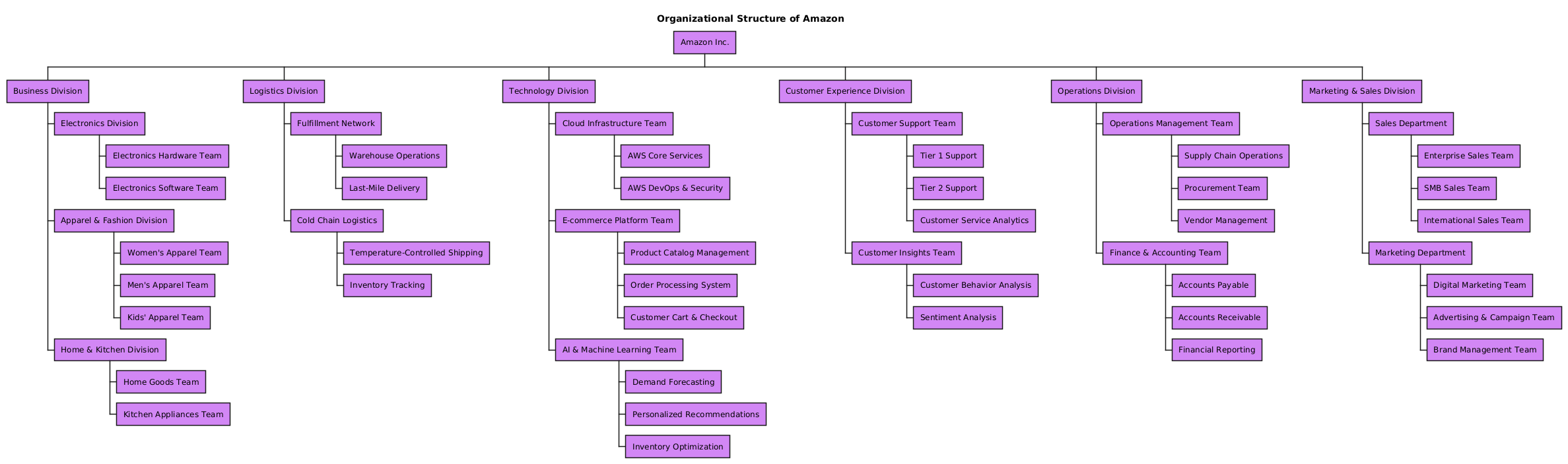
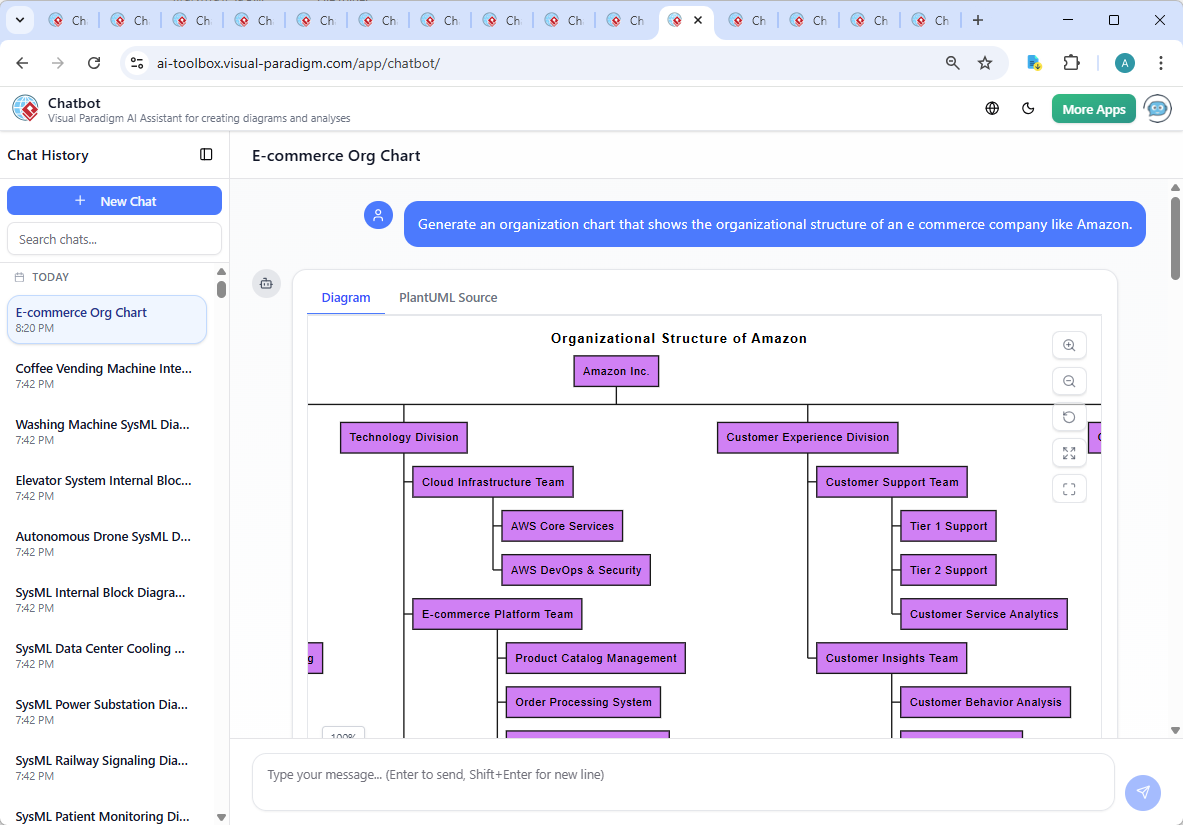
The journey began with a simple prompt: “Generate an organization chart that shows the organizational structure of an e-commerce company like Amazon.” The AI Chatbot responded instantly with a PlantUML-based WBS (Work Breakdown Structure) diagram, capturing Amazon’s core divisions in a hierarchical format. The structure wasn’t just a static list — it was a living blueprint, designed to reflect the operational realities of a company that moves billions of items annually.
But the conversation didn’t stop there. When the user asked, “Can you explain the role of the AI & Machine Learning Team in optimizing inventory?” the AI didn’t just provide a definition — it delivered a layered, insightful breakdown of how machine learning drives inventory decisions across Amazon’s ecosystem. This wasn’t a generic answer; it was a deep dive into demand forecasting, dynamic replenishment, supply chain synchronization, and predictive analytics.
The AI’s ability to refine its response based on follow-up questions — such as “Explain this branch” or “Refine the logic” — demonstrated its role as a true modeling consultant. Each iteration added depth, ensuring the diagram wasn’t just visually accurate, but operationally meaningful.
Decoding the Logic: Why This Structure Works
The organization chart is built on a clear, multi-tiered hierarchy that mirrors Amazon’s real-world operational architecture:
- Business Division: The top-level grouping of product-focused units — Electronics, Apparel & Fashion, and Home & Kitchen — each with dedicated teams for hardware, software, and goods.
- Logistics Division: Central to Amazon’s competitive edge, this includes Fulfillment Network (warehouse and last-mile delivery) and Cold Chain Logistics (for temperature-sensitive goods), ensuring speed and reliability.
- Technology Division: Houses the backbone of Amazon’s digital infrastructure — from AWS (cloud services) to the e-commerce platform and AI/ML systems that power personalization and automation.
- Customer Experience Division: Focuses on support, analytics, and behavioral insights, ensuring customer needs are not only met but anticipated.
- Operations Division: Manages supply chain, procurement, and financial functions, forming the operational spine.
- Marketing & Sales Division: Drives growth through targeted campaigns, brand strategy, and global sales outreach.
The choice of a WBS-style hierarchy was intentional. It reflects how Amazon organizes work — not just by reporting lines, but by function, value stream, and operational accountability. This structure supports cross-functional collaboration while maintaining clear ownership and performance tracking.
The Intelligence Behind the Diagram: Conversational Expertise in Action
What truly sets this process apart is the depth of insight the AI delivered after the initial diagram. When asked to explain the AI & Machine Learning Team’s role, the chatbot didn’t just list functions — it mapped out how these systems interact with inventory, demand, pricing, and logistics in real time. Each point was grounded in operational reality, showing how AI isn’t just a tool, but a strategic enabler.
This level of contextual understanding — responding to nuanced follow-ups with precision — proves the AI Chatbot isn’t a passive generator. It’s an active collaborator, capable of interpreting intent, refining logic, and delivering expert-grade analysis on demand.
More Than Just Org Charts: A Multi-Standard Modeling Powerhouse
While this example focuses on the Organization Chart, the Visual Paradigm AI Chatbot is far more versatile. It supports a full spectrum of modeling standards, including:
- UML: For software design, system behavior, and component modeling.
- ArchiMate: For enterprise architecture, aligning business, application, and technology layers.
- SysML: For systems engineering, modeling complex product lifecycles and requirements.
- C4 Model: For software architecture visualization, from context to containers and components.
- SWOT, PEST, Mind Maps, PERT Charts, and more: For strategic planning, risk analysis, and project management.
This versatility means teams can use the same AI-powered platform across the entire design lifecycle — from initial ideation to detailed system modeling and stakeholder communication.
Conclusion: Build Smarter, Faster, with AI-Powered Modeling
Visual Paradigm’s AI Chatbot turns abstract ideas into actionable, intelligent visual models — without requiring technical expertise. Whether you’re mapping Amazon’s global operations, designing a new product launch, or aligning IT and business strategy, the platform delivers clarity through conversation.
Ready to build your next organizational blueprint? Start your conversation with the AI Chatbot today and experience the future of visual modeling.