


Visualizing Healthcare Leadership: The Central Valley General Hospital Organization Chart
Designing a clear, accurate organizational structure for a major hospital is more than just mapping titles—it’s about visualizing the flow of responsibility, clinical expertise, and operational support across departments. The complexity of healthcare systems demands precision, especially when aligning leadership with clinical delivery and support functions.
With the Visual Paradigm AI Chatbot, this challenge transforms into a collaborative design journey. Instead of manually drafting hierarchies or wrestling with diagramming tools, users start with a simple natural language prompt—and the AI responds with a structured, standards-compliant organization chart, ready for refinement.
From Prompt to Precision: A Collaborative Design Journey
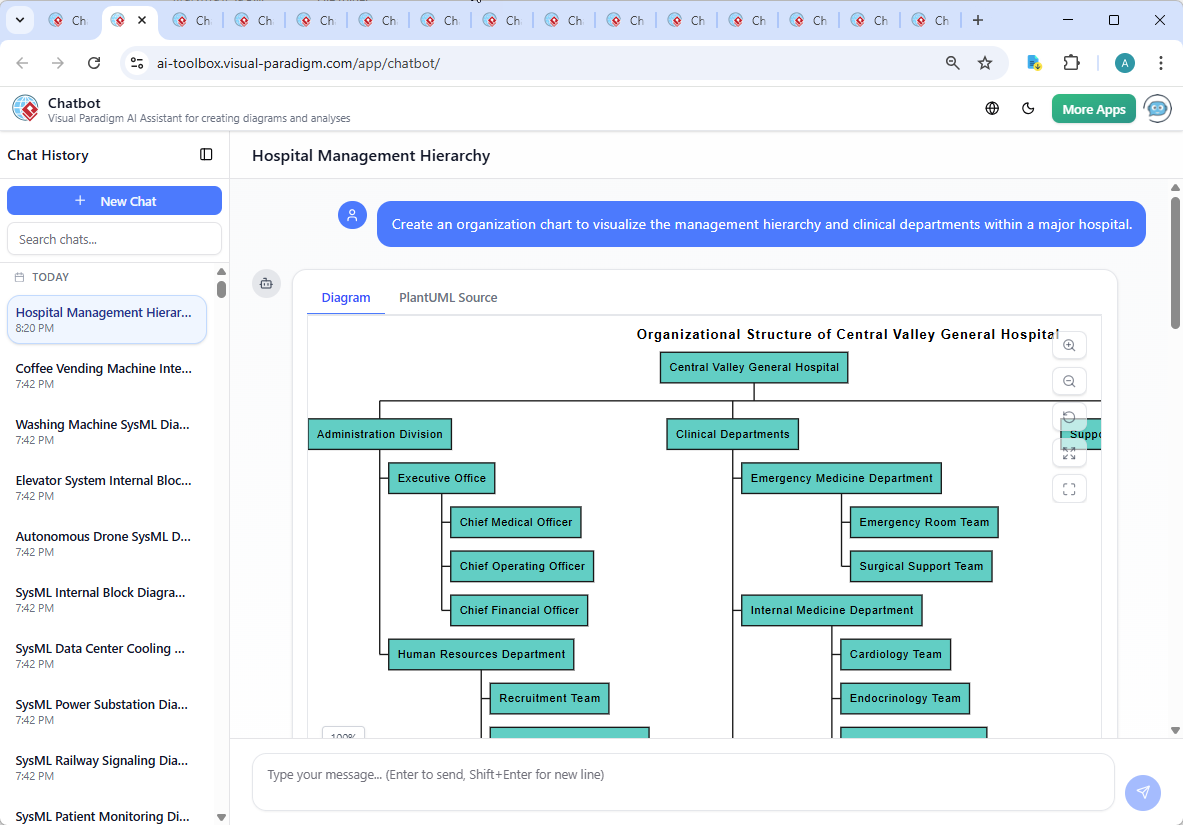
The session began with a straightforward request: “Create an organization chart to visualize the management hierarchy and clinical departments within a major hospital.” The AI Chatbot interpreted this not as a command to generate a static image, but as the opening of a design conversation.
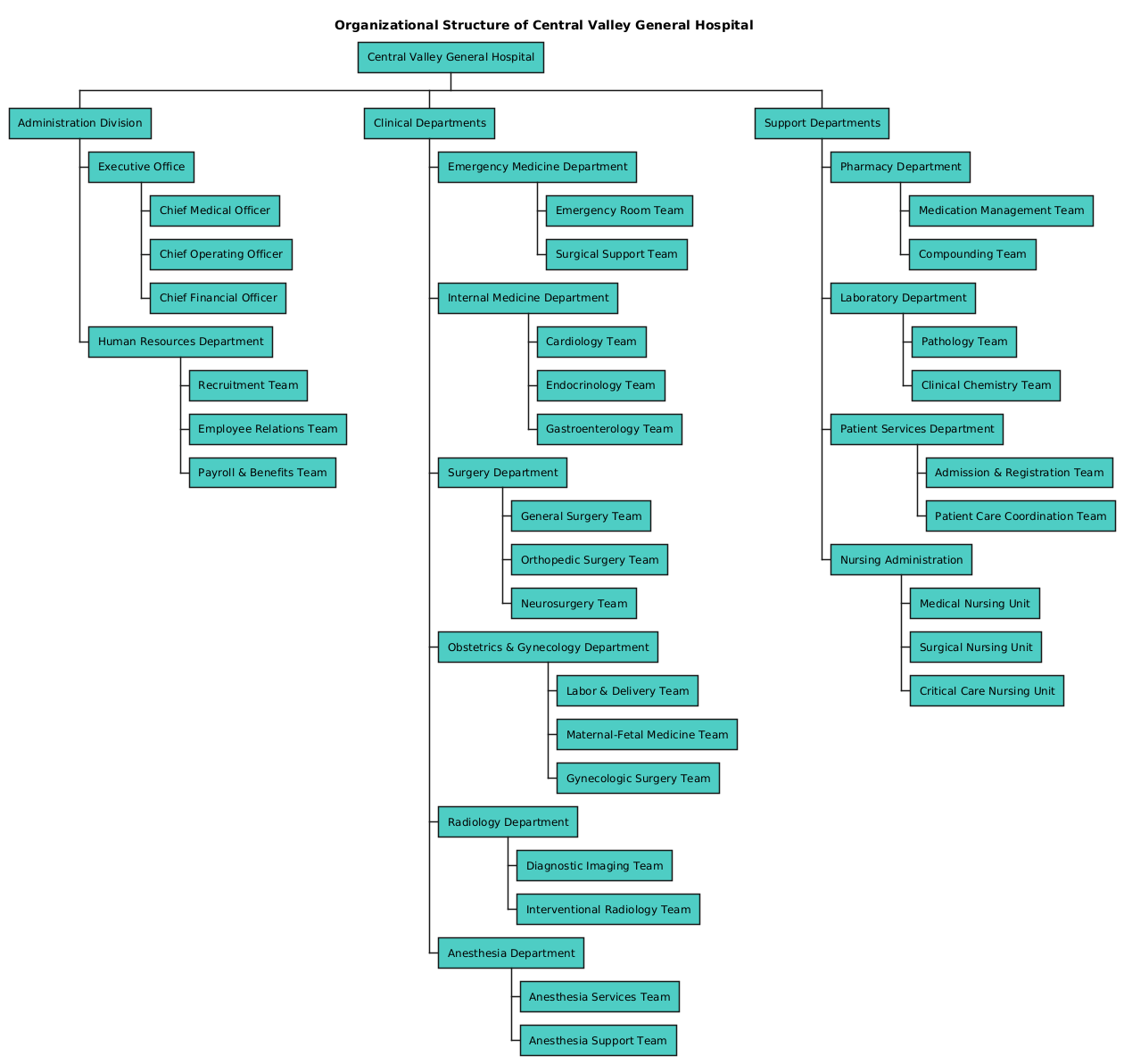
Within seconds, it delivered a PlantUML-based WBS (Work Breakdown Structure) representation of the Central Valley General Hospital, organized into three core divisions: Administration, Clinical Departments, and Support Departments. The output wasn’t just a diagram—it was a living blueprint, with nodes clearly labeled and structured using semantic hierarchy.
As the conversation progressed, the user asked a follow-up: “What specific responsibilities does the Anesthesia Support Team have within the Anesthesia Department?”
The AI didn’t just restate the title. It provided a detailed, clinically accurate breakdown of the team’s operational role—highlighting preoperative coordination, equipment readiness, infection control, and emergency response support. This wasn’t a generic definition; it was expert-level insight tailored to the hospital’s context.
When the user requested refinement—such as clarifying the distinction between anesthesia providers and support staff—the AI adjusted its response with precision, emphasizing that the team supports, but does not deliver, anesthesia care. This level of contextual awareness proves the AI isn’t just generating diagrams—it’s acting as a modeling consultant.
Decoding the Structure: Why This Design Works
The organization chart was built using a hierarchical WBS format, which aligns with industry best practices for visualizing governance and operational units. Each level represents a layer of responsibility:
- Top Level: Central Valley General Hospital — the entity itself.
- Administration Division: Houses executive leadership and HR functions, ensuring strategic oversight and workforce stability.
- Clinical Departments: Core medical units including Emergency Medicine, Internal Medicine, Surgery, Obstetrics & Gynecology, Radiology, and Anesthesia—each with specialized sub-teams.
- Support Departments: Critical operational arms like Pharmacy, Laboratory, Patient Services, and Nursing Administration, ensuring clinical delivery is backed by reliable infrastructure.
The choice of WBS over a simple tree diagram was deliberate. It enables clear visual differentiation between leadership, clinical execution, and support roles—making it easier for stakeholders to identify decision points, reporting lines, and interdependencies.
For example, the Anesthesia Support Team appears under the Anesthesia Department but is not listed as a direct care provider. This subtle but important distinction reflects real-world clinical workflows, where technical and logistical roles are distinct from clinical ones.
Conversational Intelligence in Action
What sets the Visual Paradigm AI Chatbot apart is its ability to respond to nuanced follow-ups with domain-specific accuracy. When asked about the Anesthesia Support Team’s responsibilities, the AI didn’t default to a textbook answer. Instead, it delivered a structured, real-world explanation that could be directly applied in hospital operations, training, or policy development.
This interaction demonstrates the platform’s deeper intelligence: the AI understands not just diagram syntax, but the functional logic behind organizational design in healthcare.
Beyond the Chart: A Multi-Standard Modeling Platform
While this example focuses on an Organization Chart, the Visual Paradigm AI Chatbot is built to support a full suite of modeling standards. It seamlessly handles:
- UML (for software and system design)
- ArchiMate (for enterprise architecture and business-IT alignment)
- SysML (for systems engineering and complex system modeling)
- C4 Model (for software architecture visualization)
- Mind Maps, PERT Charts, SWOT, PEST, and various data visualization types
This versatility means the same AI assistant can guide users through designing a hospital’s IT architecture with ArchiMate, model clinical workflows using SysML, or map strategic initiatives using SWOT—all within a single, intelligent environment.
Conclusion: Designing with Intelligence, Not Just Tools
The organization chart for Central Valley General Hospital isn’t just a visual aid—it’s a product of intelligent collaboration between human intent and AI expertise. From the initial prompt to the detailed explanation of team roles, the process reflects how modern modeling should work: conversational, iterative, and deeply contextual.
By leveraging the Visual Paradigm AI Chatbot, healthcare leaders, architects, and administrators gain a powerful tool to design, communicate, and refine organizational structures with confidence.
Ready to build your own AI-powered organizational model? Explore the live session and see how the AI transforms ideas into precise, actionable diagrams.