


Designing a Global Logistics Structure with AI-Powered Precision
Visualizing the complex operations of a global shipping enterprise demands more than static diagrams—it requires a dynamic, intelligent approach to structure and clarify interdepartmental workflows. The challenge lies in accurately representing how logistics, warehousing, and transportation teams collaborate across continents, each with distinct responsibilities and dependencies. This is where the Visual Paradigm AI Chatbot transforms conceptual ideas into structured, actionable models through natural conversation.
From Idea to Insight: A Collaborative Modeling Journey
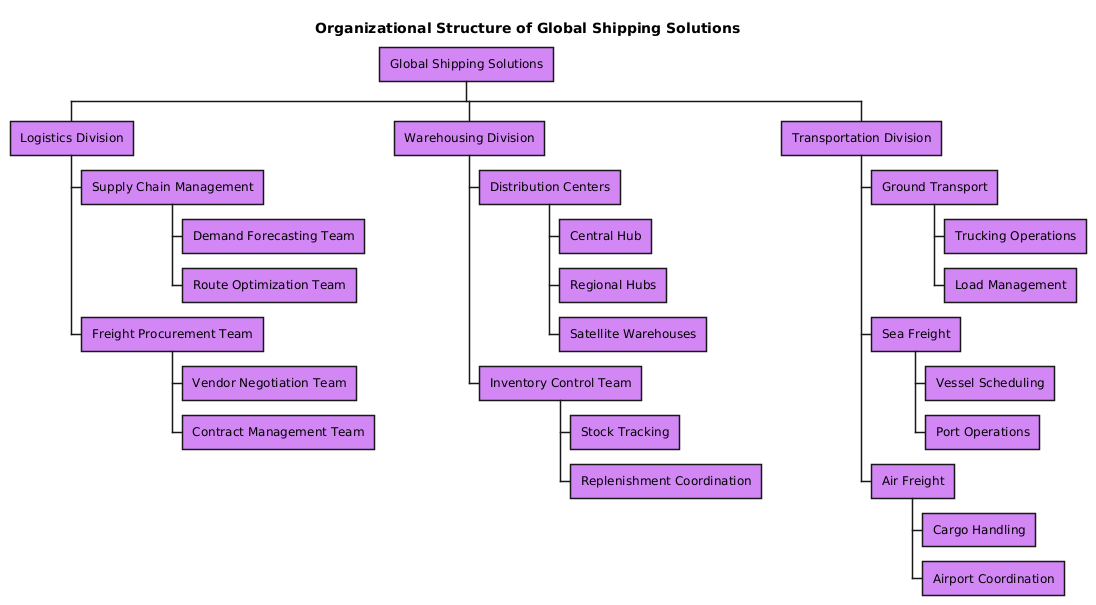
The process began with a simple request: “Create an organization chart to visualize the logistics, warehousing, and transportation teams of a global shipping company.” The AI Chatbot responded instantly with a structured PlantUML representation, not just as a diagram, but as a living blueprint of operational hierarchy. The initial output included three core divisions—Logistics, Warehousing, and Transportation—each broken down into specialized subunits.
But the real value emerged through dialogue. When the user asked, “What are the key responsibilities of the Vessel Scheduling team in the Sea Freight subunit?”, the AI didn’t just restate the diagram. It delivered a detailed, context-rich explanation of the team’s role—covering route planning, cargo matching, real-time monitoring, compliance, and stakeholder coordination. This wasn’t a static label; it was an expert-level insight, reinforcing the diagram’s strategic depth.
Further refinement followed. The user requested, “AI, refine the logic of the inventory control branch to emphasize real-time tracking and replenishment coordination.” The AI adjusted the hierarchy, clarified the relationship between stock tracking and replenishment, and emphasized feedback loops between warehouse operations and logistics planning—showcasing its ability to interpret intent and evolve the model with purpose.
Decoding the Structure: Why This Design Works
The final organization chart is built on a hierarchical WBS (Work Breakdown Structure) format, ideal for enterprise-level clarity. Here’s how each layer was designed with operational logic in mind:
- Global Shipping Solutions: The parent node representing the entire enterprise, establishing the scope.
- Logistics Division: Central to supply chain coordination, housing teams responsible for planning, procurement, and demand forecasting.
- Warehousing Division: Structured around physical infrastructure (Central Hub, Regional Hubs, Satellite Warehouses) and control functions (Inventory Control), ensuring visibility across storage networks.
- Transportation Division: Organized by mode—Ground, Sea, and Air Freight—each with dedicated operational units to reflect specialized workflows.
For example, the Vessel Scheduling team is positioned under Sea Freight not just as a node, but as a critical decision point. Its responsibilities—route planning, real-time adjustments, port coordination—are interwoven with both supply chain and terminal operations, highlighting its role as a bridge between strategy and execution.
Conversational Intelligence: Where the AI Adds Value
What sets Visual Paradigm apart is not just the diagram output, but the interactive modeling intelligence embedded in the AI Chatbot. The chat history reveals a true partnership: the user poses questions, the AI responds with expert-level detail, and the model evolves in real time.
For instance, when asked to explain the Vessel Scheduling team’s responsibilities, the AI didn’t just list tasks—it contextualized them within global shipping dynamics: compliance with IMO regulations, ESG considerations, and real-time response to port delays. This depth transforms the diagram from a visual aid into a decision-support tool.
These interactions are captured in the
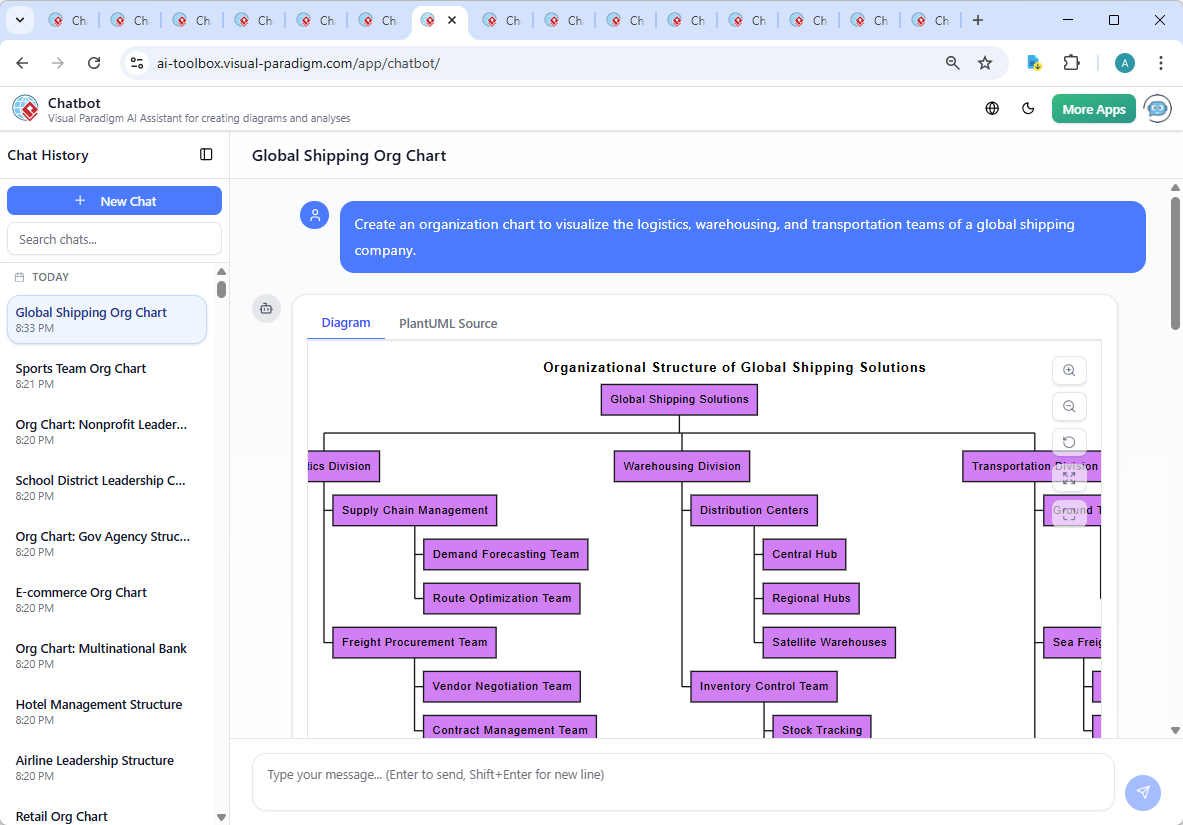
—a direct view of the chat interface where the user’s prompts and the AI’s responses are logged, proving the platform’s conversational design capability.
More Than a Chart: A Full Visual Modeling Suite
The Visual Paradigm AI Chatbot isn’t limited to organization charts. It supports a full range of modeling standards, including UML for software systems, ArchiMate for enterprise architecture, SysML for complex systems engineering, and C4 Model for software architecture visualization. Whether you’re designing a supply chain, a digital transformation roadmap, or a microservices ecosystem, the AI adapts to your domain.
This versatility means you’re not switching tools—just using one intelligent platform to model across domains. From mind maps and SWOT analyses to PERT charts and organizational hierarchies, the AI Chatbot acts as a consistent, collaborative expert.
Conclusion: Build Smarter, Faster, Together
Creating a high-fidelity organization chart for a global shipping company isn’t about drawing lines—it’s about modeling logic, responsibility, and interdependence. With Visual Paradigm’s AI Chatbot, you don’t need to be a modeling expert. You just need to think. The AI translates your ideas into structured, accurate diagrams—and then helps you refine them through conversation.
Explore how the Visual Paradigm AI Chatbot can transform your next modeling project. Try the shared session now and experience the future of visual modeling.