


Designing the GrandStay Hotel Brand’s Leadership Framework with AI Precision
Creating a clear and scalable organizational structure for a large hotel brand like GrandStay requires more than just listing roles—it demands a strategic blueprint that reflects real-world reporting flows, operational interdependencies, and leadership accountability. Traditional diagramming tools often fall short when it comes to iterative refinement and contextual intelligence. That’s where the Visual Paradigm AI Chatbot steps in—not as a passive generator, but as a collaborative modeling expert.
From Concept to Clarity: An Interactive Journey with the AI
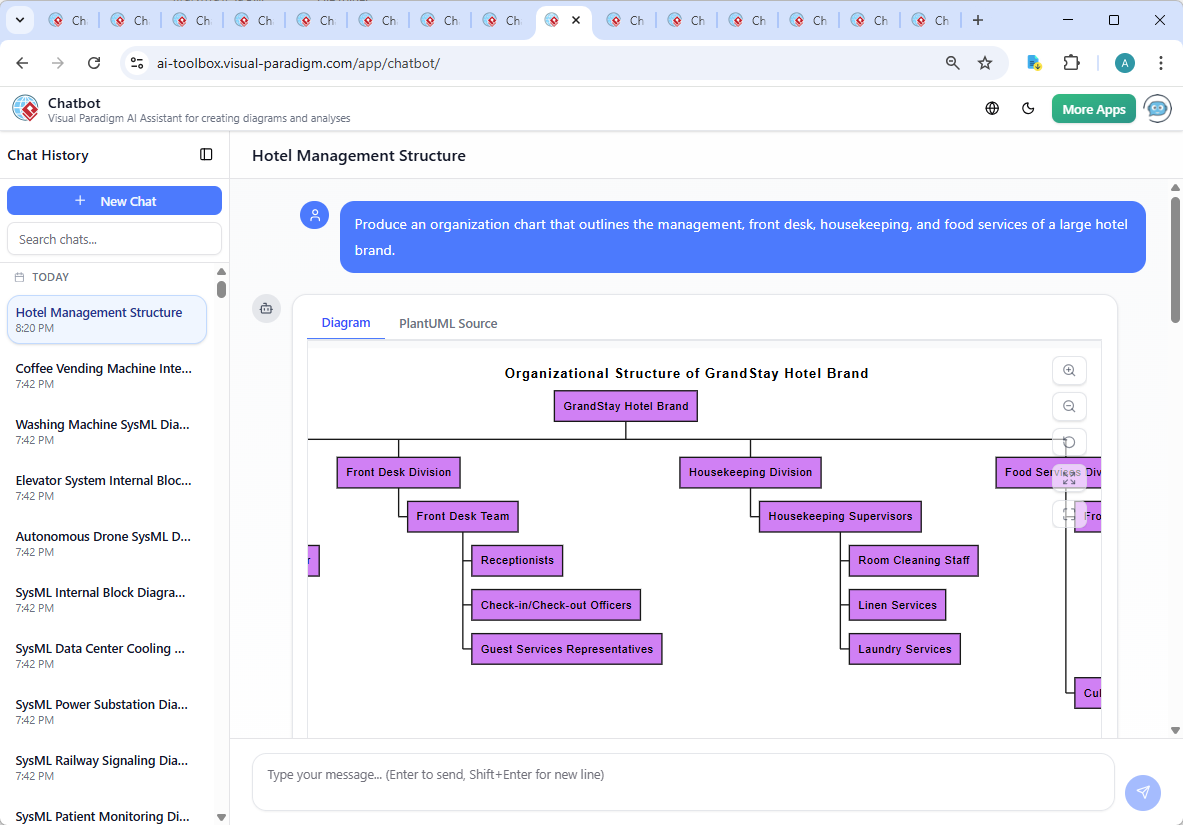
The process began with a simple request: “Produce an organization chart that outlines the management, front desk, housekeeping, and food services of a large hotel brand.” Within seconds, the AI responded with a fully structured PlantUML WBS (Work Breakdown Structure) representation, already organized into logical divisions with hierarchical nesting. The initial output wasn’t just a static diagram—it was a living model, ready for dialogue.
But the real value emerged through conversation. The user followed up with a targeted question: “Can you explain the reporting structure between the General Manager and the Operations Director?” Instead of a generic answer, the AI delivered a detailed, role-specific breakdown—complete with responsibilities, reporting flow, and strategic rationale. This wasn’t a feature toggle; it was an intelligent response rooted in enterprise architecture principles.
When the user asked for clarification on the operational chain, the AI didn’t just restate the hierarchy—it contextualized it: “The General Manager sets strategic goals, while the Operations Director translates them into daily execution.” This level of insight transforms the chatbot from a diagram tool into a design partner.
Visualizing GrandStay’s Organizational Structure
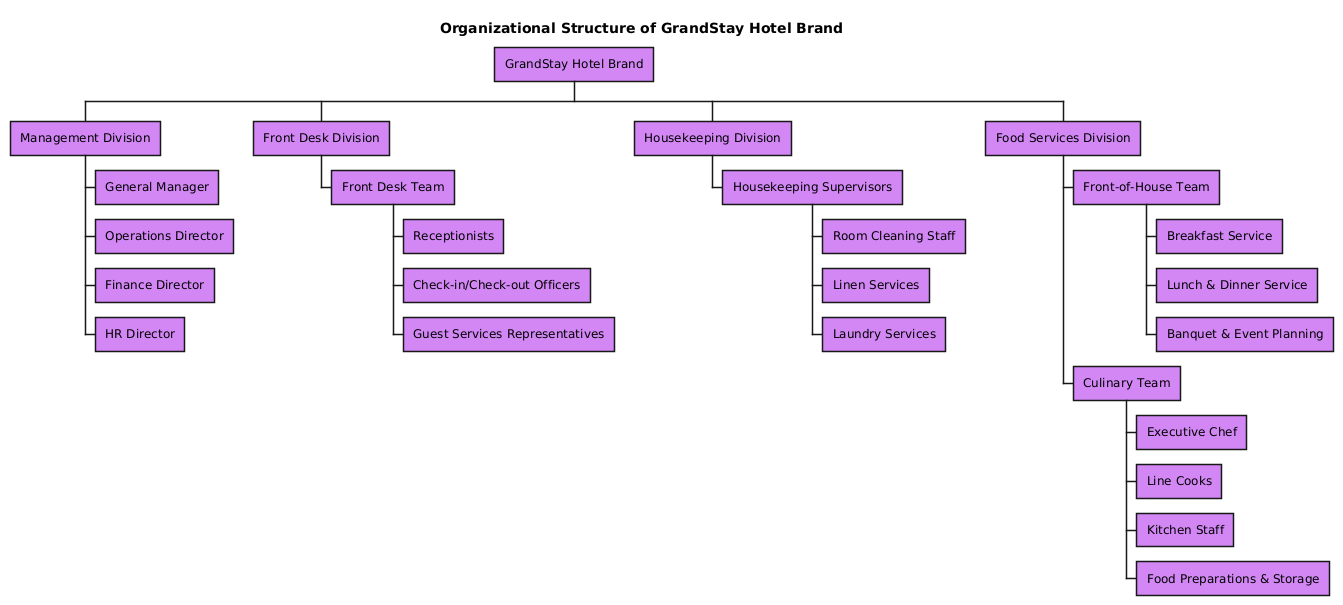
The resulting organization chart reflects a mature, scalable management model. It begins with the General Manager at the apex, overseeing four core divisions: Management, Front Desk, Housekeeping, and Food Services. Each division is further broken down into specialized teams, with clear reporting lines and functional clarity.
Decoding the Logic Behind the Structure
The diagram’s design follows a top-down, functionally segmented approach—ideal for large-scale hospitality operations. Here’s why each layer was structured as it is:
- Management Division: Centralized leadership with dedicated oversight for strategy (General Manager), operations, finance, and HR—ensuring alignment across all departments.
- Front Desk Division: Handles guest-facing services like check-in, guest support, and concierge functions, emphasizing responsiveness and first impressions.
- Housekeeping Division: Organized around cleaning, linen, and laundry—critical for guest comfort and hygiene standards. Supervisors ensure consistency across shifts.
- Food Services Division: Split into Front-of-House (service staff) and Culinary Team (cooks and kitchen staff), reflecting the dual nature of food service—service delivery and food production.
The use of PlantUML’s @startwbs syntax was intentional. It supports hierarchical modeling with visual clarity, making it ideal for organizational charts where roles and reporting relationships must be immediately apparent. The AI’s choice of notation wasn’t arbitrary—it was driven by the need for scalability, readability, and alignment with enterprise modeling standards.
Conversational Intelligence in Action
What sets this process apart is the depth of interaction. The user didn’t just receive a diagram—they engaged in a design dialogue. After the initial output, the follow-up question prompted the AI to explain the strategic rationale behind the General Manager–Operations Director relationship. The response wasn’t just descriptive; it was prescriptive, highlighting accountability, operational efficiency, and leadership balance.
Further refinements—such as clarifying how performance data flows from Operations Director to General Manager—demonstrated the AI’s ability to think like an enterprise architect, not just a diagrammer.
Beyond Organization Charts: A Full AI-Powered Modeling Suite
While this example focused on an Organization Chart, the Visual Paradigm AI Chatbot is built to support a full spectrum of modeling standards. Whether you’re designing a UML system behavior diagram, a ArchiMate business architecture model, a SysML requirements specification, or a C4 Model for software system context, the AI adapts to your domain.
For instance, if you were to model GrandStay’s IT infrastructure, the same AI could generate a C4 Component Diagram showing how the front desk system integrates with housekeeping scheduling and guest data. Or, using ArchiMate, it could map business processes like check-in workflows to IT capabilities and data flows.
This versatility means the platform isn’t just for HR or operations—it’s a unified environment for visual modeling across business, IT, and system domains.
Conclusion: Your AI-Powered Design Partner
Creating a professional, scalable organization chart for a large hotel brand is no small task. But with Visual Paradigm’s AI Chatbot, it becomes a collaborative journey—where every question leads to deeper insight, and every refinement strengthens the model.
Whether you’re designing a hotel’s operational hierarchy, a software system architecture, or a strategic business roadmap, the platform delivers precision, clarity, and intelligence—crafted using the Visual Paradigm AI Chatbot.
Ready to build your next model? Start your session now and experience the future of visual modeling.