


Reimagining Plant Management: An AI-Driven Organization Chart for PrecisionManufacture Ltd.
Designing a clear, scalable organizational structure for a manufacturing plant is more than just listing roles—it’s about mapping accountability, workflow, and operational intelligence. For PrecisionManufacture Ltd., the challenge was to visualize a cohesive hierarchy across plant management, production, quality, and maintenance—each with distinct yet interdependent responsibilities. The solution? A dynamic, AI-assisted modeling process powered by Visual Paradigm’s AI Chatbot, transforming abstract goals into a precise, navigable organizational blueprint.
From Request to Refined Structure: The Collaborative Design Journey
The journey began with a simple prompt: “Generate an organization chart to show the plant management, production, quality, and maintenance teams of a manufacturing company.” Within seconds, the Visual Paradigm AI Chatbot delivered a structured WBS (Work Breakdown Structure) representation in PlantUML syntax, capturing the core divisions and their sub-teams. But the real value emerged not in the initial output, but in the conversation that followed.
When the user asked, “Can you explain the responsibilities of the Production Planning Team within the Production Division?”, the AI didn’t just restate the name—it provided a detailed, operational breakdown. This wasn’t a static diagram; it was a living design process where the AI acted as a modeling consultant, offering insights that informed both structure and function.
Each follow-up request—whether refining logic, clarifying roles, or probing team interdependencies—was met with precision. The AI’s ability to interpret intent, maintain context, and deliver domain-specific knowledge elevated the output from a visual aid to a strategic operational document.
Decoding the Logic: Why This Structure Works
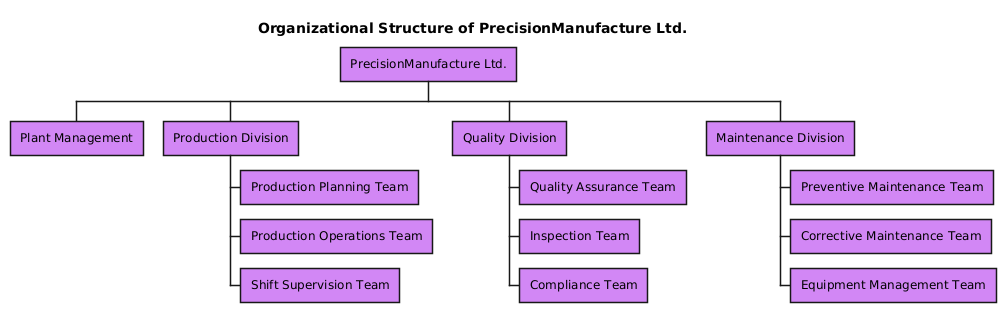
The organization chart is built on a hierarchical WBS format, a standard in project and enterprise modeling. Here’s how each layer contributes to operational clarity:
- Plant Management: The top-level node represents executive oversight, ensuring alignment across departments and strategic decision-making.
- Production Division: Central to output, this division is split into three core teams:
- Production Planning Team: Responsible for forecasting, scheduling, and resource allocation—ensuring that production meets demand without waste.
- Production Operations Team: Executes daily manufacturing tasks, following plans and reporting real-time status.
- Shift Supervision Team: Provides on-floor leadership, coordinating between shifts and enforcing safety and quality standards.
- Quality Division: Ensures compliance and consistency through:
- Quality Assurance Team: Implements standards and processes to prevent defects.
- Inspection Team: Conducts in-process and final inspections.
- Compliance Team: Tracks regulatory requirements and audit readiness.
- Maintenance Division: Prevents downtime and extends equipment life:
- Preventive Maintenance Team: Schedules regular checks and servicing.
- Corrective Maintenance Team: Responds to breakdowns and repairs.
- Equipment Management Team: Tracks asset lifecycle and performance data.
The choice of WBS over traditional org charts reflects a shift toward process-oriented modeling. It emphasizes not just who reports to whom, but how each team contributes to the overall production lifecycle—making it ideal for manufacturing environments where workflow and timing are critical.
Conversational Intelligence in Action
What sets this process apart is the depth of collaboration. The AI didn’t just generate a diagram—it engaged in a dialogue that refined both content and context. When asked to explain the Production Planning Team’s role, the AI delivered a comprehensive overview that highlighted strategic responsibilities like demand forecasting and capacity planning, demonstrating an understanding of manufacturing workflow dynamics.
This isn’t a one-off output. The AI’s ability to maintain context across multiple exchanges—such as clarifying team responsibilities or suggesting structural improvements—shows its role as a continuous modeling partner. Every interaction adds value, turning a basic chart into a decision-ready artifact.

Beyond Org Charts: A Full-Stack AI Modeling Platform
While this example focuses on an organization chart, the Visual Paradigm AI Chatbot is built to support a full spectrum of modeling standards. Whether you’re designing enterprise architecture with ArchiMate, modeling complex systems with SysML, visualizing software architecture using the C4 Model, or mapping strategic initiatives with Mind Maps, PERT Charts, SWOT, PEST, or custom charts, the AI adapts to your domain.
From concept to execution, the platform ensures consistency, accuracy, and clarity—no matter the diagram type. The same conversational intelligence that shaped this org chart can now be applied to design service flows, data models, or system behavior diagrams—all within a unified, AI-powered environment.
Build Smarter, Faster, Together
Creating a precise, actionable organizational structure is no longer a time-consuming manual task. With Visual Paradigm’s AI Chatbot, you can co-create, refine, and validate models through natural conversation—turning ideas into operational clarity in minutes.
Explore how your organization can leverage this intelligence. Start your next modeling session today.