


Reimagining School District Leadership: An AI-Driven Organization Chart
Designing a clear, accurate organizational structure for a public school district is more than just listing titles—it’s about mapping decision flows, accountability lines, and leadership responsibilities across levels. Traditional methods often lead to static, rigid diagrams that fail to reflect real-world complexity. With the Visual Paradigm AI Chatbot, this process transforms into a dynamic, conversational design journey—where ideas evolve through intelligent dialogue.
From Prompt to Precision: The Interactive Design Journey
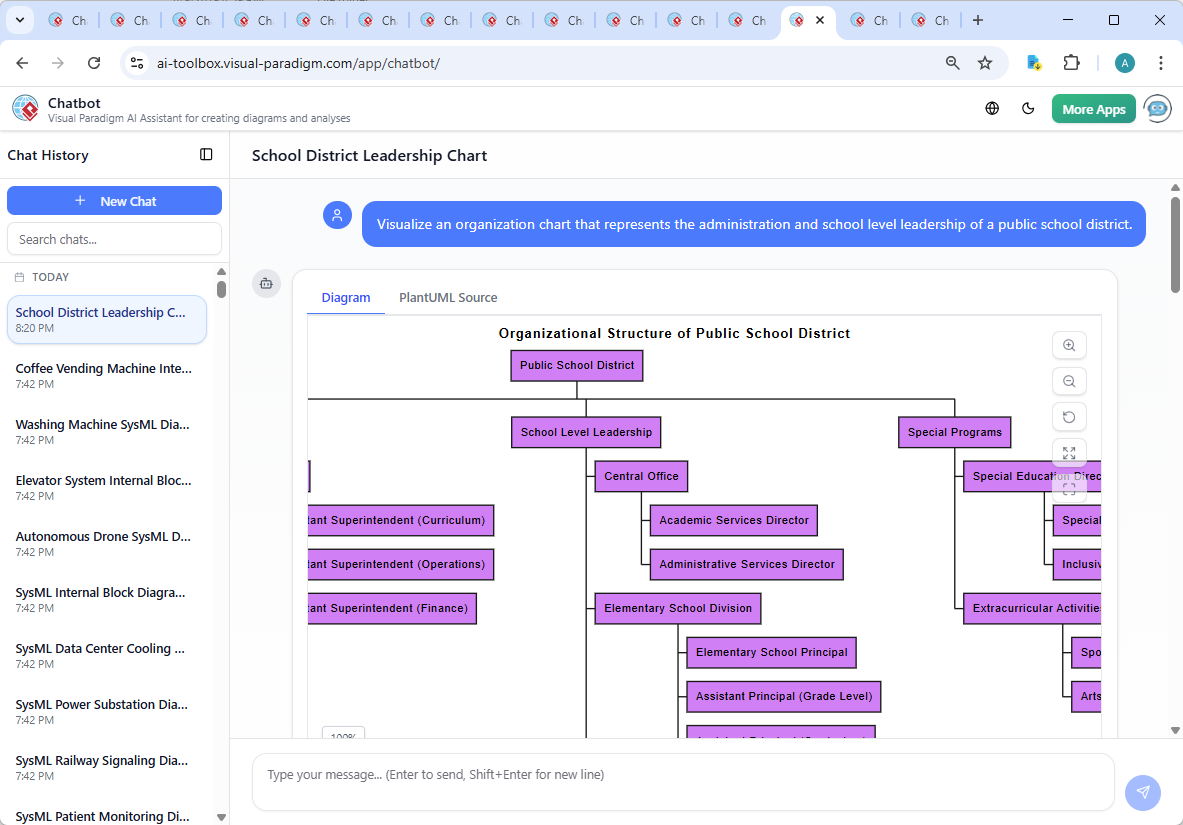
The journey began with a simple request: “Visualize an organization chart that represents the administration and school level leadership of a public school district.” The AI Chatbot immediately interpreted the intent and generated a structured WBS (Work Breakdown Structure) representation using PlantUML syntax—already a visual blueprint of the district’s leadership hierarchy.
But the real value emerged in the conversation that followed. When asked to explain the role of the Assistant Superintendent (Curriculum), the AI didn’t just define the position—it contextualized it within the broader mission of academic excellence. It outlined core responsibilities: curriculum alignment, instructional leadership, data-driven evaluation, and inclusive design, all grounded in real-world district operations.
When the user requested clarification on a specific branch—asking for a deeper dive into the curriculum role—the AI responded not with a static definition, but with a layered explanation that included responsibilities, collaboration points, and even a practical example of curriculum rollout. This isn’t automated text—it’s intelligent modeling support.
Each follow-up—like refining logic or probing a leadership function—was treated as a design refinement opportunity. The AI adjusted its output in real time, ensuring alignment with both structural integrity and operational realism.
Decoding the Structure: Why This Organization Chart Works
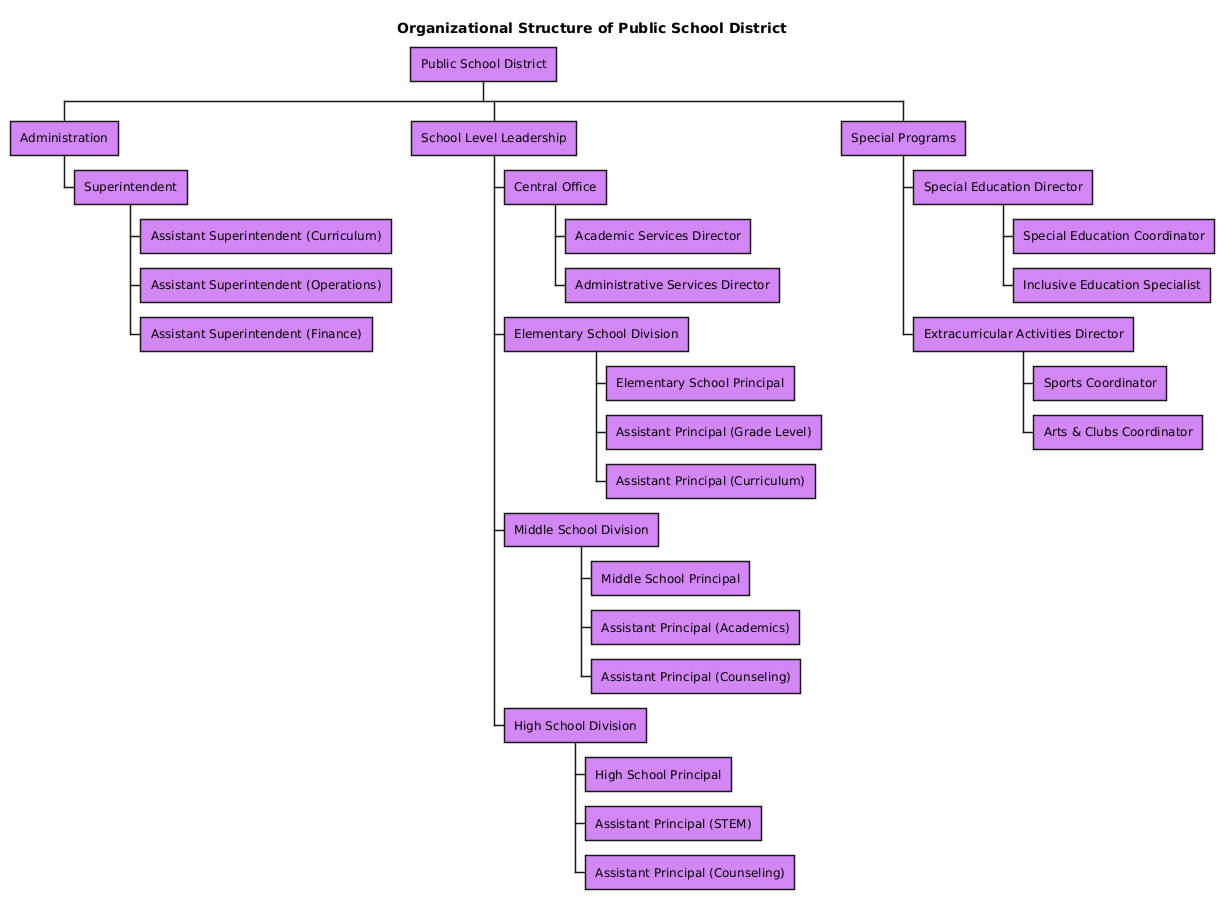
The generated organization chart is built on a hierarchical, yet flexible, structure that reflects the multi-tiered nature of public school district governance. Here’s how each layer was intentionally designed:
1. Central Leadership: The Superintendent & Key Deputies
The Superintendent sits at the apex, representing overall accountability. Below them are three Assistant Superintendents, each responsible for a critical domain:
- Curriculum: Ensures academic coherence and quality across grade levels.
- Operations: Manages facilities, transportation, and daily administrative functions.
- Finance: Oversees budgeting, grants, and financial compliance.
This triad structure enables focused leadership while maintaining strategic alignment under the Superintendent.
2. School-Level Leadership: Bridging Policy and Practice
Each academic division—elementary, middle, and high school—has its own principal and two assistant principals:
- Elementary: Assistant Principals focus on grade-level coordination and curriculum implementation.
- Middle: Emphasis on academics and student counseling to support developmental transitions.
- High: Specialized roles in STEM and counseling reflect the increasing complexity of secondary education.
This structure allows for targeted support while maintaining consistency with district-wide standards.
3. Special Programs: Equity and Enrichment
Two dedicated divisions highlight the district’s commitment to inclusion and student development:
- Special Education: Led by a Director and supported by coordinators and specialists, ensuring compliance with IDEA and individualized learning plans.
- Extracurricular Activities: Coordinates sports, arts, and clubs—critical for holistic student growth.
These are not afterthoughts; they’re strategically positioned to reflect their importance in student success.
Conversational Intelligence in Action
The true strength of the Visual Paradigm AI Chatbot lies in its ability to function as a modeling partner—not just a generator. The chat history demonstrates this in real time:
- First prompt: A high-level request for an organization chart.
- Second query: A deep dive into a specific role—showing the AI’s capacity to deliver contextual knowledge.
- Follow-up: The AI proactively offered additional value—suggesting visual representation or a meeting agenda—demonstrating anticipatory design thinking.
This isn’t a one-way output. It’s a two-way conversation where the user shapes the model, and the AI enriches it with domain expertise.
More Than Just Organization Charts: A Full Visual Modeling Suite
While this example focuses on an organization chart, the Visual Paradigm AI Chatbot is built to support a full spectrum of modeling standards. Whether you’re designing:
- UML diagrams for software systems,
- ArchiMate models for enterprise architecture,
- SysML for complex system engineering,
- C4 Model for software architecture visualization,
- or even Mind Maps, PERT Charts, SWOT, PEST, and data charts,
the AI adapts to your language and delivers precise, standards-compliant diagrams. This versatility makes it the only platform where a single conversational interface can support everything from school leadership structures to enterprise IT architecture.
Conclusion: A Smarter Way to Model Leadership
Creating an accurate, meaningful organization chart for a public school district isn’t just about listing roles—it’s about capturing how leadership functions, communicates, and drives impact. The Visual Paradigm AI Chatbot turns this challenge into a collaborative design session, where every question deepens the model and every refinement sharpens the vision.
With the ability to generate, explain, and evolve diagrams through natural conversation, Visual Paradigm isn’t just a tool—it’s a thinking partner for architects, educators, and leaders who demand clarity, precision, and insight.
Ready to build your next model? Explore the live session and see how AI transforms modeling into a conversation.