


Designing SkyFly Airline’s Leadership Framework with AI-Powered Precision
Creating a clear, scalable organizational structure for a major airline demands more than just listing titles—it requires strategic alignment across leadership, operations, and safety. The challenge lies in balancing hierarchy, accountability, and operational fluidity while ensuring that every department’s role supports the broader mission of safety, efficiency, and customer experience. Enter the Visual Paradigm AI Chatbot: not just a diagram generator, but a collaborative modeling expert that transforms high-level intent into a structured, intelligent organizational blueprint.
From Vision to Structure: A Collaborative Design Journey
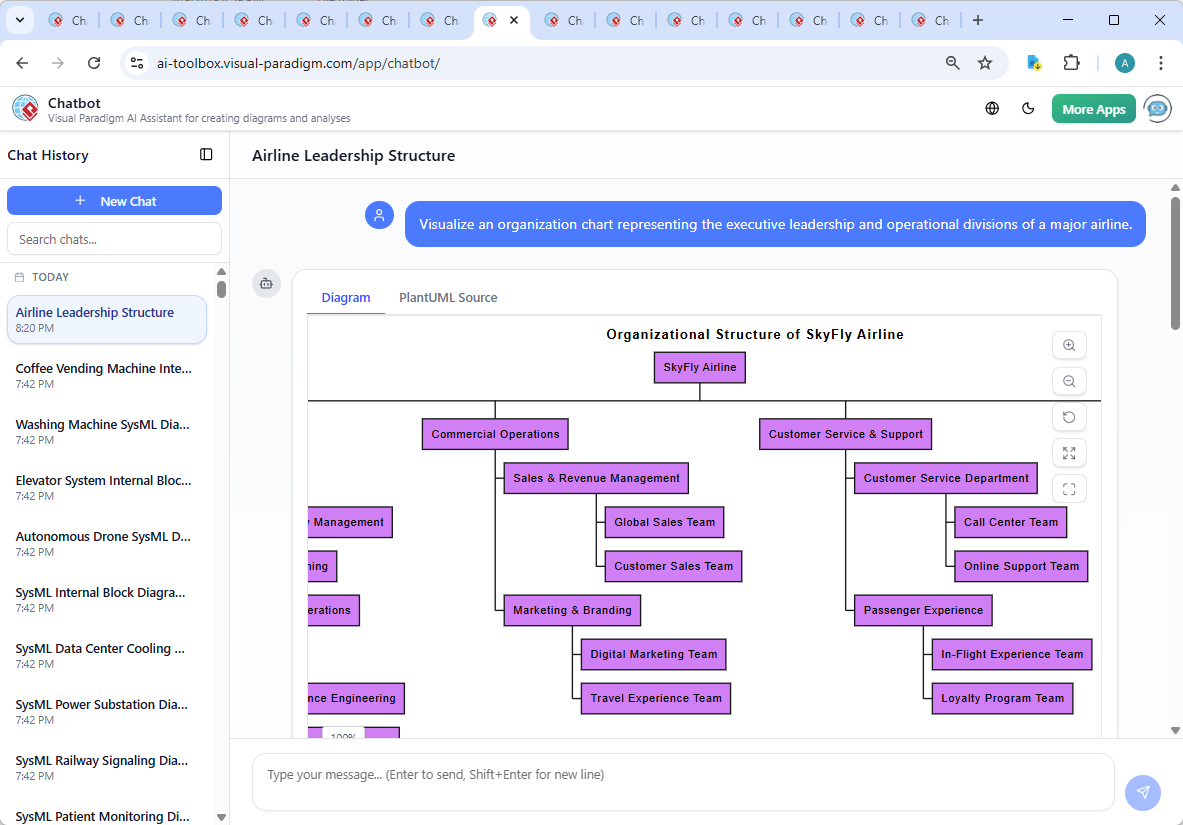
The journey began with a simple prompt: “Visualize an organization chart representing the executive leadership and operational divisions of a major airline.” Within seconds, the Visual Paradigm AI Chatbot responded with a fully structured PlantUML WBS (Work Breakdown Structure) syntax, instantly rendering a hierarchical view of SkyFly Airline’s governance and operations. The initial output wasn’t just a diagram—it was a living model, ready for refinement.
As the conversation evolved, the user asked: “Can you explain the responsibilities of the Chief Safety Officer (CSO) within SkyFly Airline’s organizational structure?” This wasn’t a request for a static definition—it was a call for deeper insight into role logic and interdependencies. The AI responded with a detailed, role-specific breakdown, highlighting the CSO’s responsibilities in policy development, risk assessment, incident investigation, and culture-building. This wasn’t a canned answer; it reflected contextual understanding of aviation safety frameworks and operational workflows.
Further refinements followed naturally. The user could ask, “AI, refine the logic of the Flight Operations branch” or “Explain this branch”—each query triggering a new layer of detail, validation, and alignment. The chatbot didn’t just generate a diagram; it co-designed the structure, adapting to user intent with precision and domain awareness.
Decoding the Structure: Why This Design Works
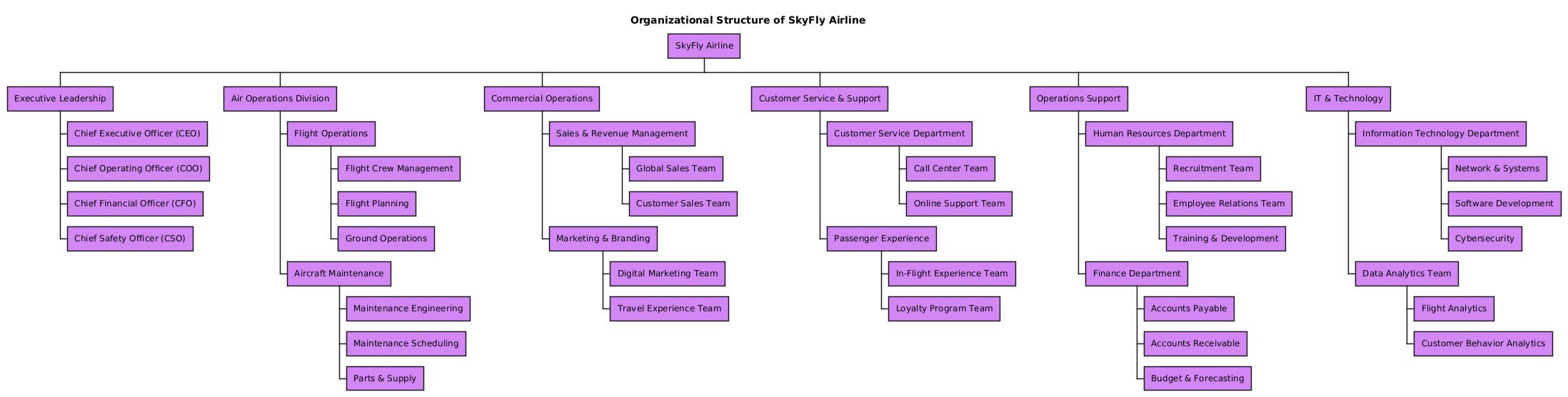
The resulting organization chart is built on a clear, multi-tiered hierarchy that reflects real-world airline operations:
- Executive Leadership: The top tier includes the CEO, COO, CFO, and CSO—each a strategic pillar. The inclusion of the CSO as a direct reporting line to the CEO underscores the airline’s commitment to safety as a core business value, not just a compliance function.
- Air Operations Division: This division is split into Flight Operations and Aircraft Maintenance, both critical to daily flight safety and reliability. Sub-teams like Flight Planning and Maintenance Engineering reflect specialized expertise required in high-stakes environments.
- Commercial Operations: Sales, marketing, and customer experience are grouped under a unified commercial strategy, enabling cross-functional alignment in revenue generation and brand engagement.
- Customer Service & Support: Positioned as a distinct division, it emphasizes the importance of passenger experience—from call centers to loyalty programs—ensuring that service quality is institutionalized, not ad hoc.
- Operations Support: HR and Finance are not siloed; instead, they are embedded in operations, reflecting their role in enabling performance through talent and fiscal discipline.
- IT & Technology: A forward-looking inclusion, with dedicated teams for cybersecurity, data analytics, and software development—key for digital transformation, flight optimization, and customer personalization.
The choice of a WBS-style diagram (via PlantUML) was intentional. It enables clear visual hierarchy while supporting scalability. Unlike flat org charts, this structure allows for easy expansion—adding regional hubs, new fleets, or digital service units—without losing clarity.
Conversational Intelligence in Action
What truly sets Visual Paradigm apart is the depth of insight the AI brings to each interaction. When the user questioned the CSO’s role, the AI didn’t just list duties—it contextualized them within regulatory standards (FAA, EASA, ICAO), operational workflows, and cultural impact. This level of domain-specific intelligence transforms the chatbot from a tool into a modeling partner.
Moreover, the AI’s ability to handle follow-up queries—such as refining branches, explaining interdependencies, or suggesting role overlaps—demonstrates its capacity for continuous improvement. Every response builds on the previous one, creating a shared understanding that evolves with the user’s needs.
More Than Just Org Charts: A Full Modeling Suite
While this example focuses on an organization chart, the Visual Paradigm AI Chatbot is not limited to a single diagram type. It supports a full spectrum of enterprise modeling standards, including:
- UML: For software architecture and system design.
- ArchiMate: For enterprise architecture, mapping business, application, and technology layers.
- SysML: For complex system engineering, especially in aviation and aerospace contexts.
- C4 Model: For software architecture visualization, ideal for cloud-native and microservices environments.
- Mind Maps, PERT Charts, SWOT, PEST, and Data Charts: For strategic planning, project scheduling, and performance analysis.
This versatility means that whether you’re designing a new airline division, modeling a digital transformation roadmap, or analyzing market trends, the same AI-powered environment adapts to your needs—ensuring consistency, accuracy, and collaboration across all stages of design.
Conclusion: Build Smarter, Faster, Together
Visual Paradigm’s AI Chatbot turns the process of organizational modeling from a manual, time-consuming task into an intelligent, interactive dialogue. With real-time feedback, domain-specific insights, and support across multiple modeling standards, it empowers teams to design with clarity, confidence, and strategic foresight.
Explore how the AI Chatbot can transform your next organizational design—whether in aviation, finance, healthcare, or tech. The future of visual modeling isn’t just automated; it’s conversational.
Ready to build your next organizational structure with AI precision? Start your session now.