


Reimagining Agency Structure: How AI Collaborated to Build SparkMark’s Leadership Framework
Designing a clear, scalable organizational structure for a marketing agency isn’t just about hierarchy—it’s about aligning teams with strategic goals, deliverables, and cross-functional workflows. The challenge lies in balancing clarity with flexibility, especially when teams like Creative and Client Service operate in parallel but interdependent cycles. Enter the Visual Paradigm AI Chatbot: not just a diagram generator, but a collaborative modeling partner that turns high-level intent into a structured, actionable blueprint.
From Concept to Clarity: A Dialogue That Shapes the Structure
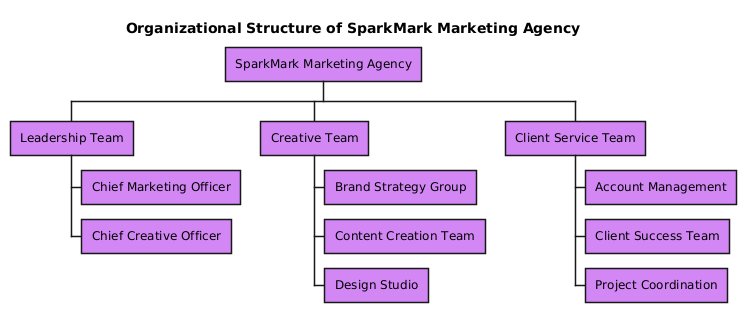
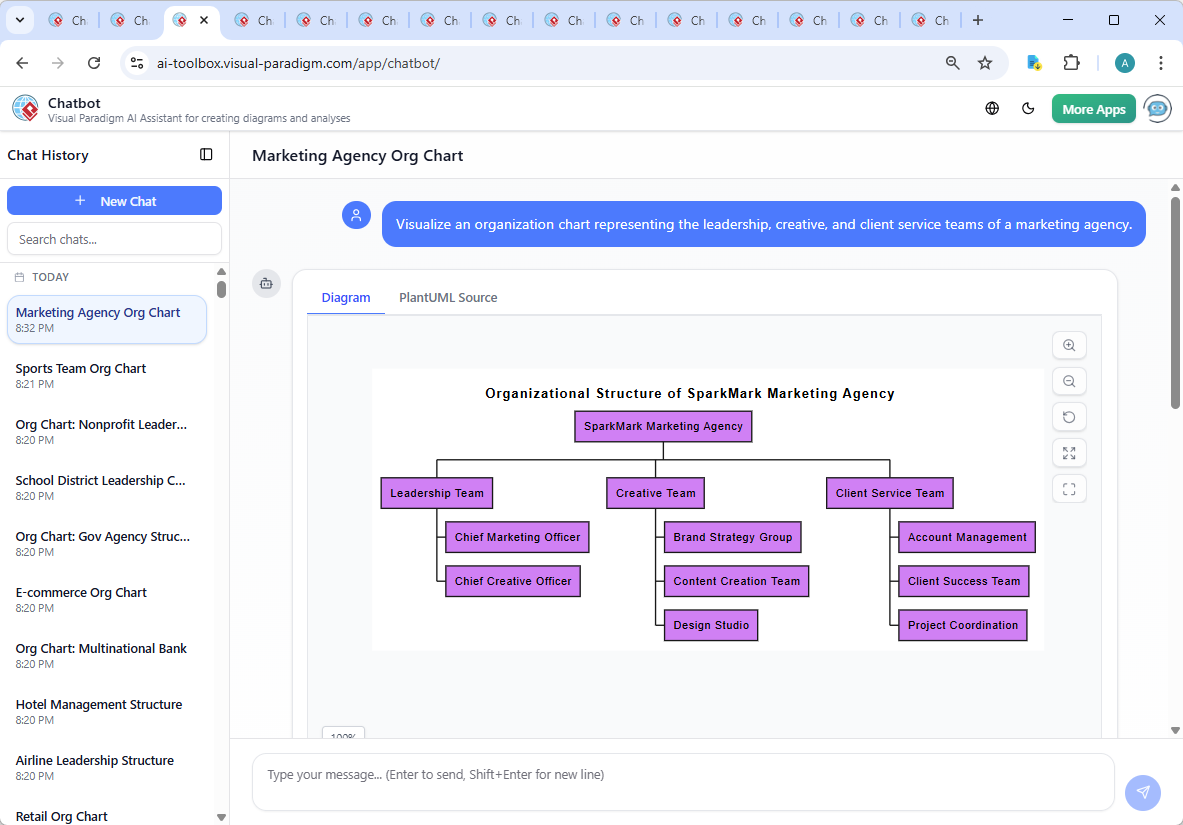
The journey began with a simple request: “Visualize an organization chart representing the leadership, creative, and client service teams of a marketing agency.” The AI responded instantly with a PlantUML-based WBS (Work Breakdown Structure) diagram, capturing the core teams and their reporting lines. This wasn’t a static output—it was the first step in a dynamic conversation.
As the user probed deeper—asking, “What specific deliverables does the Design Studio produce as part of the Creative Team?”—the AI didn’t just list outputs. It contextualized them within the agency’s operational rhythm: from brand identity kits to motion graphics, each deliverable tied back to client outcomes and internal consistency. This response wasn’t a lookup; it was a modeling insight.
The AI then refined the structure by adding specificity to roles and responsibilities. When the user requested clarification on the project coordination flow, the chatbot adjusted the hierarchy to reflect how tasks move from client service to creative execution, ensuring transparency across departments.
Decoding the Structure: Why This Design Works
The resulting organization chart is built on a hierarchical WBS format, chosen for its clarity in showing reporting lines and team groupings. Here’s how the logic was crafted:
- Leadership Team: Positioned at the top, this layer includes the CMO and CCO—key decision-makers responsible for strategic direction, budgeting, and cross-team alignment.
- Creative Team: A central pillar, subdivided into specialized groups. The Brand Strategy Group defines tone and positioning, while the Design Studio translates that into visual assets. The Content Creation Team handles copy and narrative development, ensuring brand voice consistency.
- Client Service Team: Acts as the operational bridge. The Account Management team owns client relationships, while Client Success ensures retention and satisfaction. Project Coordination manages timelines, resources, and handoffs between creative and client-facing units.
This structure reflects real-world agency dynamics: leadership sets the vision, creative delivers the experience, and client service ensures delivery excellence. The AI’s use of WBS notation—rather than a flat org chart—supports scalability and future expansion, such as adding regional teams or specialized units.
Conversational Intelligence in Action
What sets this process apart is the depth of interaction. The AI didn’t stop at diagram generation. It anticipated follow-up questions and provided value in real time. When asked about the Design Studio’s deliverables, it didn’t just list items—it explained their purpose: to maintain brand consistency while enabling campaign agility.
Further refinement came when the user requested a breakdown of the project coordination role. The AI clarified how it acts as a central hub, receiving briefs from account managers and distributing them to creative teams with clear deadlines and dependencies—mirroring real workflow tools like Asana or Monday.com.
This back-and-forth demonstrates the AI Chatbot’s role as a modeling consultant: it doesn’t just draw diagrams—it guides users through decisions, challenges assumptions, and elevates the design process with domain-specific knowledge.
Beyond Org Charts: A Unified Modeling Platform
While this example focuses on an Organization Chart, the Visual Paradigm AI Chatbot is not limited to one standard. It supports a full spectrum of modeling languages, including:
- UML: For software architecture and system design
- ArchiMate: For enterprise architecture and business-IT alignment
- SysML: For complex system engineering and requirements modeling
- C4 Model: For software architecture visualization at multiple abstraction levels
- Mind Maps, PERT Charts, SWOT, PEST, and Data Charts: For strategic planning and data-driven decision-making
This versatility means users can switch between modeling standards seamlessly—whether designing a new product launch (SysML), mapping IT governance (ArchiMate), or visualizing a client’s market positioning (PEST). The AI adapts to the context, ensuring consistency and accuracy across all diagram types.
Build Smarter, Faster, Together
Visual Paradigm’s AI Chatbot transforms the way teams design and communicate complex structures. By turning natural language into precise, professional diagrams, it removes the friction between idea and execution. Whether you’re mapping leadership, designing software systems, or planning a market entry, the platform empowers you with intelligent, collaborative modeling.
Explore how your organization can leverage AI-driven visual modeling—start your conversation today.