


Designing the Future: AI-Powered Workflow for Building a Recommendation System
Developing an AI-driven recommendation system is more than just training a model—it’s a complex orchestration of data, engineering, evaluation, and iteration. Without a clear, structured timeline, teams risk delays, misaligned priorities, and suboptimal deployment. That’s where the Visual Paradigm AI Chatbot steps in: not as a diagram generator, but as a collaborative modeling expert that transforms high-level ideas into precise, actionable workflows—through natural conversation.
From Concept to Execution: A Conversational Design Journey
When asked to produce a PERT chart for an AI recommendation system, the AI Chatbot didn’t just render a static diagram. Instead, it began by interpreting the intent: “Illustrate the workflow of developing and deploying an AI-based recommendation system.” The response was immediate—a fully structured PERT chart using PlantUML syntax, already organized into logical lanes: Data Preparation, Model Development, Model Evaluation, Deployment, and User Feedback & Iteration.
But the conversation didn’t stop there. The user followed up with a critical question: “What metrics are typically used to validate the accuracy and recall of a recommendation system?” Rather than offering a generic answer, the AI delivered a detailed, context-aware breakdown—complete with definitions, formulas, and real-world application notes. When the user requested refinement—asking for clarity on the logic behind task dependencies—the AI responded by reinforcing the causal chain: “Model training cannot begin until data is cleaned,” and “A/B testing must follow staging deployment.” These weren’t assumptions—they were the foundation of a resilient project timeline.
Visualizing the Workflow: The PERT Chart in Action
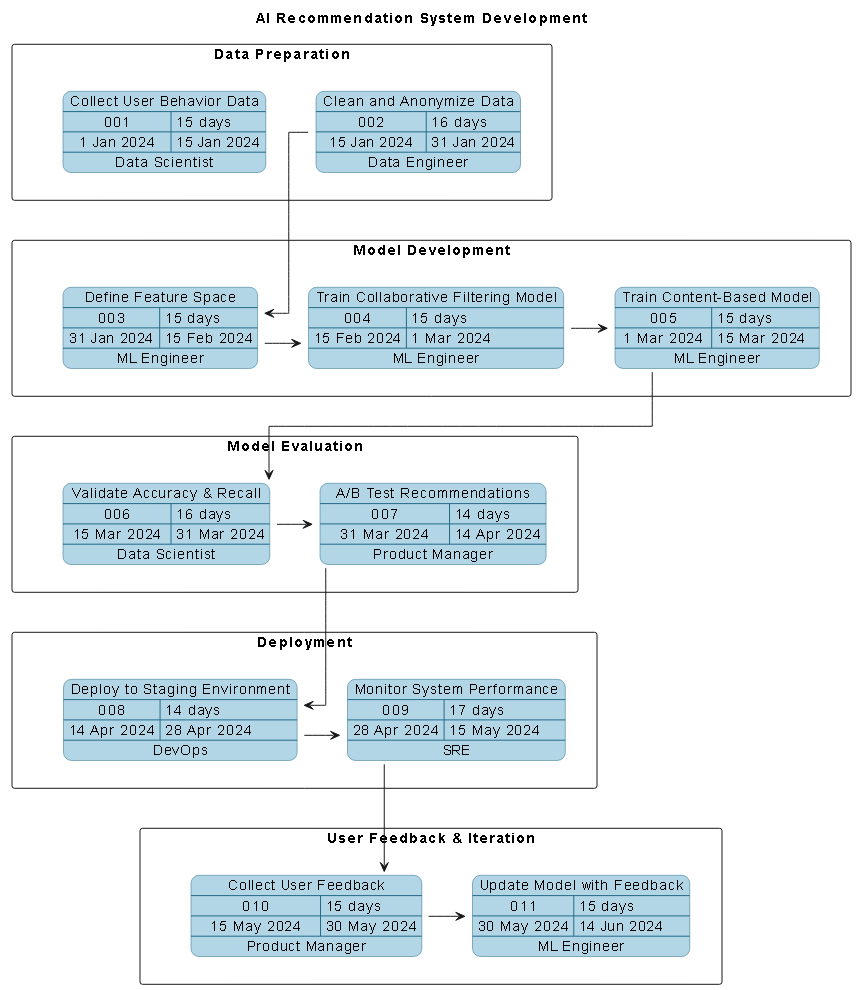
The final PERT chart reflects a realistic, phased approach to AI system development. Each task is time-bound, assigned to a responsible role, and linked through logical dependencies. For example:
- Data Preparation (Jan 1 – Jan 31, 2024): Collect and clean user behavior data.
- Model Development (Feb 1 – Mar 15, 2024): Train collaborative filtering and content-based models.
- Model Evaluation (Mar 16 – Apr 14, 2024): Validate accuracy and run A/B tests.
- Deployment (Apr 15 – May 15, 2024): Push to staging, monitor performance.
- Iteration (May 16 – Jun 14, 2024): Incorporate user feedback into model updates.
These phases aren’t arbitrary. The AI selected PERT notation because it excels at visualizing task dependencies, critical paths, and time constraints—essential for managing the iterative nature of AI projects where model updates often require re-validation and re-deployment.
Behind the Logic: Why This Structure Works
The source logic uses PlantUML’s PERT chart syntax, with custom $tasksInLane and $dependency functions to define:
- Lanes for organizational clarity (e.g., Data Scientist, ML Engineer, DevOps).
- Start and finish dates for each task, enabling timeline tracking.
- Dependency chains that enforce workflow integrity—no task can start until its predecessor finishes.
For instance, the dependency $dependency(task02, task03) ensures that data cleaning (task02) must complete before feature space definition (task03) begins. This prevents bottlenecks and aligns with real-world project management best practices.
Conversational Intelligence: Where AI Adds Real Value
What sets Visual Paradigm apart is not just the diagram output—but the depth of the conversation that shapes it. The AI Chatbot didn’t just answer a question; it integrated the answer into the design process. When asked about evaluation metrics, it didn’t stop at listing terms—it explained their relevance, use cases, and how they inform decisions in the model evaluation phase.
This level of insight turns the AI from a tool into a co-designer. The user wasn’t just receiving a diagram—they were receiving a strategy, grounded in domain expertise.
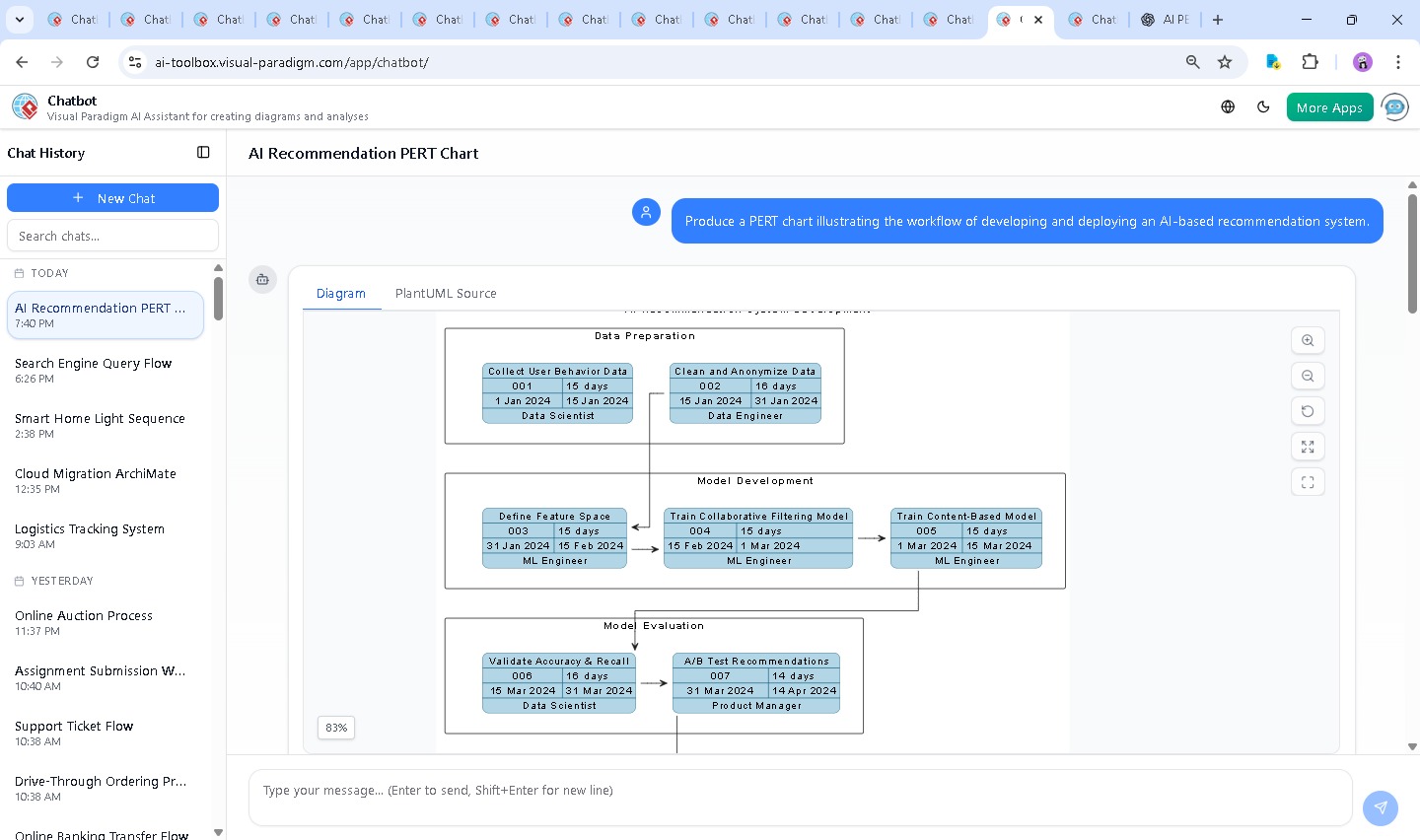
The chat interface (visible in the screenshot) shows how seamlessly the user and AI collaborated: from initial request to metric clarification to logical refinement. Each exchange built upon the last, refining the model’s structure and purpose.
More Than a PERT Chart: A Unified Modeling Platform
While this example focuses on a PERT chart, the Visual Paradigm AI Chatbot is far more versatile. It supports UML for software design, ArchiMate for enterprise architecture, SysML for systems engineering, C4 Model for software architecture, and even SWOT, PEST, Org Charts, Mind Maps, and various data visualization charts.
This means the same AI assistant can help you:
- Model business processes with ArchiMate.
- Design system behavior with SysML.
- Map software architecture with C4.
- Visualize strategic planning with PEST or SWOT.
Whether you’re a data scientist, architect, product manager, or DevOps engineer, the AI Chatbot adapts to your domain—delivering diagrams that are not just visually accurate, but contextually intelligent.
Conclusion: Build Smarter, Together
Developing an AI recommendation system demands precision, foresight, and collaboration. The Visual Paradigm AI Chatbot doesn’t just generate diagrams—it guides you through the design, answers your questions, and ensures your workflow is both technically sound and strategically aligned.
Explore how the AI can transform your next project—try the live session and experience the future of visual modeling.