


Visualizing the Onboarding Journey: A Smart PERT Chart for New Employee Integration
Onboarding new employees in a large organization is more than a checklist—it’s a complex, interdependent process that demands precision, clarity, and coordination across HR, IT, facilities, and departmental teams. Without a structured view, delays and misalignment can derail the entire experience.
That’s where the Visual Paradigm AI Chatbot steps in—not just as a diagram generator, but as a collaborative modeling partner. By transforming natural language prompts into rich, interactive PERT charts, it turns abstract workflows into actionable visual plans. This isn’t automation; it’s intelligent design support.
From Prompt to Precision: The Interactive Journey
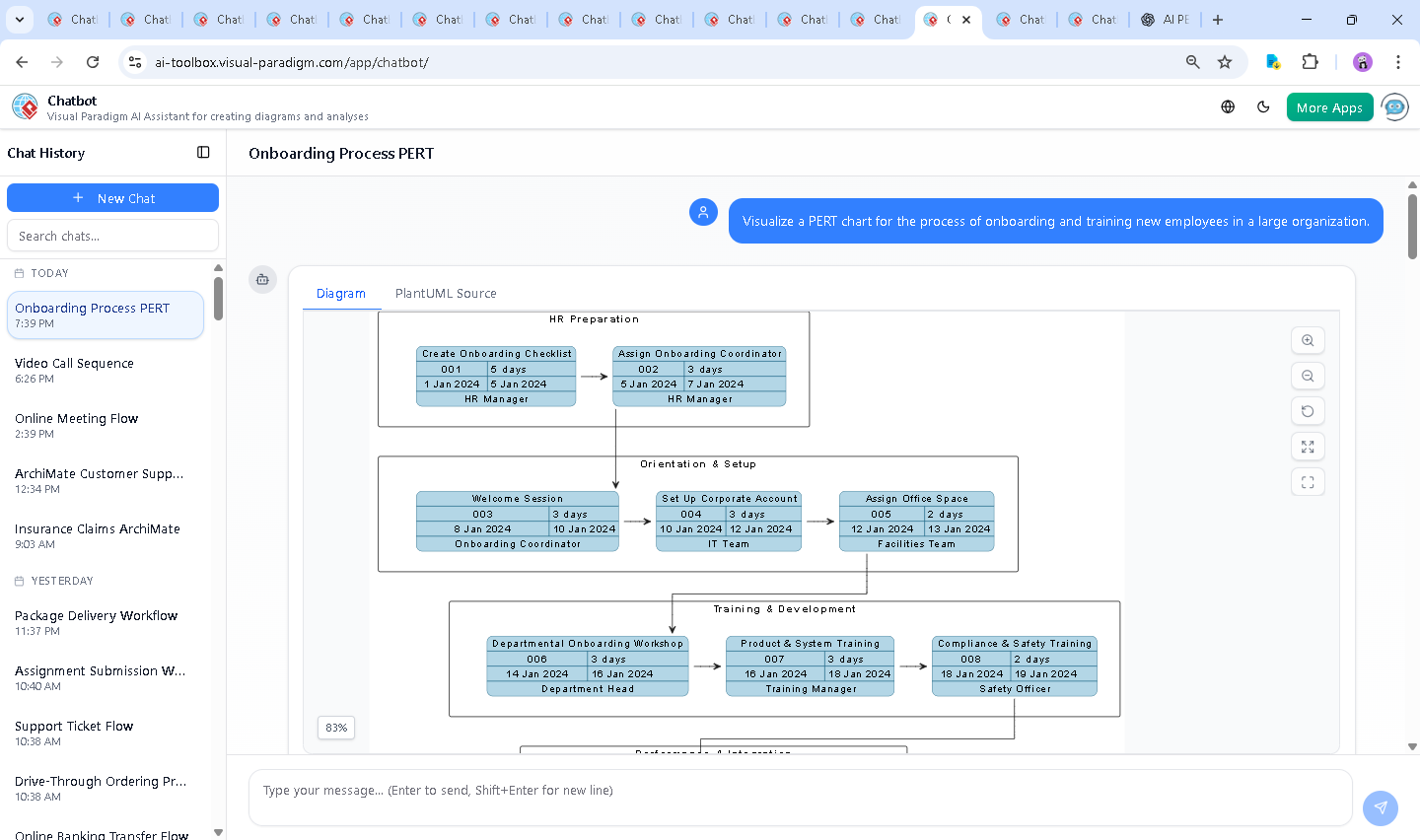
The process began with a simple request: “Visualize a PERT chart for the process of onboarding and training new employees in a large organization.” The AI Chatbot responded not with a static image, but with a fully structured PlantUML script—complete with task sequences, timelines, and dependencies—crafted using the Visual Paradigm AI Chatbot’s deep understanding of project management principles.
When the user asked, “Explain this diagram,” the AI didn’t just describe the chart—it conducted a guided walkthrough, breaking down each phase, assigning responsibilities, and highlighting critical path logic. The conversation evolved naturally: the user requested clarification on task dependencies, and the AI refined the explanation with real-world reasoning—such as why IT setup must follow the welcome session, or how compliance training must come before performance reviews.
Each follow-up—like “Explain this branch” or “Refine the logic”—was met with expert-level insight, demonstrating that the AI isn’t just generating visuals—it’s thinking through workflows like a seasoned project manager.
Decoding the PERT Logic: Structure, Sequence, and Strategy
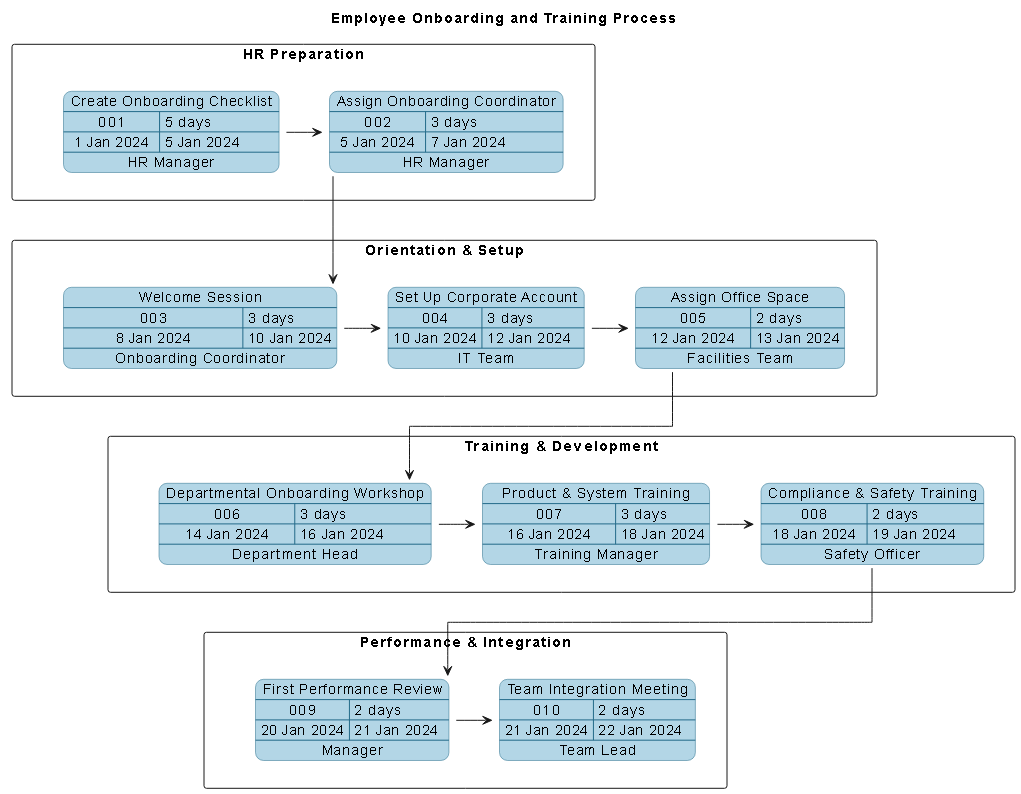
The resulting PERT chart is built on a four-phase workflow, each with clear task dependencies and realistic durations:
Phase 1: HR Preparation (Jan 1–7)
- Task 01: Create Onboarding Checklist — HR prepares the foundation.
- Task 02: Assign Onboarding Coordinator — Only after the checklist exists.
Dependency: Task 01 → Task 02. This ensures no gaps in onboarding readiness.
Phase 2: Orientation & Setup (Jan 8–13)
- Task 03: Welcome Session — Sets tone and context.
- Task 04: Set Up Corporate Account — IT begins after the welcome.
- Task 05: Assign Office Space — Facilities only after IT setup.
Dependency: Task 03 → Task 04 → Task 05. The order reflects real-world coordination: you can’t assign a workspace until accounts are ready.
Phase 3: Training & Development (Jan 14–19)
- Task 06: Departmental Onboarding Workshop — Team-specific knowledge.
- Task 07: Product & System Training — Tools after team context.
- Task 08: Compliance & Safety Training — Final mandatory step.
Dependency: Task 05 → Task 06 → Task 07 → Task 08. This sequence ensures learning builds logically from team integration to system mastery to policy compliance.
Phase 4: Performance & Integration (Jan 20–22)
- Task 09: First Performance Review — Manager assesses progress.
- Task 10: Team Integration Meeting — Final step before full team inclusion.
Dependency: Task 08 → Task 09 → Task 10. The performance review acts as a gatekeeper—ensuring readiness before full team participation.
The critical path—the longest sequence of dependent tasks—runs from Task 01 to Task 10, spanning 21 days. This defines the minimum project duration. Any delay in this chain impacts the entire onboarding timeline, making it a key focus for risk management.
Conversational Intelligence in Action
What sets the Visual Paradigm AI Chatbot apart is its ability to engage in a design dialogue. When the user asked for an explanation, the AI didn’t just restate the diagram—it contextualized it: why certain tasks are sequential, how responsibilities are distributed, and what happens if a task is delayed.
For example, the chat response highlighted that IT delays could ripple through the entire process, prompting the user to consider adding buffers. It also suggested potential parallelization opportunities—such as running training modules in parallel if dependencies allow—demonstrating strategic foresight.
These insights aren’t generic. They’re derived from the AI’s understanding of project management best practices and the real-world dynamics of onboarding.
More Than a PERT Chart: A Multi-Standard Modeling Powerhouse
While this example focuses on PERT, the Visual Paradigm AI Chatbot isn’t limited to one diagram type. It supports a full suite of modeling standards, including:
- UML – For software design and system architecture.
- ArchiMate – For enterprise architecture and business-IT alignment.
- SysML – For systems engineering and complex system modeling.
- C4 Model – For software architecture visualization at multiple levels.
- Mind Maps, Org Charts, SWOT, PEST, and data charts – For strategic planning, organizational analysis, and performance tracking.
This versatility means the same AI assistant can help you design a system architecture, map business capabilities, or visualize a marketing campaign—all within a single, intelligent environment. The AI doesn’t switch modes; it understands context and adapts accordingly.
Conclusion: A Smarter Way to Model
Creating a professional onboarding process is no longer about guesswork or fragmented tools. With the Visual Paradigm AI Chatbot, you get a conversational modeling environment where every interaction builds a more accurate, strategic, and executable plan.
Whether you’re mapping workflows, managing project timelines, or aligning teams across departments, the AI doesn’t just draw diagrams—it guides decisions, anticipates bottlenecks, and enriches collaboration.
Ready to turn your next idea into a visual strategy? Try it yourself: Explore the shared session and experience how the AI Chatbot transforms conversation into clarity.