


From Crisis to Control: Building a Resilient Product Recall Process with AI
When a consumer goods company faces a product recall, speed and precision aren’t just goals—they’re survival tools. The process demands coordination across legal, logistics, customer service, and engineering teams, all under intense scrutiny. Yet, without a clear, dynamic plan, teams risk delays, miscommunication, and repeated failures.
That’s where the Visual Paradigm AI Chatbot steps in—not as a passive tool, but as a collaborative modeling expert. It transforms a vague request into a structured, actionable PERT chart, while guiding users through the strategic thinking behind each phase. This isn’t automation; it’s intelligent co-creation.
Turning a Prompt into a Strategic Blueprint
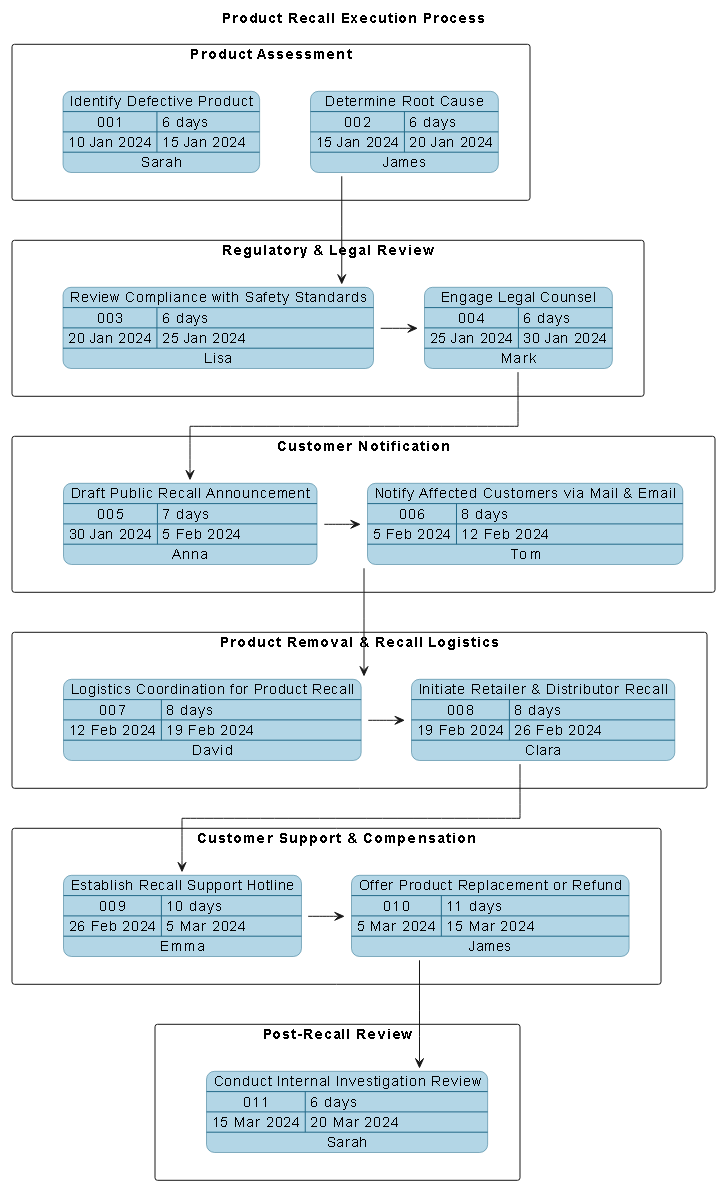
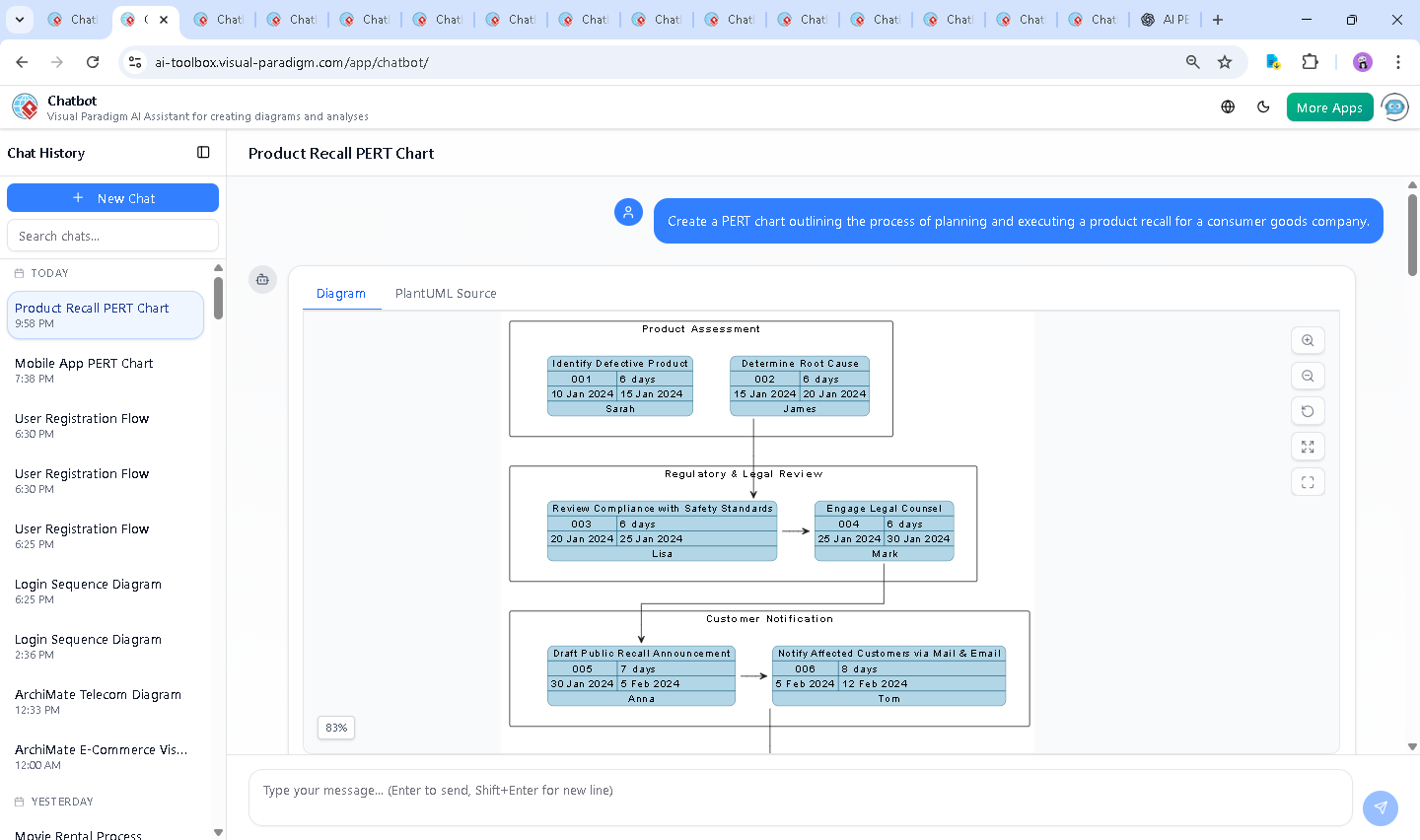
It began with a simple instruction: “Create a PERT chart outlining the process of planning and executing a product recall for a consumer goods company.” The AI Chatbot didn’t just generate a diagram—it interpreted the intent, mapped out a logical workflow, and structured it across five key lanes: Product Assessment, Regulatory & Legal Review, Customer Notification, Product Removal & Recall Logistics, and Customer Support & Compensation.
Within minutes, the AI delivered a fully formatted PlantUML script with precise start and finish dates, responsible roles, and critical path dependencies. But the real value emerged in the conversation that followed.
When the user asked, “How can we ensure that the root cause analysis in the early stages leads to a permanent fix in the product design process?”, the AI didn’t default to a generic answer. Instead, it provided a structured, actionable framework—linking RCA findings to design validation, change management, and long-term product development. This wasn’t just a diagram update; it was a strategic insight embedded directly into the modeling workflow.
With follow-up requests like “Explain this branch” and “Refine the logic”, the AI responded with depth—adjusting task sequences, clarifying dependencies, and even suggesting how to integrate RCA outcomes into future product design cycles. The conversation became a living design session, where the AI acted as a senior process architect.
Decoding the PERT Chart Logic
The resulting PERT chart is not just a timeline—it’s a decision-making map. Each lane represents a functional domain, with tasks ordered by logical and temporal dependencies:
- Product Assessment: Identifying the defective product and determining its root cause sets the foundation. The AI ensured this phase was completed before any external actions, reflecting real-world dependency.
- Regulatory & Legal Review: Compliance and legal input must follow root cause analysis. The AI enforced this sequence with a dependency from task02 (Root Cause) to task03 (Compliance Review).
- Customer Notification: Only after legal approval could the public announcement be drafted and sent. This reflects real-world risk mitigation—no public disclosure without regulatory green light.
- Logistics & Recall Execution: Coordination with retailers and distributors follows customer notification, ensuring alignment and reducing confusion.
- Support & Compensation: The support hotline and refund/replacement processes are triggered after the recall is underway, ensuring customers have access to help when they need it.
- Post-Recall Review: The final step is not just closure—it’s a feedback loop. The AI positioned this as a critical phase for learning and preventing recurrence.
By using a PERT chart format, the AI prioritized critical path identification—highlighting the sequence of tasks that directly impact the overall timeline. For example, the delay in legal review (task04) would cascade into every downstream task, making it a high-risk bottleneck. This level of insight isn’t just visual—it’s operational intelligence.
Conversational Intelligence in Action
What makes this process truly powerful is the AI’s ability to evolve the model through dialogue. The user didn’t just receive a static diagram—they engaged in a back-and-forth that refined the design:
- Follow-up Query: “How can we ensure that the root cause analysis leads to a permanent fix?” → AI Response: A structured, step-by-step guide linking RCA to design controls, FMEA, and change management.
- Follow-up Query: “Explain this branch” → AI Response: Clarified why legal review must precede public announcement, citing regulatory risk.
- Follow-up Query: “Refine the logic” → AI Response: Adjusted task durations and added rationale for task08 (Initiate Retailer Recall), emphasizing coordination complexity.
This wasn’t a one-way data transfer. It was a design dialogue, where the AI acted as a consultant, anticipating risks and suggesting improvements in real time.
More Than a PERT Tool: A Full Visual Modeling Platform
While this example focused on a PERT chart, the Visual Paradigm AI Chatbot is built for multi-standard modeling. It seamlessly supports:
- UML for software and system design
- ArchiMate for enterprise architecture and business alignment
- SysML for systems engineering and complex requirement modeling
- C4 Model for software architecture visualization
- Mind Maps, Org Charts, SWOT, PEST for strategic planning
- Charts (column, area, pie, line) for data storytelling
Whether you’re modeling a software system with SysML, aligning business goals with IT using ArchiMate, or visualizing a product launch with a PERT chart, the AI Chatbot adapts—understanding context, refining logic, and delivering models that are both accurate and actionable.
Conclusion: Modeling with Purpose, Not Just Tools
Creating a product recall plan isn’t just about scheduling tasks. It’s about building resilience, accountability, and continuous improvement. The Visual Paradigm AI Chatbot transforms this challenge into a collaborative journey—where every question leads to deeper insight, and every diagram evolves into a living strategy.
With the ability to generate, refine, and explain complex models through natural conversation, Visual Paradigm isn’t just a diagramming tool. It’s an AI-powered visual modeling platform that turns ideas into structured, intelligent design.
Ready to model your next critical process? Explore the live session and experience how the AI Chatbot can guide your next project from concept to execution.