


Designing a Seamless Sports Tournament: How AI Transforms Planning into Precision
Organizing a major sports tournament is a complex undertaking — coordinating venues, teams, schedules, logistics, and personnel across months. Without a clear roadmap, even the best plans can unravel under pressure. That’s where the Visual Paradigm AI Chatbot steps in: not just as a diagram generator, but as a collaborative modeling expert that turns high-level goals into structured, actionable project blueprints.
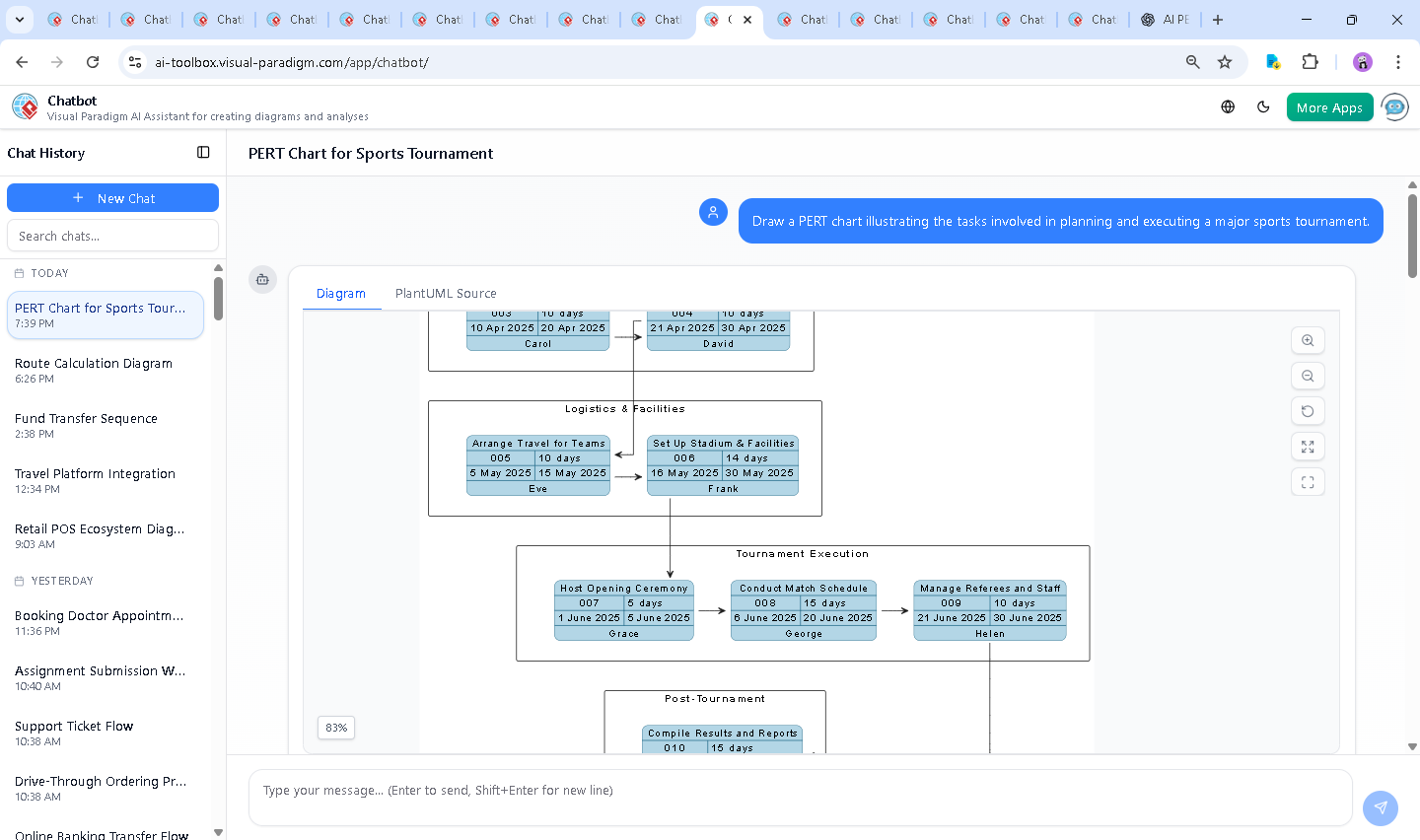
When a user asked to “draw a PERT chart illustrating the tasks involved in planning and executing a major sports tournament,” the AI didn’t just render a static diagram. It engaged in a real-time, iterative conversation — asking clarifying questions, proposing logical sequences, and refining the model based on user feedback. This isn’t automation. It’s intelligent design co-creation.
From Idea to Insight: The Interactive Journey of PERT Chart Creation
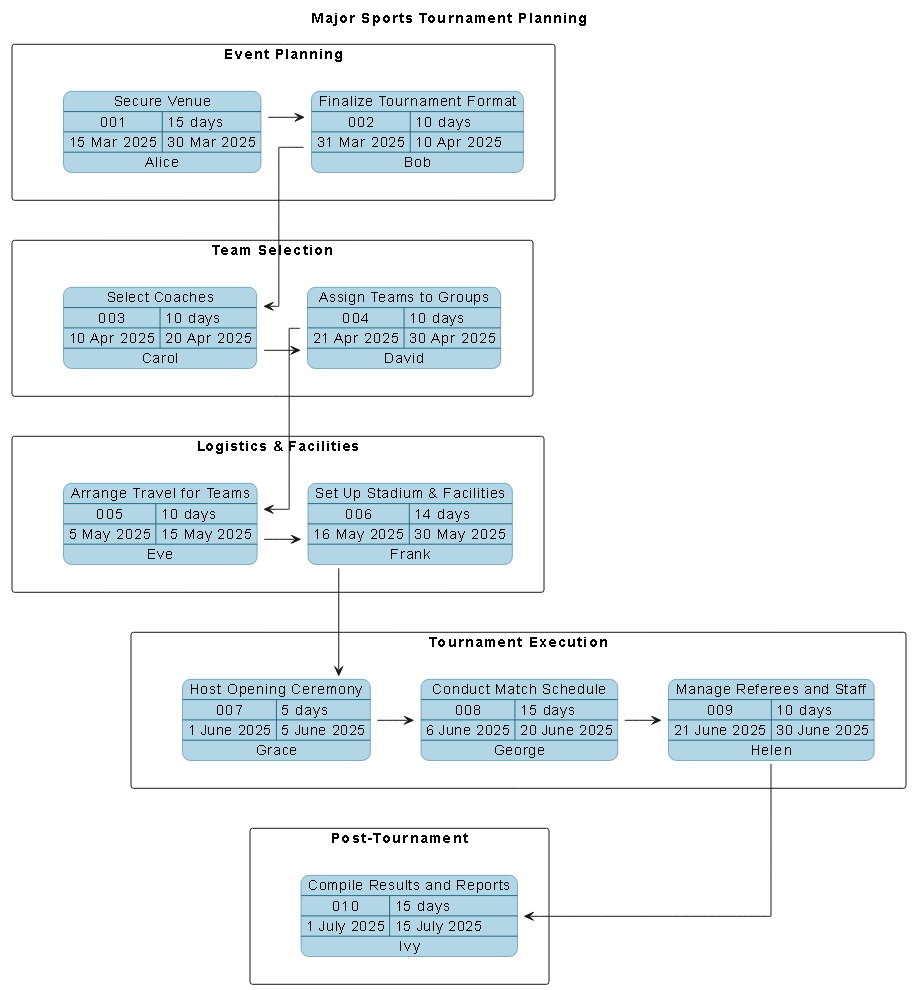
The process began with a simple prompt: “Draw a PERT chart for a sports tournament.” The AI responded with a fully structured PlantUML script that mapped out five core phases: Event Planning, Team Selection, Logistics & Facilities, Tournament Execution, and Post-Tournament.
But the conversation didn’t stop there. The user asked, “Explain this diagram.” In response, the AI delivered a detailed breakdown — not just what each task was, but why it mattered. It clarified dependencies, highlighted the critical path, and explained how each task’s start date was tied to the completion of its predecessor.
When the user requested deeper understanding, the AI didn’t default to generic explanations. Instead, it offered context-specific insights: for example, why “Finalize Tournament Format” couldn’t start before “Secure Venue,” or how delays in “Set Up Stadium & Facilities” would ripple through the entire schedule.
Each follow-up — “Explain this branch,” “Refine the logic,” “Add milestones” — was met with a precise, context-aware response. This back-and-forth isn’t just a feature; it’s the hallmark of a true AI-powered modeling assistant.
Decoding the Logic: Why This PERT Chart Works
The PERT chart is more than a timeline — it’s a strategic decision-making tool. The AI’s implementation reflects deep project management principles:
- Phased Structure: Tasks are grouped into logical lanes — from venue selection to post-event reporting — ensuring clarity and ownership.
- Time-Driven Logic: Each task includes start date, finish date, and duration, enabling accurate forecasting. For instance, “Secure Venue” (15 Mar – 30 Mar 2025) sets the foundation for all subsequent tasks.
- Dependency Mapping: The AI used
$dependency()to link tasks in a strict sequence: no task starts until its predecessor finishes. This prevents timeline clashes and ensures flow. - Responsible Assignments: Every task is assigned to a person (Alice, Bob, Eve, etc.), supporting accountability and delegation.
- Clear Critical Path: The AI identified the longest chain of dependent tasks — from venue to reports — which defines the project’s minimum completion time. Any delay here directly impacts the final deadline.
By using PlantUML’s pert-chart.puml library, the AI ensured compatibility with standard project management tools. The result is not just a visual diagram but a living document that can be exported, shared, or integrated into project tracking systems.
The AI Chatbot in Action: Conversational Intelligence at Work
What makes this process truly transformative is the AI’s ability to evolve with the user’s needs. After the initial diagram was generated, the user asked for an explanation. The AI didn’t just list tasks — it contextualized them, explaining the cause-and-effect logic behind each dependency.
For example, the AI clarified that “Assign Teams to Groups” cannot begin until “Select Coaches” is complete — because team composition depends on coaching staff. Similarly, “Arrange Travel” is contingent on team assignments, and “Set Up Stadium” must be finished before the opening ceremony.
This level of reasoning isn’t pre-programmed. It’s the result of the AI’s deep understanding of project workflows and its ability to simulate expert judgment in real time.
When the user later requested refinements — such as adding milestones or risk analysis — the AI was ready to adapt, demonstrating its role as a dynamic modeling partner, not a static tool.
More Than Just PERT: A Full-Spectrum Modeling Platform
While this example focused on a PERT chart, the Visual Paradigm AI Chatbot is built to support a wide range of modeling standards — making it a complete solution for IT and enterprise architects:
- UML: For software design, system behavior, and component modeling.
- ArchiMate: For enterprise architecture, mapping business, application, and technology layers.
- SysML: For systems engineering, requirements modeling, and behavior analysis.
- C4 Model: For software architecture visualization at different abstraction levels.
- Mind Maps, SWOT, PEST, Org Charts, and more: For strategic planning, stakeholder analysis, and organizational design.
Whether you’re designing a new software system, aligning business strategy with IT, or managing a global event, the AI Chatbot adapts to your domain — offering consistent, accurate, and collaborative modeling support across standards.
Turning Vision into Execution
Planning a major sports tournament isn’t just about scheduling matches. It’s about managing risk, ensuring accountability, and maintaining momentum across dozens of interdependent tasks. The PERT chart generated by the Visual Paradigm AI Chatbot delivers more than a timeline — it delivers clarity, control, and confidence.
With its ability to transform natural language into structured, executable models — and to refine them through intelligent conversation — Visual Paradigm isn’t just a diagramming tool. It’s an AI-powered visual modeling platform that works alongside you, from idea to execution.
Ready to bring your next project to life? Explore the full interactive session and see how the AI Chatbot can help you model any project — no coding, no complexity, just clarity.