


Designing 5G’s Future: A Conversational Approach to Latency and Reliability Requirements
Designing a 5G mobile network demands precision—especially when it comes to defining the stringent requirements for latency, reliability, and coverage. These aren’t just technical benchmarks; they’re foundational to mission-critical applications like autonomous vehicles, remote surgery, and industrial automation. The challenge? Translating complex performance targets into a structured, traceable, and verifiable model—without getting bogged down in diagramming mechanics.
Enter the Visual Paradigm AI Chatbot: not a passive tool, but a collaborative modeling expert. It doesn’t just generate diagrams—it guides, refines, and deepens the design through natural conversation. In this session, we didn’t just create a SysML requirement diagram—we co-developed a living specification, evolving it through real-time feedback and technical insight.
From Prompt to Precision: A Collaborative Modeling Journey
The journey began with a clear directive: “Produce a SysML requirement diagram outlining the latency, reliability, and coverage requirements of a 5G mobile network.” The AI responded instantly, generating a fully structured PlantUML-based SysML requirement diagram with key requirements, use cases, test cases, and traceability links—ready for immediate review.
But the real value emerged in the next phase. When the user asked: “Can you explain how the edge computing support (E-01) impacts the latency requirements in more detail?”, the AI didn’t just restate the definition—it delivered a layered technical explanation, breaking down how edge computing reduces round-trip time, enables sub-10ms response, and supports real-time decision-making in autonomous systems.
This wasn’t a static output. It was a dialogue. The AI didn’t just answer—it contextualized. It highlighted how E-01 is not just a standalone feature, but a technical enabler of L-01, using traceability links like deriveReqt and refine to show dependency and influence. This level of reasoning transforms the diagram from a static artifact into a dynamic, explainable model.
Further refinement came when the user requested a deeper look at the traceability between coverage (C-01) and network resilience (N-01). The AI clarified how resilience mechanisms are required to maintain coverage during faults, reinforcing the need for redundancy and automated failover—ensuring that the network doesn’t just meet coverage targets, but sustains them under stress.
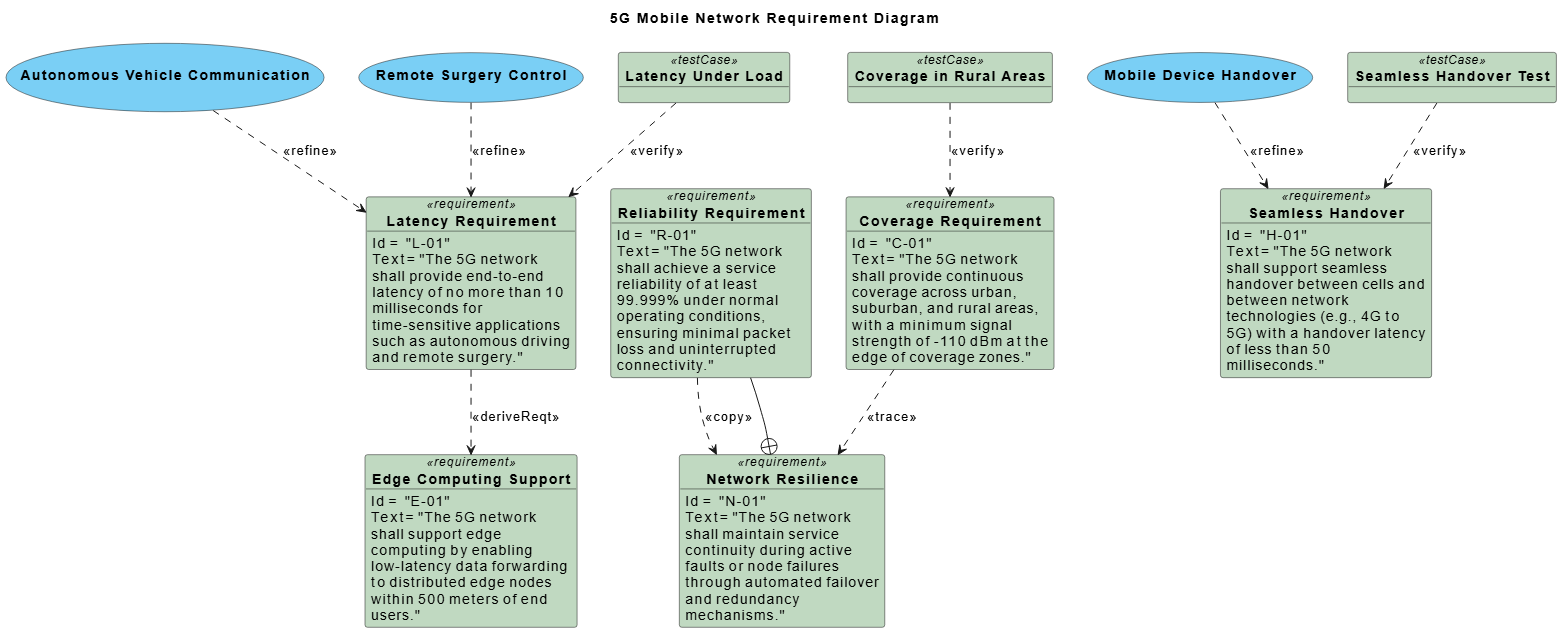
Decoding the Logic: Why This Diagram Works
The SysML requirement diagram isn’t just a visual—it’s a structured representation of system intent, verification, and traceability. Let’s break down the key elements and their strategic choices:
Core Requirements
- L-01 (Latency): “End-to-end latency ≤10ms”—critical for real-time applications. The diagram positions this as a top-level requirement, linked to use cases like autonomous driving and remote surgery.
- R-01 (Reliability): 99.999% uptime. This is not just a number—it implies near-zero packet loss and continuous service, essential for safety-critical systems.
- C-01 (Coverage): -110 dBm signal strength at edge zones. This ensures reliable connectivity even in remote or densely populated areas.
- E-01 (Edge Computing): Enables low-latency processing within 500m of users. This is a system-level capability that directly enables L-01.
- H-01 (Seamless Handover): <50ms handover between cells and 4G/5G. Vital for uninterrupted mobility.
- N-01 (Network Resilience): Automatic failover during faults. Ensures continuity when components fail.
Traceability and Dependency Logic
What makes this diagram powerful is the semantic structure beneath the visuals:
deriveReqt(req01, req04): Latency (L-01) is derived from edge computing (E-01). This means E-01 is a foundational capability enabling L-01.refine(useCase01, req01): The use case “Autonomous Vehicle Communication” refines the latency requirement—showing how real-world scenarios shape requirements.verify(testCase01, req01): Test case “Latency Under Load” verifies L-01—ensuring the requirement is testable.containment(req06, req02): Network resilience (N-01) contains reliability (R-01), showing that resilience is a broader system property that includes reliability.trace(req03, req06): Coverage (C-01) is traced to resilience (N-01), emphasizing that maintaining coverage under failure is a resilience goal.
This structure ensures that every requirement is linked to a use case, a test case, and a logical dependency—making the model both verifiable and maintainable.
Conversational Intelligence: The AI as Modeling Consultant
The true strength of the Visual Paradigm AI Chatbot lies in its ability to act as a technical advisor during design. The conversation wasn’t a one-way request-response loop—it was a collaborative modeling session, where each follow-up question deepened the understanding of the system’s architecture.
For example, when asked to explain the impact of E-01 on L-01, the AI didn’t just describe edge computing—it illustrated its role in reducing end-to-end latency by eliminating cloud round trips. It even provided a real-world scenario: autonomous vehicles making split-second decisions based on local processing, not remote servers.
These insights weren’t added after the fact—they were generated in real time, based on the diagram’s structure and the user’s intent. The AI didn’t just create the diagram—it understood it and could explain it at a systems engineering level.
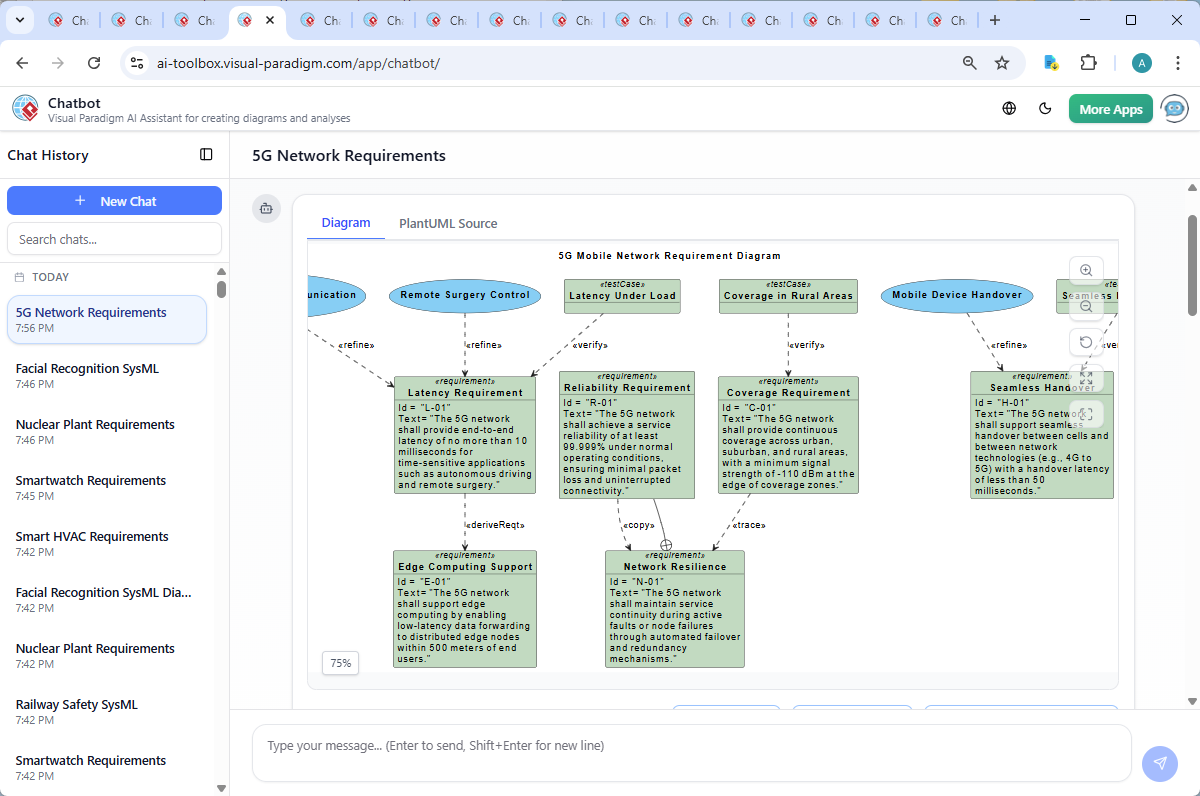
More Than Just a Diagram: A Multi-Standard Modeling Platform
While this example focused on SysML, the Visual Paradigm AI Chatbot is not limited to one standard. It supports a full suite of modeling languages, including:
- UML: For software and system design
- ArchiMate: For enterprise architecture and business-IT alignment
- C4 Model: For software architecture at different abstraction levels
- Mind Maps, Org Charts, SWOT, PEST, PERT Charts, and more: For strategic planning and visual thinking
Whether you’re modeling a 5G network’s technical requirements or designing an enterprise strategy, the AI Chatbot adapts—using natural language to generate, explain, and refine models across domains.
Conclusion: The Future of Requirements Modeling Is Conversational
Creating a 5G network requirement diagram isn’t about drawing boxes and lines. It’s about capturing intent, ensuring traceability, and enabling verification. The Visual Paradigm AI Chatbot turns this process into a dialogue—where every question leads to deeper insight, and every refinement strengthens the model.
With the ability to generate, explain, and evolve models in real time, Visual Paradigm isn’t just a diagramming tool. It’s an AI-powered visual modeling platform that transforms how teams design, validate, and communicate complex systems.
Ready to build your next system with confidence? Explore the full session and see how the AI Chatbot can turn your ideas into precise, traceable, and intelligent models.