


Designing a Scalable E-Commerce System with AI-Powered Requirement Modeling
Building a robust e-commerce platform like Amazon demands more than just coding—it requires precise, traceable, and scalable requirement modeling. The challenge lies in capturing both functional needs (e.g., user login, product search) and non-functional constraints (e.g., performance, security, compliance) in a way that aligns development, testing, and architecture teams.
Enter the Visual Paradigm AI Chatbot—not just a diagram generator, but a collaborative modeling partner. It transforms natural language prompts into structured SysML requirement diagrams, enabling rapid iteration and deep technical insight. With the ability to handle multiple modeling standards—including UML, ArchiMate, SysML, C4, and more—the AI Chatbot acts as a full-stack design consultant, guiding users through complex system design with contextual intelligence.
From Prompt to Precision: The Interactive Journey
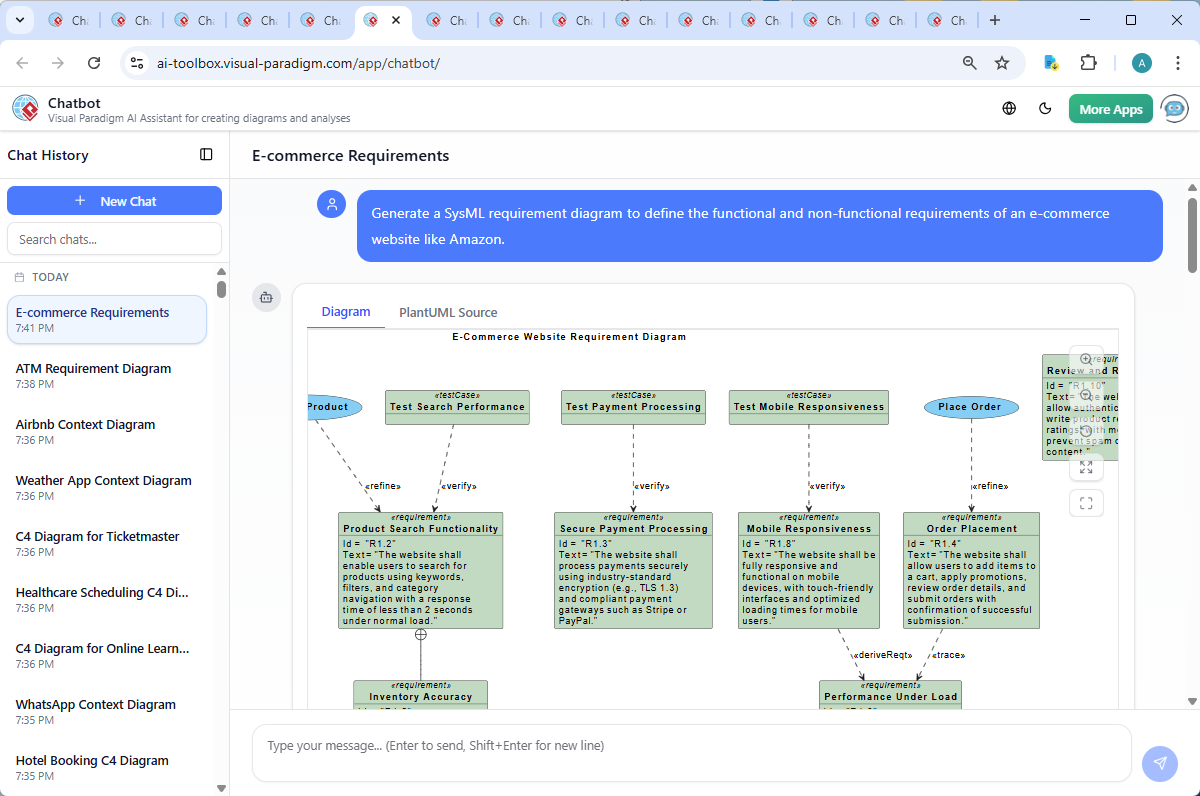
The process began with a simple request: “Generate a SysML requirement diagram to define the functional and non-functional requirements of an e-commerce website like Amazon.” The AI Chatbot responded instantly with a fully rendered PlantUML-based SysML Requirement Diagram, complete with traceability and refinement relationships.
But the real value emerged in the conversation that followed. When asked, “How does the system ensure real-time inventory accuracy during high-traffic periods?”, the AI didn’t just provide a text answer—it expanded the design context with a technical deep dive, explaining:
- Event-driven inventory updates via message queues (Kafka/RabbitMQ)
- Optimistic concurrency control to prevent overselling
- Stale-first caching with TTL for low-latency responses
- Automated reconciliation and monitoring for system integrity
This wasn’t a static diagram—it was a living design conversation. The AI adapted to follow-up requests like “Explain this branch” or “Refine the logic for high-load scenarios”, demonstrating its ability to function as a modeling expert.
Visualizing the E-Commerce Requirements
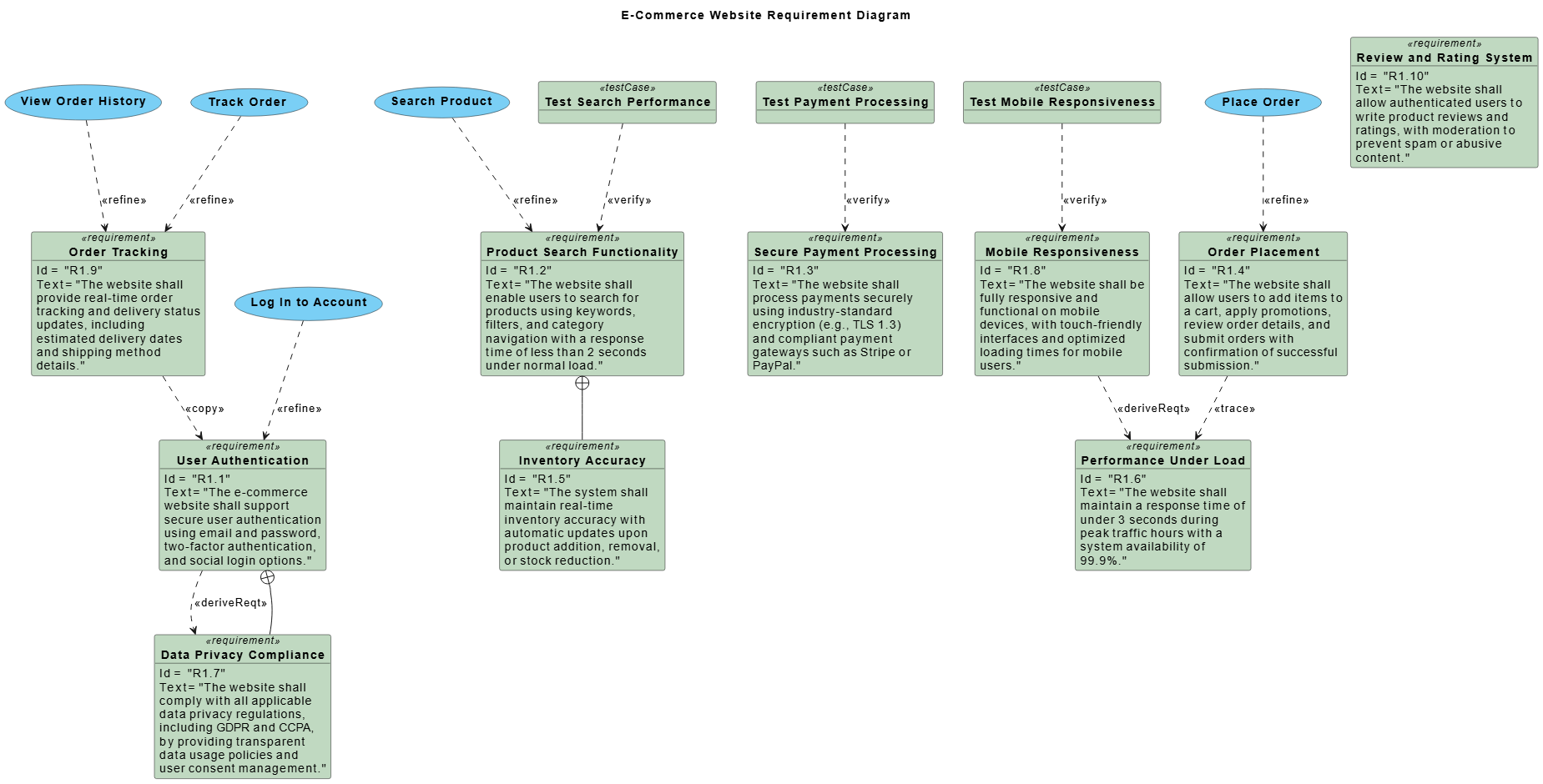
The resulting Requirement Diagram captures 10 core requirements across two categories:
- Functional Requirements: User authentication, product search, order placement, inventory updates, review system.
- Non-Functional Requirements: Performance under load, data privacy compliance, mobile responsiveness, secure payment processing.
Each requirement is linked to real-world use cases and test cases, ensuring full traceability. For example:
$refine(useCase01, req02)connects the Search Product use case to the Product Search Functionality requirement.$verify(testCase01, req03)ensures that the Test Payment Processing test validates the Secure Payment Processing requirement.$deriveReqt(req01, req07)shows that user authentication must comply with data privacy laws.
Decoding the Logic: Why This Diagram Structure Works
The choice of SysML for this requirement diagram is intentional. SysML’s support for requirements modeling allows for:
- Traceability: Every requirement is linked to use cases, test cases, and other requirements, forming a clear audit trail.
- Refinement and Derivation: The diagram uses
$refine,$deriveReqt, and$containmentto show how high-level goals break down into specific behaviors and constraints. - Validation and Verification:
$verifyrelationships ensure that test cases are aligned with requirements, reducing gaps in QA.
For instance, the requirement R1.6: Performance Under Load is not just a standalone statement—it’s linked to $trace(req04, req06), showing that order placement must meet performance thresholds. This ensures that development teams don’t overlook non-functional constraints during implementation.
Conversational Intelligence: The AI Chatbot as Design Consultant
What sets Visual Paradigm apart is the depth of insight the AI provides beyond diagram generation. When the user asked for clarification on inventory accuracy, the AI didn’t stop at a definition—it delivered a full technical architecture explanation, complete with:
- Event-driven workflows
- Concurrency control mechanisms
- Cache invalidation strategies
- Monitoring and alerting systems
This level of contextual understanding turns the AI Chatbot into a modeling consultant, not just a tool. It anticipates follow-up questions and proactively offers deeper diagrams—such as “Would you like a SysML block diagram or sequence diagram to visualize this process?”—demonstrating its versatility across modeling standards.
Beyond SysML: A Unified Modeling Platform
The Visual Paradigm AI Chatbot isn’t limited to SysML. It supports a full spectrum of modeling languages, making it ideal for enterprise architects and development teams working across domains:
- UML: For detailed class, sequence, and activity diagrams.
- ArchiMate: To model business, application, and technology layers in enterprise architecture.
- C4 Model: For contextualizing system architecture at different abstraction levels (Context, Containers, Components, Code).
- Organizational Charts, Mind Maps, PERT Charts, SWOT, PEST: For strategic planning and stakeholder alignment.
This multi-standard support ensures that the same AI assistant can guide users from high-level business vision to detailed technical design—without switching tools.
Conclusion: Design Smarter with AI-Powered Modeling
Creating a requirement diagram for an e-commerce system isn’t just about listing features—it’s about building a shared understanding across teams. The Visual Paradigm AI Chatbot turns this challenge into a dynamic, conversational process, where every question leads to deeper clarity.
By combining precise SysML modeling with intelligent, real-time collaboration, Visual Paradigm delivers an AI-powered visual modeling platform that evolves with your design journey.
Ready to model your next system with AI-driven precision? Start your session now and experience the future of visual modeling.