


Designing Smart Charging: How AI Transforms EV Interoperability and Power Management
Designing a modern electric vehicle (EV) charging station involves more than just hardware—it demands a robust, future-proof system architecture that supports seamless interoperability across global standards and intelligent power management. The challenge lies in capturing complex functional and non-functional requirements with precision, traceability, and scalability.
Enter the Visual Paradigm AI Chatbot, not just a diagram generator but a conversational modeling expert. By engaging in a natural dialogue, users can transform high-level concepts into structured SysML Requirement Diagrams—complete with traceability, validation logic, and real-world applicability.
From Prompt to Precision: An Interactive Design Journey
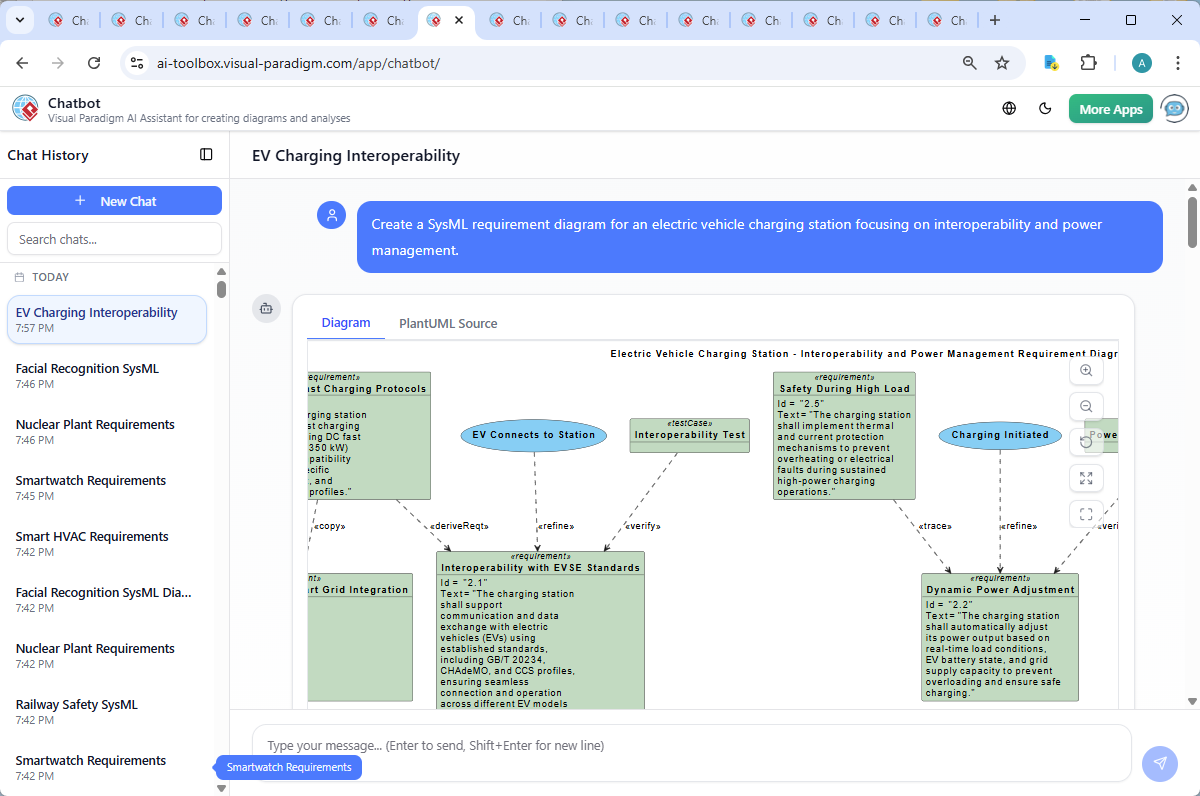
It began with a simple request: “Create a SysML requirement diagram for an electric vehicle charging station focusing on interoperability and power management.” The AI Chatbot responded instantly with a fully rendered PlantUML script, structured for SysML compliance and ready for visualization.
But the conversation didn’t stop there. When the user asked, “Explain this diagram,” the AI didn’t just list elements—it provided a layered breakdown, explaining the purpose of each requirement, use case, and test case, and how they interconnect through formal relationships like $refine, $verify, and $deriveReqt.
Each follow-up query deepened the design. When asked to refine the logic, the AI clarified that req06 (Fast Charging) is not just a standalone feature—it’s a derivation of the broader req01 (Interoperability), ensuring that high-speed charging doesn’t compromise compatibility. Another request—“Explain this branch”—led to a detailed explanation of how req07 (Smart Grid Integration) is contained within req04 (Remote Monitoring), highlighting the layered nature of system capabilities.
This wasn’t a one-way output. It was a collaborative modeling session—where the AI acted as a technical advisor, refining structure, validating relationships, and anticipating real-world deployment challenges.

Decoding the Logic: Why This Diagram Works
The generated SysML Requirement Diagram is built on a foundation of systems engineering best practices. Here’s how each element contributes to a resilient, scalable charging station:
✅ Core Requirements: The System’s Foundation
- req01: Interoperability with EVSE Standards – Ensures compatibility with GB/T 20234, CHAdeMO, and CCS, enabling universal EV access.
- req02: Dynamic Power Adjustment – Uses real-time data to modulate output, preventing grid overloads and optimizing charging speed.
- req03: Power Management During Grid Outages – Maintains service for up to 30 minutes using backup power, critical for commercial reliability.
- req04: Remote Monitoring and Control – Empowers operators and third-party platforms to track usage and manage fleets securely.
- req05: Safety During High Load – Implements thermal and current protection to prevent failures during sustained high-power operations.
- req06: Support for Fast Charging Protocols – Enables DC fast charging up to 350 kW, meeting demand in urban and highway settings.
- req07: Interoperability with Smart Grid Integration – Allows participation in demand response, load balancing, and renewable energy utilization.
🔍 Relationships: The Intelligence Behind the Structure
What makes this diagram more than a list is the traceability network:
$refine(useCase01, req01)– The act of an EV connecting to the station is a concrete manifestation of interoperability.$verify(testCase01, req01)– The interoperability test is designed to validate this core requirement.$deriveReqt(req06, req01)– Fast charging is a specialized form of interoperability, not a separate capability.$containment(req07, req04)– Smart grid integration is enabled through remote monitoring, showing dependency.$trace(req05, req02)– Safety mechanisms are directly linked to power management, emphasizing holistic design.
These relationships aren’t decorative—they’re essential for compliance, testing, and system validation, especially in regulated industries like energy and transportation.
Conversational Intelligence in Action
What sets the Visual Paradigm AI Chatbot apart is its ability to think like a systems engineer. When the user asked for clarification, the AI didn’t default to generic definitions—it provided context-aware insights, such as:
- Why
req06is a derivative ofreq01(because fast charging must still comply with existing standards). - How
req07extendsreq04—remote monitoring isn’t just about status, but enabling grid-level coordination. - Why
req05is linked toreq02—safety is not isolated; it’s a direct consequence of dynamic power control.
This depth of understanding turns the AI into a modeling consultant, guiding users through trade-offs, dependencies, and best practices—without requiring deep SysML expertise.
Beyond SysML: A Full Modeling Ecosystem
The Visual Paradigm AI Chatbot isn’t limited to SysML. It’s a multi-standard AI-powered visual modeling platform that supports:
- UML – For software design and system behavior modeling.
- ArchiMate – For enterprise architecture, defining business, application, and technology layers.
- C4 Model – For clear, scalable system context and container diagrams.
- Mind Maps, Org Charts, PEST, SWOT, and Charts – For strategic planning, stakeholder analysis, and data visualization.
Whether you’re designing a smart grid integration strategy, mapping stakeholder roles, or visualizing energy consumption trends, the AI Chatbot adapts to your standard of choice—delivering consistent, accurate, and collaborative modeling.
Conclusion: Where AI Meets Engineering Excellence
Creating a high-fidelity Requirement Diagram for an EV charging station isn’t just about drawing boxes and lines. It’s about capturing the complexity of interoperability, safety, and sustainability in a way that’s traceable, testable, and aligned with real-world constraints.
The Visual Paradigm AI Chatbot delivers this through a conversational, intelligent workflow—where every prompt is met with expert-level modeling, and every clarification strengthens the design.
Ready to design your next system with confidence? Try the AI Chatbot today and experience the future of visual modeling.
Explore the full session: View the EV Charging Interoperability Session