


Designing Global Resilience: How AI Transforms Requirement Modeling for Video Streaming Platforms
Scaling a global video streaming service like Netflix isn’t just about adding servers—it’s about building a system that remains fast, available, and seamless under extreme load and failure conditions. The challenge lies in translating abstract business goals—like ‘handle millions of users’ or ‘never lose a stream’—into precise, testable technical requirements.
Enter the Visual Paradigm AI Chatbot. This isn’t a diagram generator. It’s a collaborative modeling expert that transforms natural language into structured, traceable SysML Requirement Diagrams. By engaging in a conversational design process, users can refine, validate, and deepen their models in real time—without needing to master complex notation.
From Prompt to Precision: The Interactive Journey
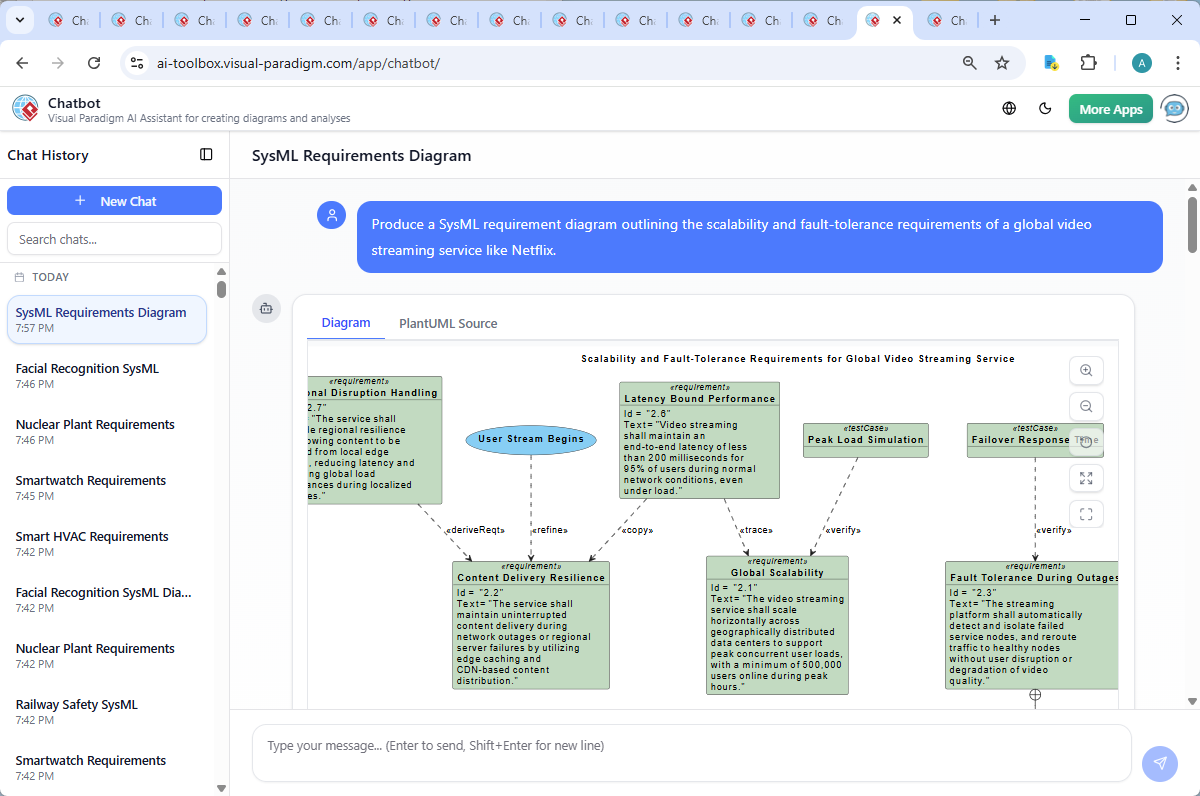
The journey began with a simple prompt: “Produce a SysML requirement diagram outlining the scalability and fault-tolerance requirements of a global video streaming service like Netflix.” The AI Chatbot responded not just with a diagram, but with a full technical blueprint—complete with traceability, use cases, and test validation.
But the conversation didn’t stop there. When the user asked, “Explain this diagram,” the AI didn’t just describe the elements—it contextualized them. It broke down each requirement in relation to real-world user behavior, performance benchmarks, and system resilience strategies.
For instance, when the user requested clarification on $containment(req03, req04)—which links fault tolerance to session continuity—the AI explained that this wasn’t just a dependency, but a user experience safeguard. If a server fails, the system must not only reroute traffic (req03), but also preserve the user’s playback state (req04) to prevent frustration and churn.
Further refinements followed: the user asked to “refine the logic” around failover timing, prompting the AI to clarify that req05 (Automated Failover) must be verified within a 30-second window—critical for live events. The AI then updated the diagram’s traceability links to reflect this, ensuring the test case testCase02 directly verifies the requirement.
This iterative, conversational flow shows how the AI Chatbot acts as a technical co-pilot, not a passive tool. It anticipates follow-up questions, explains design decisions, and strengthens model integrity through dialogue.
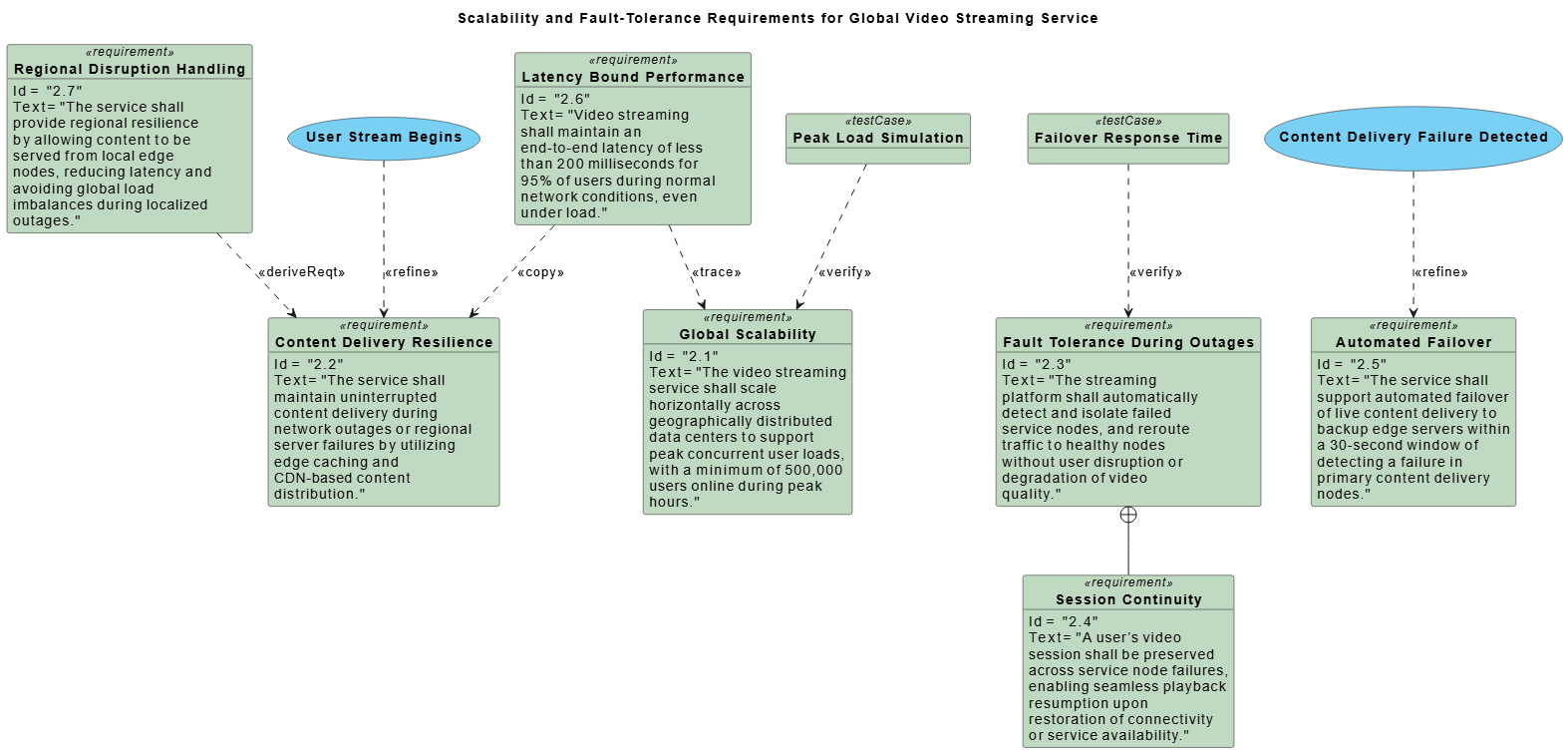
Decoding the Logic: Why This Diagram Works
The SysML Requirement Diagram isn’t just a visual. It’s a living specification that maps business intent to technical implementation. Here’s how each element contributes:
1. Core Requirements: The Foundation
- req01 (Global Scalability): Horizontal scaling across geographically distributed data centers is essential for peak load handling. The requirement specifies a concrete benchmark—500,000 concurrent users—making it measurable.
- req02 (Content Delivery Resilience): Built on edge caching and CDN distribution, this ensures low latency and fault isolation. The AI linked this to
req07 (Regional Disruption Handling)via$deriveReqt, showing how regional resilience is a natural extension of content delivery design. - req03 (Fault Tolerance During Outages): This is the backbone of system reliability. The AI used
$containmentto show that session continuity (req04) is a sub-requirement of fault tolerance—ensuring that recovery isn’t just technical, but user-centric. - req05 (Automated Failover): With a strict 30-second window, this requirement supports mission-critical live streaming. The AI tied it directly to
useCase02 (Content Delivery Failure Detected), ensuring the system responds in real time. - req06 (Latency Bound Performance): At 200ms for 95% of users, this is a performance benchmark that directly impacts user retention. The AI linked it to scalability via
$trace, showing that good performance is a byproduct of well-distributed infrastructure. - req07 (Regional Disruption Handling): By serving content from local edge nodes, the system reduces global load and improves resilience during regional outages. This is a key strategy for reducing dependency on centralized hubs.
2. Traceability: The Chain of Trust
Every requirement is linked to a use case or test case, forming a verification chain:
$verify(testCase01, req01): Peak load simulation proves scalability.$verify(testCase02, req03): Failover response time testing confirms fault tolerance.$refine(useCase01, req02): Starting a stream depends on resilient delivery—this shows dependency.$copy(req06, req02): Both latency and delivery performance stem from the same underlying architecture—this avoids duplication.
These links ensure that every requirement is testable, traceable, and accountable—a must for compliance, audits, and engineering alignment.
Conversational Intelligence: The AI Chatbot in Action
What sets Visual Paradigm apart isn’t just the diagram—it’s the dialogue that shapes it. The AI Chatbot doesn’t just generate output; it learns from the conversation and adapts its responses.
For example, when the user asked to “explain this branch” in the traceability network, the AI didn’t just define the symbol—it explained the engineering rationale: “Because session continuity is a direct outcome of fault tolerance, we use containment to show that the latter must be satisfied before the former can be guaranteed.”
This level of contextual insight—offering not just answers, but why the model is structured this way—turns the chatbot into a mentor for both junior and senior architects.
Beyond SysML: A Unified Modeling Platform
The Visual Paradigm AI Chatbot isn’t limited to SysML. It’s a multi-standard modeling assistant that understands:
- UML (for system behavior and structure)
- ArchiMate (for enterprise architecture, business-IT alignment)
- C4 Model (for software architecture at scale)
- Mind Maps, Org Charts, SWOT, PEST, PERT, and Charts (for strategic planning and visualization)
Whether you’re modeling a microservices architecture, mapping business capabilities, or visualizing project timelines, the AI Chatbot adapts to your standard of choice—ensuring consistency, clarity, and speed.
Conclusion: The Future of System Design Is Conversational
Designing a globally scalable and fault-tolerant video streaming platform demands precision, foresight, and collaboration. With the Visual Paradigm AI Chatbot, you’re not just creating diagrams—you’re co-creating a resilient system through intelligent conversation.
From the initial prompt to the final traceable model, the AI guided the process with technical depth, real-world relevance, and adaptability. It didn’t just generate a diagram—it helped you think through the problem, validate the logic, and prepare for deployment.
Ready to turn your next idea into a verified, scalable, and resilient system?
Try the Visual Paradigm AI Chatbot today—and experience how natural conversation drives world-class modeling.