


Designing a Safe and Intelligent Industrial Robotic Arm: An AI-Powered Requirement Journey
Developing a high-performance industrial robotic arm demands precision not just in mechanics, but in defining what the system must do—especially when safety, control, and performance intersect. The challenge lies in translating complex operational goals into structured, testable, and traceable requirements. This is where the Visual Paradigm AI Chatbot becomes more than a tool—it acts as a collaborative modeling expert.
From Idea to Model: A Conversational Design Journey
The journey began with a simple prompt: “Generate a SysML requirement diagram to define the control, safety, and performance requirements of an industrial robotic arm.” Within seconds, the AI Chatbot delivered a fully formed PlantUML-based SysML Requirement Diagram, complete with precise notation and logical relationships. But the real value emerged not in the initial output, but in the dialogue that followed.
When the user asked, “Can you explain how the collision avoidance requirement is tested in practice?”, the AI didn’t just provide a definition—it launched into a detailed technical explanation covering sensor integration, real-time decision logic, test metrics, and compliance standards. This wasn’t a canned response; it was expert-level insight, grounded in real-world engineering practices.
The conversation continued with targeted follow-ups: “Explain this branch” and “Refine the logic” were used to deepen the diagram’s structure. Each interaction refined the model—adding traceability, containment, and derivation relationships that reflect how requirements evolve in actual development.
Visualizing the Requirements: The Final Diagram
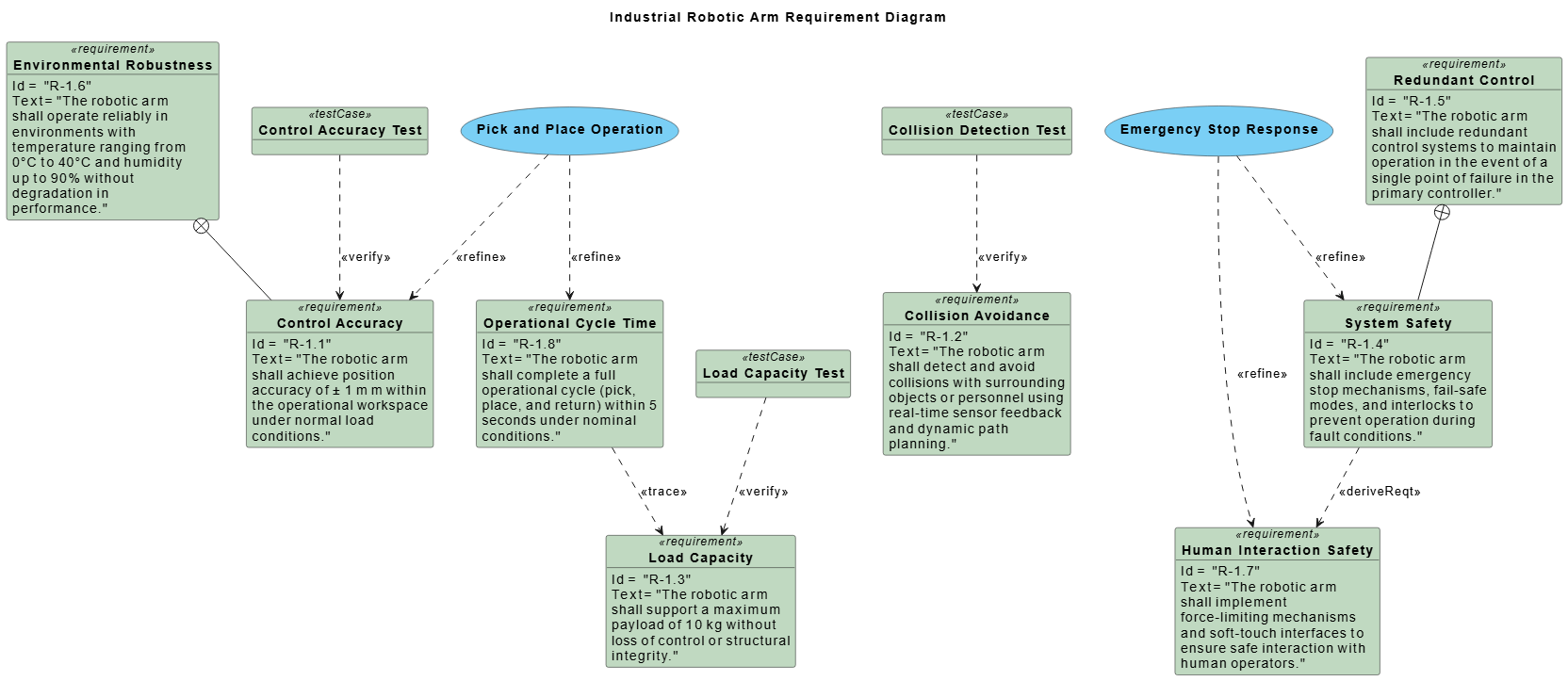
The resulting Requirement Diagram is a comprehensive blueprint of the robotic arm’s functional and safety mandates. It captures:
- Control Accuracy (±1 mm positioning)
- Collision Avoidance via real-time sensor feedback
- Load Capacity (10 kg max)
- Fail-Safe Mechanisms including emergency stops
- Redundant Control Systems for fault tolerance
- Environmental Robustness (0–40°C, 90% humidity)
- Human Interaction Safety with force-limiting and soft-touch interfaces
- Operational Cycle Time (5 seconds per cycle)
Decoding the Logic: Why This Structure Works
The diagram’s power lies in its use of SysML’s formal requirement notation and relationship types:
- $requirement() defines each requirement with a unique ID (e.g., R-1.1), a name, and a clear, measurable statement.
- $useCase() and $testCase() link requirements to real-world behaviors and validation methods.
- $verify() establishes traceability: each test case confirms a specific requirement.
- $refine() shows how use cases refine or expand upon requirements—e.g., the pick and place operation refines both control accuracy and cycle time.
- $deriveReqt() and $containment() model hierarchical and dependency relationships—e.g., safety (R-1.4) is derived from human interaction safety (R-1.7), and redundant control contains safety logic.
- $trace() ensures that performance requirements (e.g., cycle time) are traceable to load capacity, showing how system constraints interlock.
This structure isn’t just visual—it’s a living model that supports verification, validation, and compliance tracking. It transforms abstract goals into a verifiable engineering artifact.
Conversational Intelligence in Action
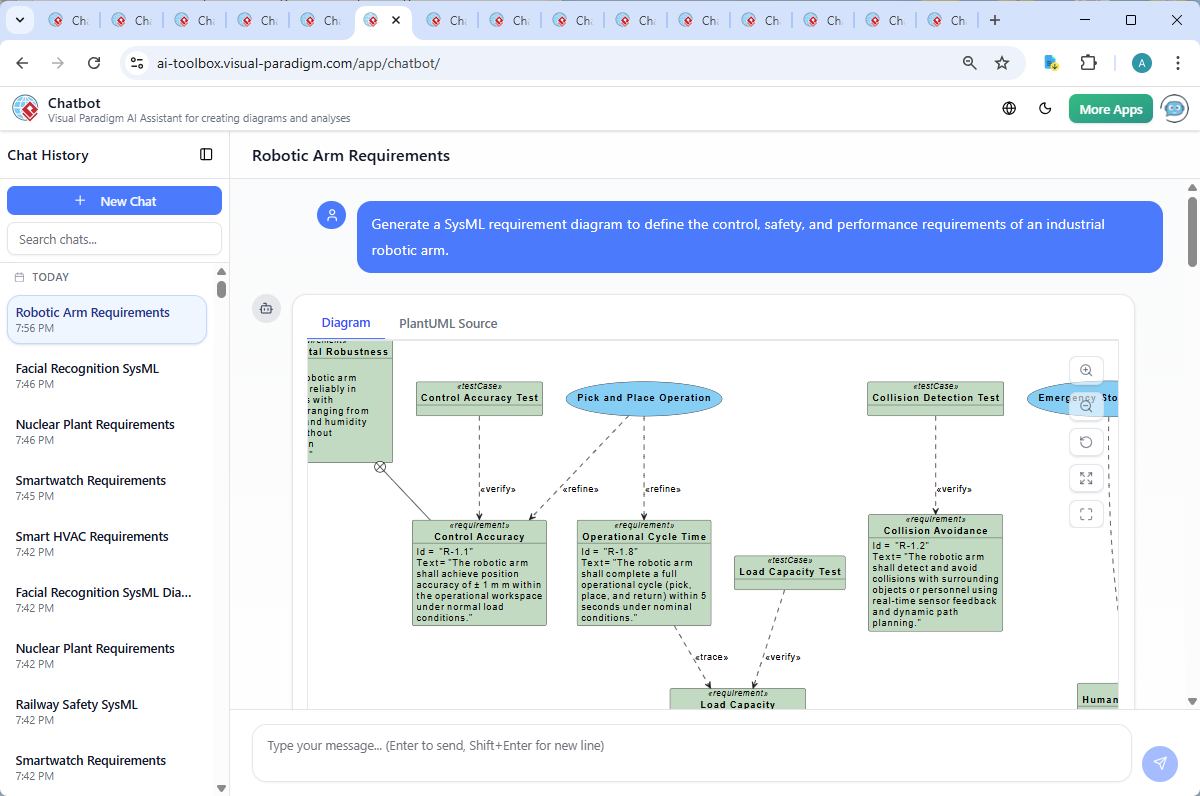
What sets the Visual Paradigm AI Chatbot apart is its ability to engage in a true design dialogue. The chat history reveals a pattern of intelligent back-and-forth:
- The AI didn’t stop at generating a diagram—it anticipated follow-up questions and pre-emptively included testable logic.
- When asked to explain a requirement, it didn’t just restate the text—it provided a full technical validation framework, including real-world test scenarios, sensor types, and performance benchmarks.
- Each refinement request was met with precise updates to the diagram logic, demonstrating deep understanding of SysML semantics and engineering best practices.
This isn’t automation—it’s collaboration. The AI functions as a modeling consultant, guiding the user through trade-offs, dependencies, and compliance considerations in real time.
More Than Just Requirements: A Full Modeling Ecosystem
While this example focuses on SysML Requirement Diagrams, the Visual Paradigm AI Chatbot is built to support a broad spectrum of modeling standards. It seamlessly handles:
- UML for software design and system behavior
- ArchiMate for enterprise architecture and business-IT alignment
- SysML for systems engineering and complex requirement modeling
- C4 Model for software architecture visualization
- Mind Maps, Org Charts, PEST, SWOT, PERT, and more for strategic planning and project management
Whether you’re designing a safety-critical robotic system or mapping out a digital transformation strategy, the AI Chatbot adapts to your modeling language and context—making it the central hub for all visual design work.
Conclusion: The Future of Visual Modeling Is Conversational
The industrial robotic arm control and safety system example shows how the Visual Paradigm AI Chatbot transforms requirement engineering from a static documentation task into an intelligent, interactive design process. With real-time feedback, deep technical insight, and support across multiple modeling standards, it empowers engineers, architects, and product teams to build safer, smarter systems—faster and with greater confidence.
Explore the full diagram and conversation at the shared session: View the Shared Session.
Ready to turn your next idea into a model? Start your conversation with the Visual Paradigm AI Chatbot today.