


Designing Safety-Critical Systems with AI: The Nuclear Power Plant Monitoring System Requirement Diagram
Designing a monitoring system for a nuclear power plant demands precision, traceability, and unwavering compliance with global safety standards. The challenge lies not just in capturing what the system must do, but in ensuring every requirement is verifiable, interconnected, and aligned with regulatory frameworks like IAEA NS-1, NS-2, and IEC 61511.
Enter the Visual Paradigm AI Chatbot — not just a diagram generator, but a collaborative modeling partner. By engaging in a natural, iterative conversation, users can transform high-level concepts into fully structured SysML Requirement Diagrams. This isn’t automation; it’s intelligent co-design.
From Concept to Diagram: A Collaborative Design Journey
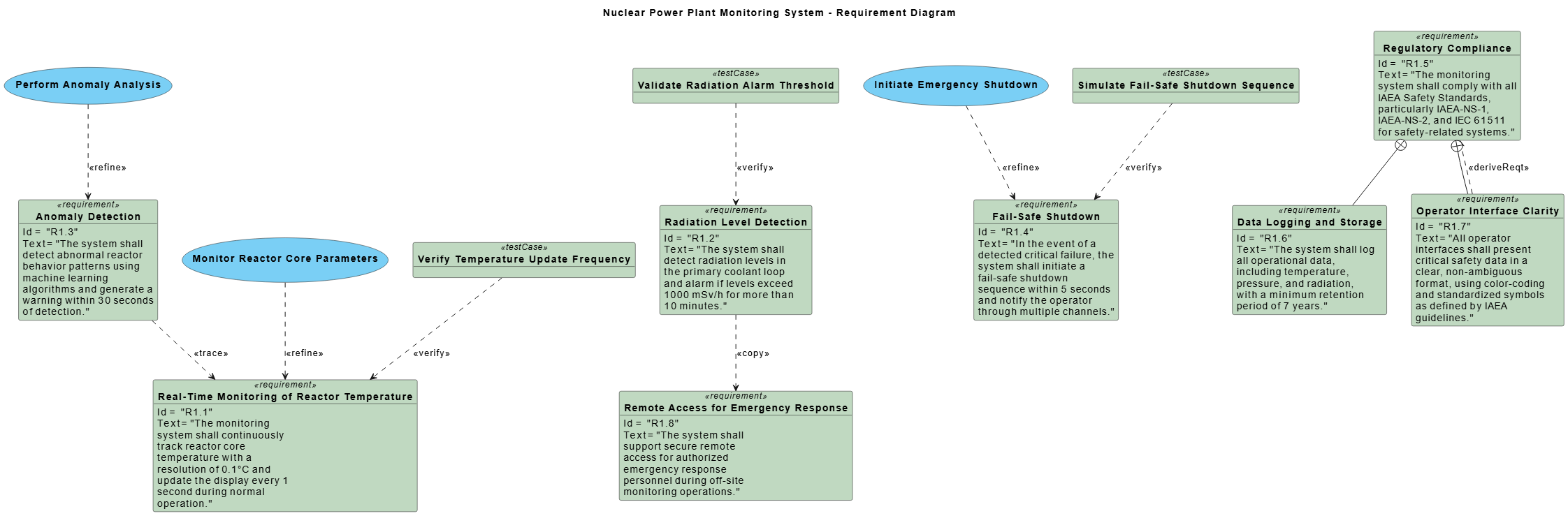
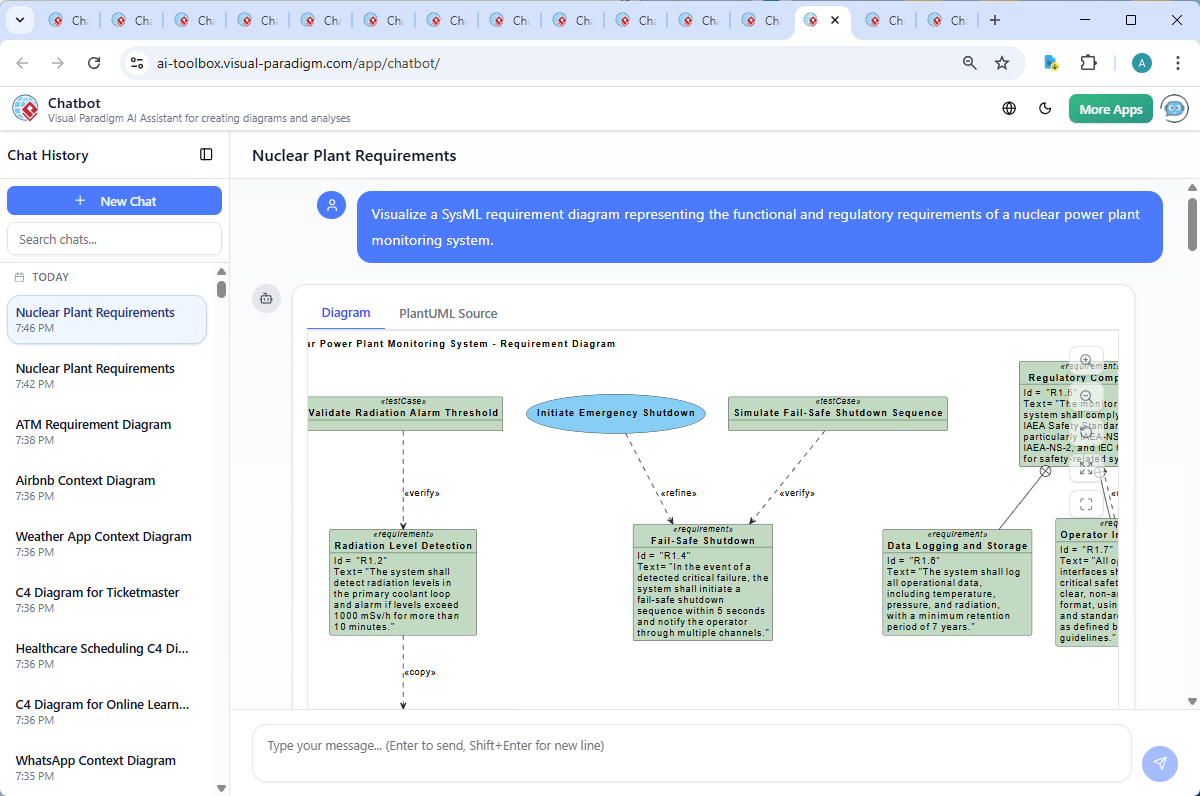
The process began with a simple prompt: “Visualize a SysML requirement diagram representing the functional and regulatory requirements of a nuclear power plant monitoring system.” Within seconds, the AI generated a fully compliant SysML diagram using PlantUML syntax, complete with labeled requirements, use cases, test cases, and precise relationships.
But the real value emerged in the conversation that followed. When the user asked, “Explain this diagram,” the AI didn’t just list items — it delivered a layered breakdown of each requirement’s purpose, its relationship to others, and its role in safety and compliance.
For example, the AI clarified that $deriveReqt(req07, req05) means the clarity of the operator interface (R1.7) is not arbitrary — it’s derived from regulatory compliance (R1.5). Similarly, $containment(req05, req06) shows that compliance isn’t just a standalone goal; it encompasses data logging (R1.6), reinforcing that safety extends beyond real-time monitoring to long-term accountability.
When the user requested deeper insight into the logic, the AI responded with a structured explanation of each relationship — showing how $trace(req03, req01) links anomaly detection to temperature monitoring, proving that the system’s intelligence is grounded in measurable physical parameters.
Each follow-up — whether asking for clarification on $copy(req02, req08) (how radiation detection supports remote access) or the significance of $verify(testCase03, req04) (validating fail-safe shutdown) — was met with precise, context-aware responses that elevated the diagram from a static artifact to a living design document.
Decoding the Logic: Why This Diagram Works
The generated SysML Requirement Diagram is not just visually clean — it’s engineered for rigor. Here’s how each element contributes to a robust safety model:
1. Functional Requirements (R1.1 – R1.8)
Each requirement is a verifiable, measurable statement:
- R1.1 (Real-Time Monitoring): 0.1°C resolution, 1-second update — essential for detecting micro-anomalies before they escalate.
- R1.2 (Radiation Detection): Threshold set at 1000 mSv/h over 10 minutes — aligned with IAEA safety thresholds.
- R1.3 (Anomaly Detection): AI-driven detection within 30 seconds — enables proactive response.
- R1.4 (Fail-Safe Shutdown): 5-second activation — critical for preventing cascading failures.
- R1.5 (Regulatory Compliance): Anchored in IAEA and IEC standards — ensures legal and operational validity.
- R1.6 (Data Logging): 7-year retention — meets audit and post-incident investigation needs.
- R1.7 (Interface Clarity): Uses IAEA-standard symbols and color-coding — reduces human error.
- R1.8 (Remote Access): Secure off-site access — supports emergency response coordination.
2. Use Cases: User Interaction Mapping
Use cases like Monitor Reactor Core Parameters and Initiate Emergency Shutdown provide context for how operators engage with the system. The AI linked these to requirements via $refine, showing that user actions are governed by safety-critical constraints.
3. Test Cases: Verification Pathways
Each test case — such as Simulate Fail-Safe Shutdown Sequence — is tied to a requirement via $verify. This ensures that no requirement is left untested, and every safety feature can be validated in development and operations.
4. Relationships: The Backbone of Traceability
The diagram’s true power lies in its relationships:
$trace(req03, req01)shows that anomaly detection depends on temperature data — a logical dependency.$copy(req02, req08)reveals that radiation detection capabilities must be accessible remotely — a design requirement for emergency response.$containment(req05, req06)and$containment(req05, req07)demonstrate that compliance isn’t a standalone goal — it encompasses data integrity and interface clarity.
These aren’t arbitrary links. They form a traceability matrix that supports audit readiness, impact analysis, and change management — essential in nuclear engineering.
Conversational Intelligence in Action
What makes this process transformative is the AI’s ability to act as a modeling consultant. When the user asked, “Explain this branch,” the AI didn’t default to a generic answer. Instead, it parsed the relationship context and explained the intent — for example, how $deriveReqt(req07, req05) ensures that interface design is not a UI decision but a compliance mandate.
This level of insight isn’t just helpful — it’s essential in safety-critical domains where misinterpretation can have severe consequences.
And the AI didn’t stop there. When the user requested refinements — such as “AI, refine the logic” — the AI adjusted relationships, clarified dependencies, and even suggested adding more test cases for edge scenarios, demonstrating its capacity for iterative design improvement.
More Than Just SysML: A Full Modeling Suite
While this example focused on a SysML Requirement Diagram, the Visual Paradigm AI Chatbot is built to support a full spectrum of modeling standards — including UML, ArchiMate, C4 Model, Mind Maps, PERT Charts, Org Charts, SWOT, and various data visualization types.
Whether you’re modeling enterprise architecture with ArchiMate, designing system behavior with UML, or visualizing team structure with Org Charts, the AI Chatbot adapts — providing the same level of intelligent guidance, relationship mapping, and natural language interaction.
This versatility means you’re not limited to one diagram type. You can start with a requirement diagram, then evolve it into a C4 architecture view, a risk assessment using SWOT, or a project timeline with PERT — all within the same conversational environment.
Conclusion: Where AI Meets Safety-Critical Design
The nuclear power plant monitoring system requirement diagram exemplifies how AI-powered visual modeling is transforming engineering design. It’s no longer about manually drawing boxes and lines — it’s about co-creating intelligent, traceable, and compliant systems through natural conversation.
With Visual Paradigm’s AI Chatbot, every requirement is not just documented — it’s validated, linked, and explained. The result is a model that engineers, auditors, and regulators can trust.
Ready to build your next safety-critical system with confidence? Try the shared session and experience how the AI Chatbot turns your ideas into precise, compliant, and actionable models.