


Designing a Secure and Compliant Online Banking Platform with AI-Powered Requirement Modeling
Building a modern online banking platform demands more than functional features—it requires a rigorous foundation in regulatory compliance, data security, and system availability. The challenge lies in translating complex legal and technical mandates into a clear, traceable, and actionable design. This is where the Visual Paradigm AI Chatbot transforms the process from manual documentation to a dynamic, conversational modeling experience.
Instead of drafting requirements in isolation, users collaborate with the AI to define, refine, and validate system constraints through natural language. The result? A fully traceable SysML Requirement Diagram that captures the full scope of regulatory, security, and availability needs—crafted using the Visual Paradigm AI Chatbot.
From Prompt to Precision: The Interactive Journey of Requirement Modeling
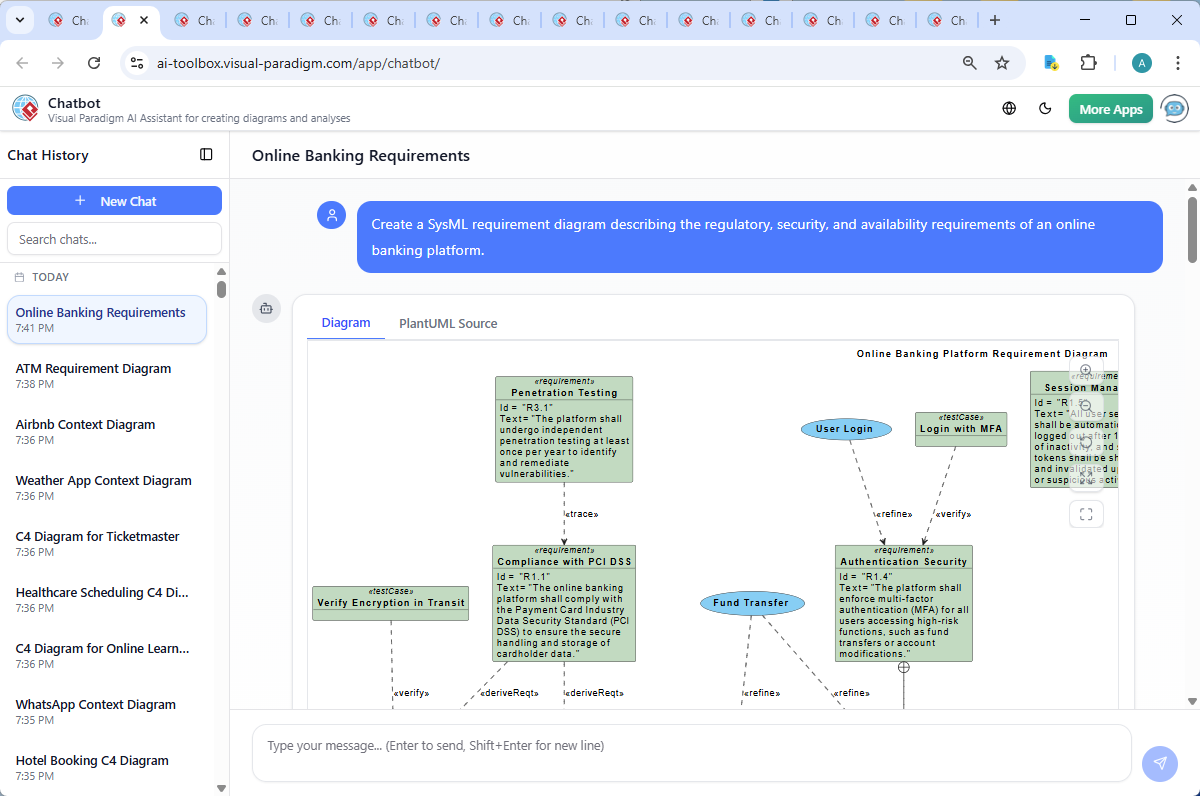
The journey began with a straightforward request: “Create a SysML requirement diagram describing the regulatory, security, and availability requirements of an online banking platform.” The AI Chatbot responded instantly with a fully structured PlantUML representation of the requirement diagram, already incorporating best practices from SysML standards.
But the conversation didn’t stop there. The user asked, “Can you explain how the audit logging requirement (R1.8) is specifically implemented in the system?” This wasn’t just a follow-up—it was a test of the AI’s ability to act as a modeling consultant. The response delivered not only a technical breakdown of the audit logging mechanism but also demonstrated how the requirement is tied to real-world implementation, monitoring, and compliance.
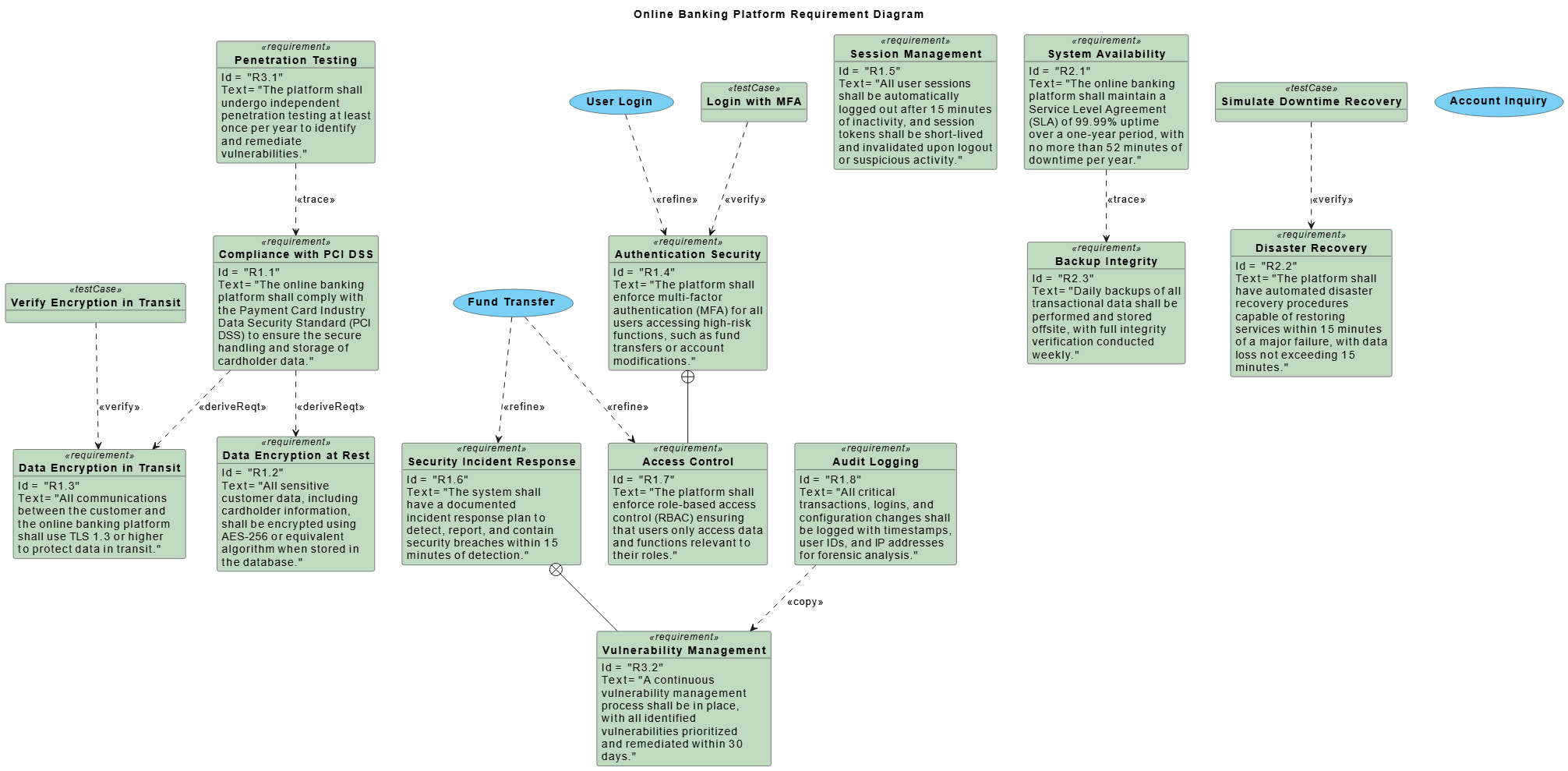
Through iterative refinement, the AI clarified dependencies: “$containment(req06, req13)” shows how the incident response plan (R1.6) is nested within the broader vulnerability management process (R3.2). Another refinement, “$deriveReqt(req01, req02)”, illustrates how PCI DSS compliance (R1.1) logically leads to encryption at rest (R1.2), reinforcing requirement hierarchies.
These interactions reveal the AI Chatbot’s intelligence: it doesn’t just generate diagrams—it understands modeling semantics, enforces traceability, and anticipates the next logical question.
Unpacking the Requirement Diagram: Logic and Design Rationale
The final Requirement Diagram is more than a visual list—it’s a structured, machine-readable model that maps business and technical needs to implementation. Here’s how the logic unfolds:
Regulatory Compliance (R1.x)
Requirements like R1.1 (PCI DSS Compliance) and R1.3 (Encryption in Transit) are foundational. The AI ensures these are not isolated but linked to technical implementations—such as TLS 1.3 enforcement and AES-256 encryption—through traceability and derivation.
Security Controls (R2.x)
Security isn’t just about rules—it’s about behavior. The diagram captures:
- R1.4 (MFA for high-risk actions) tied to use cases like fund transfer.
- R1.5 (Session management) with automatic logout and short-lived tokens.
- R1.7 (RBAC) enforced across all user roles.
Availability & Resilience (R2.x)
High-availability is non-negotiable in banking. The AI models:
- R2.1 (99.99% uptime SLA) with strict annual downtime limits.
- R2.2 (Disaster Recovery) with 15-minute recovery time and ≤15-minute data loss.
- R2.3 (Backup Integrity) with weekly verification.
Verification & Validation (R3.x)
Security isn’t static. The AI includes:
- R3.1 (Penetration Testing) performed annually.
- R3.2 (Vulnerability Management) with 30-day remediation windows.
These are linked to test cases like “Simulate Downtime Recovery” and “Verify Encryption in Transit”, ensuring every requirement is testable and verifiable.
Conversational Intelligence in Action
When the user requested clarification on R1.8 (Audit Logging), the AI didn’t offer a generic answer. Instead, it delivered a detailed implementation blueprint:
- Centralized, encrypted logging using ELK or CloudWatch.
- Structured JSON logs with timestamps, IP addresses, and user IDs.
- RBAC and MFA enforced for log access.
- Real-time anomaly detection and alerting.
- 7-year retention policy aligned with financial regulations.
This level of depth—combined with the ability to generate sample JSON log entries or PlantUML diagrams of the logging component—shows the AI Chatbot acting as a full-stack modeling expert, not just a diagram generator.
Beyond SysML: A Unified Platform for Enterprise Modeling
While this example focuses on SysML Requirement Diagrams, the Visual Paradigm AI Chatbot is not limited to one standard. It seamlessly supports:
- UML for software design and behavior modeling.
- ArchiMate for enterprise architecture and business-IT alignment.
- C4 Model for system context and container-level design.
- Mind Maps, Org Charts, SWOT, PEST, PERT, and data charts for strategic planning and visualization.
Whether you’re designing a secure banking system, mapping an enterprise’s digital transformation, or visualizing a product roadmap, the AI Chatbot adapts to your needs—acting as a consistent, intelligent modeling partner across all domains.
Conclusion: Designing with Confidence, Not Guesswork
The AI-generated Requirement Diagram for the online banking platform isn’t just a visual—it’s a living model of compliance, security, and resilience. Every requirement is traceable, every dependency is explicit, and every implementation detail is documented through conversation.
With the Visual Paradigm AI Chatbot, you’re not just building diagrams—you’re co-designing systems with an expert partner that understands standards, anticipates needs, and evolves with your project.