


Designing a Railway Signaling System with AI-Powered Precision
Creating a safe, reliable, and fault-tolerant railway signaling system demands more than technical expertise—it requires a deep understanding of safety-critical design principles, timing constraints, and fail-safe logic. The challenge lies in translating abstract safety requirements into a structured, verifiable, and traceable model. This is where the Visual Paradigm AI Chatbot steps in—not as a passive tool, but as an intelligent modeling collaborator.
From Concept to Requirement Diagram: A Conversational Design Journey
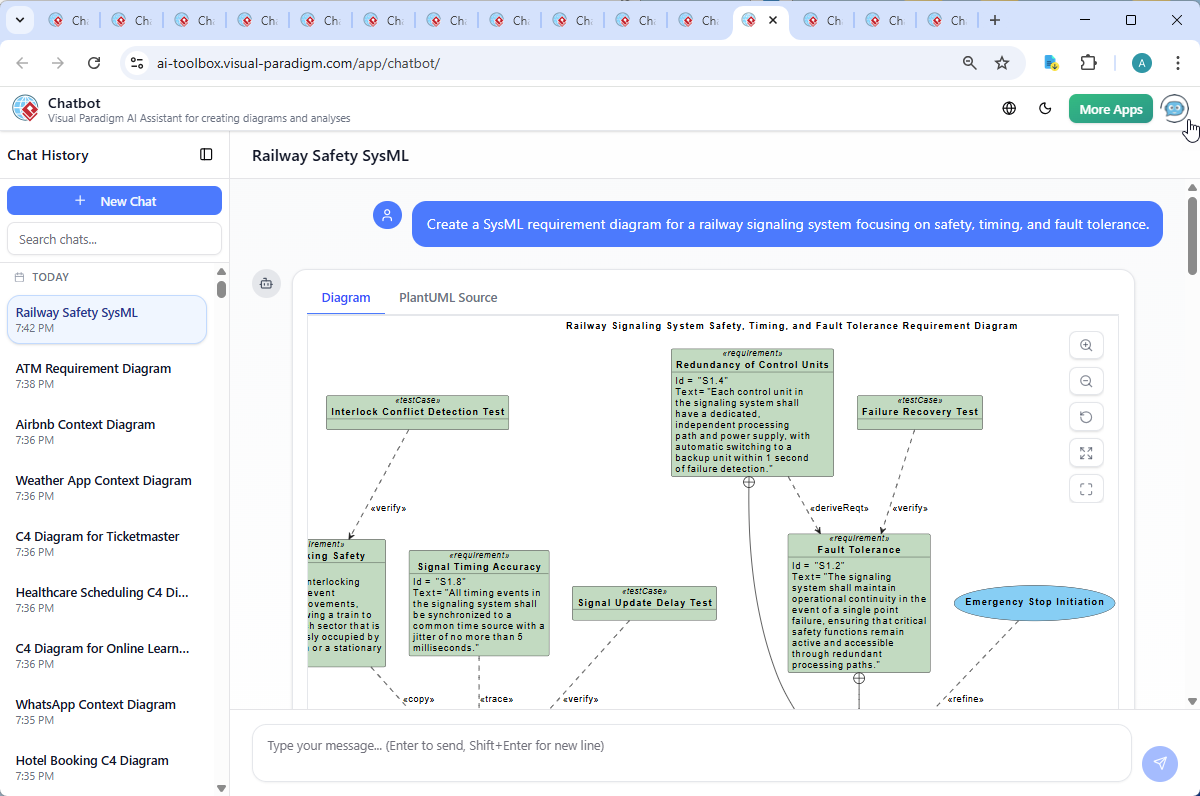
The process began with a simple prompt: “Create a SysML requirement diagram for a railway signaling system focusing on safety, timing, and fault tolerance.” The AI Chatbot immediately interpreted the intent and generated a fully structured SysML requirement diagram using PlantUML syntax, incorporating key safety and timing requirements.
But the real value emerged in the conversation that followed. When asked, “Can you explain how the fail-safe default state is implemented in the signaling system during a power loss?”, the AI didn’t just provide a definition—it delivered a detailed, technically grounded explanation that included:
- Hardware-level power monitoring and emergency power switching
- Software-based fail-safe logic and state transitions
- Integration with redundant power supplies and manual override protocols
- Alignment with international safety standards like EN 50126 and IEC 61508
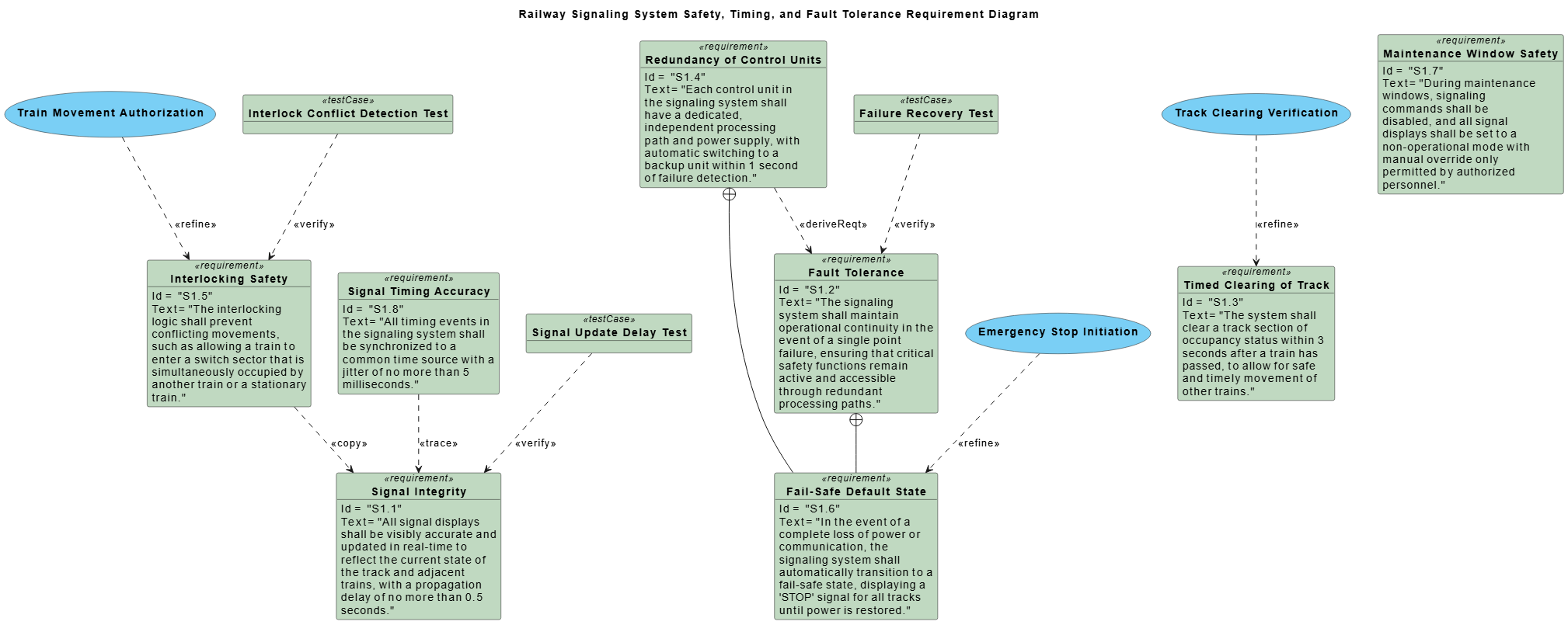
Each response was not just informative—it was a design insight. The AI then used this knowledge to refine the diagram, adding traceability links and containment relationships to reflect real-world system behavior. For instance, it clarified that the “Fail-Safe Default State” (req06) is both a derived requirement and a containment of the broader fault tolerance strategy (req02).
Visualizing Safety: The Core Requirement Diagram
Decoding the Logic: Why This Structure Matters
The generated SysML requirement diagram is not just a visual representation—it’s a living model of system safety. Here’s how each element contributes:
1. Requirement Clusters
- Signal Integrity (req01): Ensures signals update in real time with a maximum delay of 0.5 seconds. This is critical for preventing train collisions due to outdated information.
- Fault Tolerance (req02): Mandates that the system remains operational after a single point failure, enforced through redundant processing paths.
- Timed Clearing of Track (req03): Limits the time to clear a track section to 3 seconds after train passage—ensuring timely availability for subsequent trains.
- Redundancy of Control Units (req04): Requires dedicated, independent paths and automatic failover within 1 second—directly supporting req02.
- Interlocking Safety (req05): Prevents conflicting movements—such as allowing a train into a track already occupied—by enforcing logical constraints.
- Fail-Safe Default State (req06): Triggers a system-wide “STOP” state during power loss, ensuring no train proceeds into an unknown or unsafe condition.
- Maintenance Window Safety (req07): Disables automatic signaling during maintenance, allowing only manual override by authorized personnel.
- Signal Timing Accuracy (req08): Enforces synchronization across the system with a jitter of ≤5ms—critical for coordinated timing across distributed nodes.
2. Traceability and Validation
The diagram uses SysML’s $verify and $trace constructs to link test cases to requirements. For example:
$verify(testCase01, req01): The Signal Update Delay Test validates the 0.5-second propagation delay.$trace(req08, req01): The timing accuracy requirement (req08) supports the signal integrity requirement (req01).$refine(useCase01, req05): The “Train Movement Authorization” use case is refined by the interlocking safety requirement.
3. Hierarchical Relationships
Through $containment and $deriveReqt, the AI establishes logical dependencies:
$containment(req04, req06): Redundancy (req04) is a means to achieve the fail-safe state (req06).$deriveReqt(req04, req02): Redundancy is a specific implementation of fault tolerance.
These relationships ensure that the model is not just a list of requirements—it’s a coherent, traceable, and maintainable system architecture.
Conversational Intelligence: How the AI Deepened the Design
What sets the Visual Paradigm AI Chatbot apart is its ability to engage in a continuous design dialogue. The user’s follow-up question about the fail-safe mechanism wasn’t just answered—it was used to refine the model. The AI didn’t stop at explanation; it demonstrated how that knowledge could be encoded into the diagram through:
- Explicit traceability from safety requirements to implementation logic
- Use of containment to show that fail-safe behavior is a systemic outcome of redundancy
- Linking operational use cases (e.g., emergency stop) to their underlying safety requirements
This iterative refinement process mirrors how real-world system architects work—iterating between design, validation, and safety analysis.
Beyond SysML: A Unified Modeling Platform
The Visual Paradigm AI Chatbot isn’t limited to SysML. It supports a full suite of modeling standards, including:
- UML: For software and system design
- ArchiMate: For enterprise architecture and business-IT alignment
- C4 Model: For clear, scalable software architecture visualization
- Organizational Charts, Mind Maps, SWOT, PEST, and Data Charts: For strategic planning and business modeling
Whether you’re modeling a railway signaling system, a cloud migration strategy, or a digital transformation roadmap, the AI Chatbot adapts to your domain, delivering accurate, standards-compliant diagrams in natural language.
Conclusion: A Smarter Way to Model Safety-Critical Systems
Designing a railway signaling system demands precision, foresight, and compliance. The Visual Paradigm AI Chatbot transforms this challenge into a collaborative design journey—where every question leads to deeper insight, and every refinement strengthens the model.
By combining AI-powered intelligence with industry-standard modeling, Visual Paradigm empowers engineers, architects, and designers to build safer, more reliable systems—faster, smarter, and with full traceability.
Ready to model your next safety-critical system? Try the shared session and experience how the AI Chatbot turns your ideas into precise, validated models.