


Designing Mission-Critical Resilience: How AI Shapes Satellite Communication Requirements
Designing a satellite communication system demands precision, foresight, and rigorous adherence to operational and reliability standards. The challenge lies not only in defining what the system must do—but in ensuring it can withstand failures, environmental extremes, and long-term degradation. This is where the Visual Paradigm AI Chatbot transforms abstract vision into structured, verifiable design.
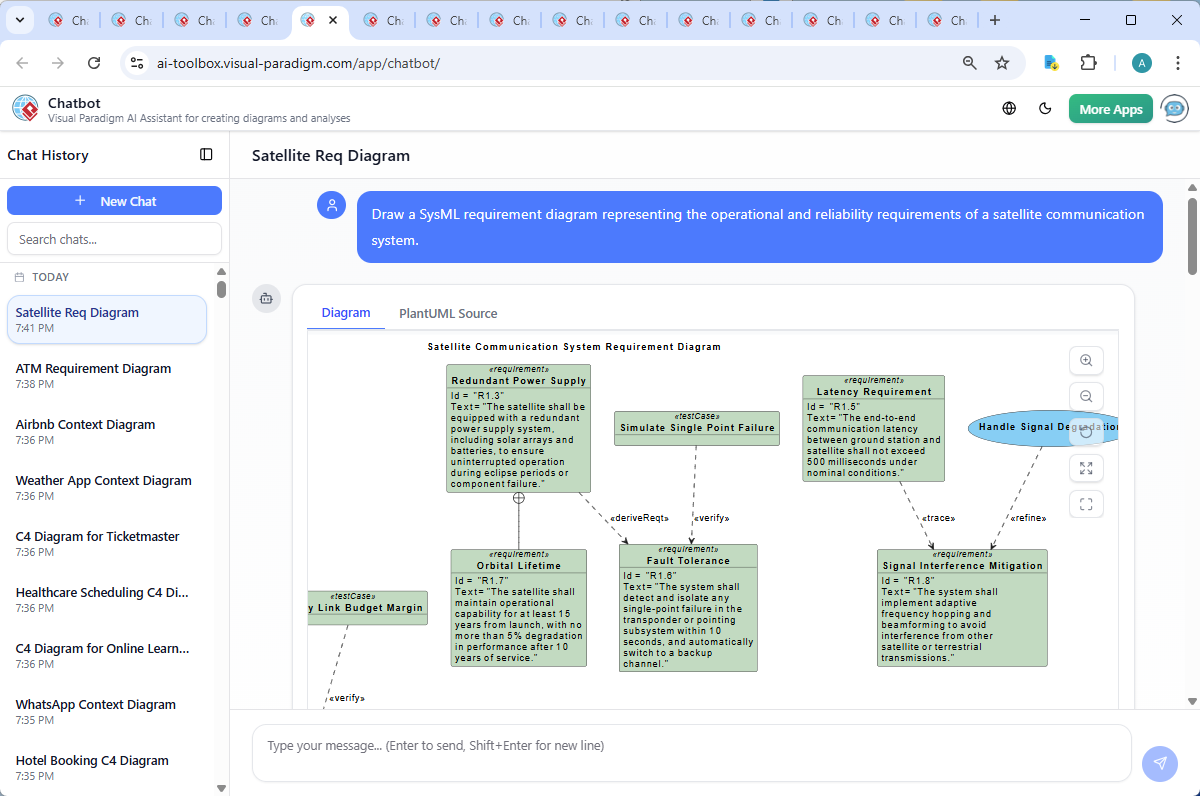
Instead of starting from scratch with manual diagramming, the user began with a clear directive: “Draw a SysML requirement diagram representing the operational and reliability requirements of a satellite communication system.” Within seconds, the AI Chatbot responded with a fully rendered SysML Requirement Diagram—crafted using the Visual Paradigm AI Chatbot, powered by deep modeling intelligence and real-time collaboration.
From Prompt to Precision: The Interactive Design Journey
The conversation didn’t end at diagram generation. It evolved into a collaborative design review, where the AI acted not as a tool, but as a modeling consultant.
After the initial diagram was delivered, the user asked: “How does the fault tolerance requirement (R1.6) impact the design of the satellite’s transponder and pointing subsystems?” This wasn’t a request for a new diagram—it was a call for deeper technical insight. The AI responded with a structured, multi-layered analysis that mapped the requirement to physical subsystems, design constraints, and operational scenarios.
Each follow-up—such as refining the logic of failure detection or tracing how signal integrity relates to interference mitigation—was handled with contextual awareness. The AI didn’t just answer; it explained the engineering rationale behind each design choice, reinforcing the diagram’s validity and traceability.
This iterative exchange exemplifies the AI Chatbot’s role: it’s not just generating visuals, but guiding the user through the decision-making process, ensuring every requirement is not only documented but logically connected to system behavior and testability.
Decoding the Requirement Diagram: Logic and Structure
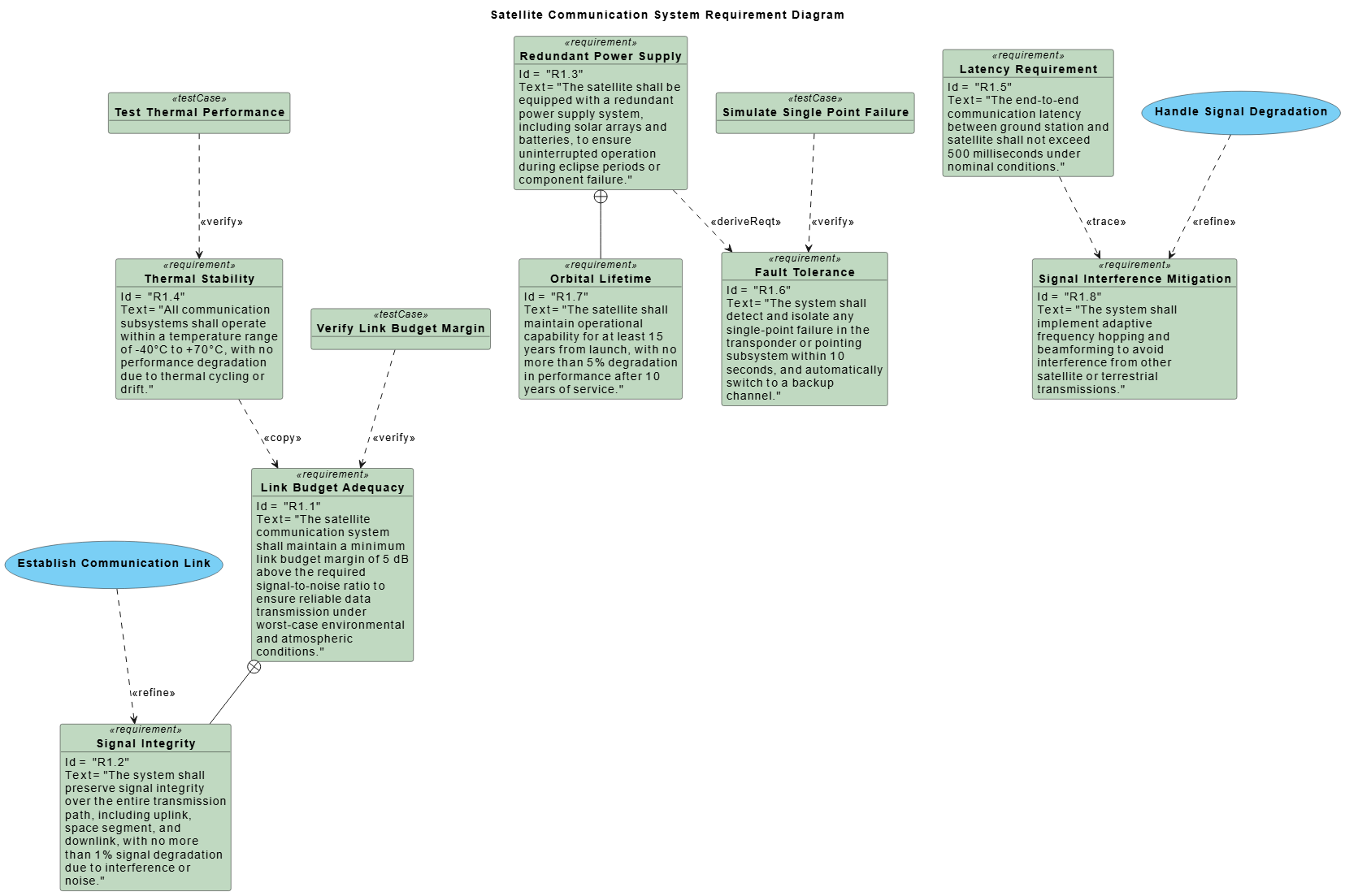
The generated SysML Requirement Diagram is more than a visual aid—it’s a living blueprint of system intent. Here’s how the elements align with best practices in systems engineering:
Core Requirements
- R1.1 – Link Budget Adequacy: Ensures signal strength remains robust under worst-case conditions. This is critical for maintaining link availability during solar storms or atmospheric disturbances.
- R1.2 – Signal Integrity: Limits degradation to 1%, ensuring data fidelity across the full transmission path.
- R1.3 – Redundant Power Supply: Addresses the challenge of eclipse periods and component failure, directly supporting long mission life.
- R1.4 – Thermal Stability: Enforces performance consistency across extreme temperature swings, a key factor in orbital longevity.
- R1.5 – Latency Requirement: Sets a strict 500ms end-to-end ceiling, essential for real-time command and control.
- R1.6 – Fault Tolerance: The cornerstone of reliability—enabling automatic failure detection, isolation, and recovery within 10 seconds.
- R1.7 – Orbital Lifetime: Mandates 15 years of operation with minimal performance decay, aligning with commercial and scientific mission objectives.
- R1.8 – Signal Interference Mitigation: Uses adaptive frequency hopping and beamforming to avoid congestion and interference.
Modeling Logic & Relationships
The diagram leverages SysML’s advanced modeling constructs to ensure traceability and validation:
- $verify: Links test cases to requirements (e.g.,
testCase01verifiesreq01), ensuring every requirement is testable. - $refine: Shows how use cases (e.g.,
Establish Communication Link) refine specific requirements, clarifying intent. - $deriveReqt: Demonstrates that
req03(Redundant Power Supply) is a prerequisite forreq06(Fault Tolerance), establishing dependency. - $containment: Indicates that
req03is contained withinreq07, showing that power redundancy is a design enabler for long-term operation. - $trace: Links
req05(Latency) toreq08(Interference Mitigation), revealing that low latency depends on interference control. - $copy: Reuses
req04(Thermal Stability) in the context ofreq01, highlighting cross-cutting environmental constraints.
This relational structure ensures that the system’s requirements are not isolated statements—but a cohesive, interconnected model where changes in one area trigger validation across others.
Conversational Intelligence in Action
What truly sets the Visual Paradigm AI Chatbot apart is its ability to sustain a technical dialogue. The follow-up query about fault tolerance wasn’t answered with a static diagram—it was expanded into a full systems engineering analysis, complete with:
- Hardware redundancy strategies
- Failover logic and control loops
- Autonomous self-correction mechanisms
- Real-world failure scenarios
This level of insight is only possible when the AI understands the semantics of SysML, the physics of satellite operation, and the engineering trade-offs involved. The AI doesn’t just generate code—it interprets context, anticipates follow-ups, and delivers expert-level guidance.
Beyond Requirements: A Unified Modeling Platform
While this example focuses on SysML Requirement Diagrams, the Visual Paradigm AI Chatbot is not limited to one standard. It seamlessly supports:
- UML: For software architecture, component design, and behavioral modeling.
- ArchiMate: For enterprise architecture, aligning business goals with IT infrastructure.
- SysML: For systems engineering, including requirements, behavior, and parametric modeling.
- C4 Model: For software architecture at scale, visualizing context, containers, components, and code.
- Mind Maps, Org Charts, SWOT, PEST, and Data Charts: For strategic planning, stakeholder analysis, and performance visualization.
This versatility makes Visual Paradigm the only AI-powered visual modeling platform that supports the full lifecycle of design—from conceptual thinking to detailed engineering and stakeholder alignment.
Conclusion: The Future of Systems Design Is Conversational
Designing a satellite communication system is not a linear task—it’s a dynamic, iterative process that demands collaboration, precision, and foresight. With Visual Paradigm’s AI Chatbot, this process becomes a dialogue: the user proposes, the AI responds with intelligence, and together, they build a model that is not just accurate—but actionable.
Whether you’re defining requirements, validating system behavior, or aligning stakeholders, the platform transforms complex technical challenges into clear, traceable, and collaborative outcomes.
Explore how the AI Chatbot can transform your next project—visit the shared session to see the full interaction in action.