


Designing a Smarter City: AI-Powered Requirement Modeling for Real-Time Traffic Management
Urban congestion is more than a traffic jam—it’s a systemic challenge that impacts productivity, air quality, and quality of life. To address this, modern transportation systems demand intelligent, adaptive solutions. Enter the smart traffic management system, powered by real-time data, AI prediction, and dynamic control. But turning this vision into a reliable, traceable system begins with a clear, structured foundation: the Requirement Diagram.
With the Visual Paradigm AI Chatbot, crafting such a diagram isn’t a matter of manual drawing or guesswork. It’s a collaborative design conversation—where your intent is transformed into a precise, standards-compliant model in seconds. The AI doesn’t just generate a diagram; it acts as a modeling consultant, understanding context, refining logic, and ensuring alignment with industry best practices.
From Idea to Diagram: A Collaborative Design Journey
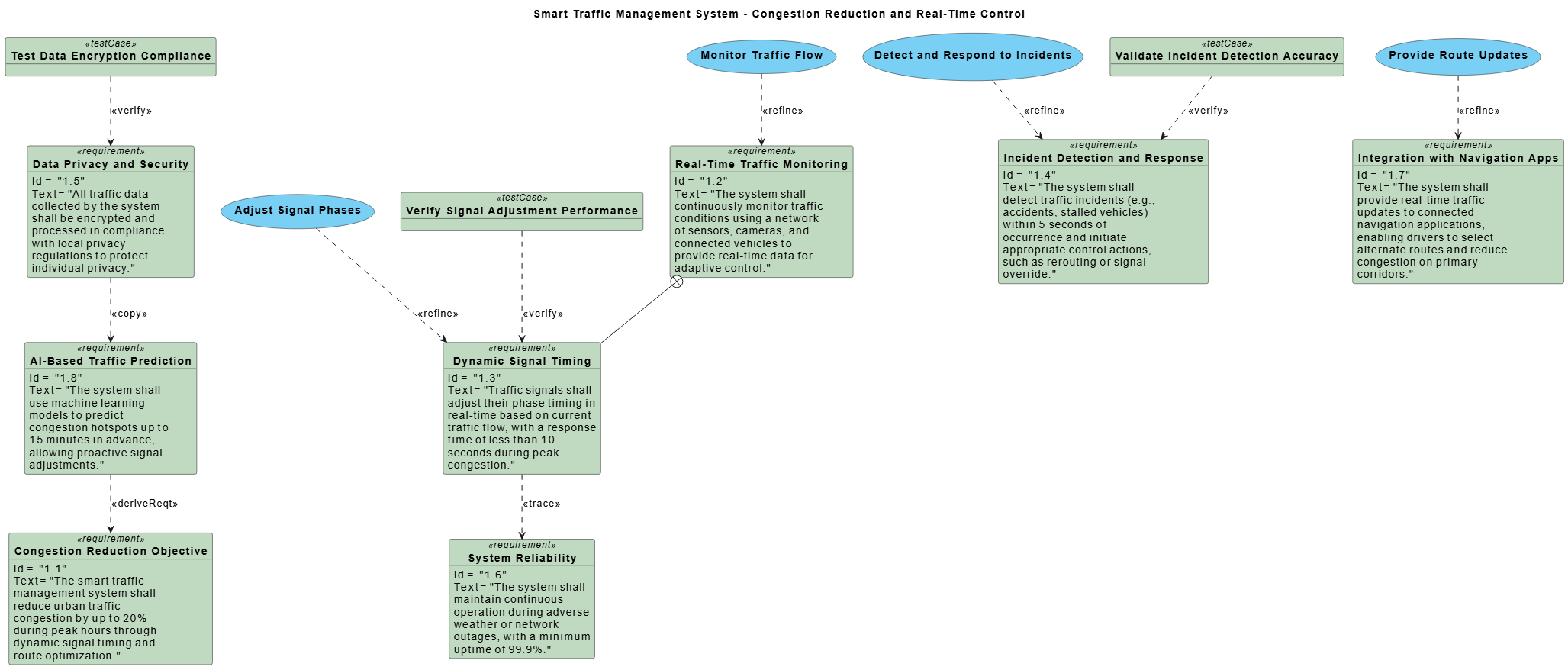
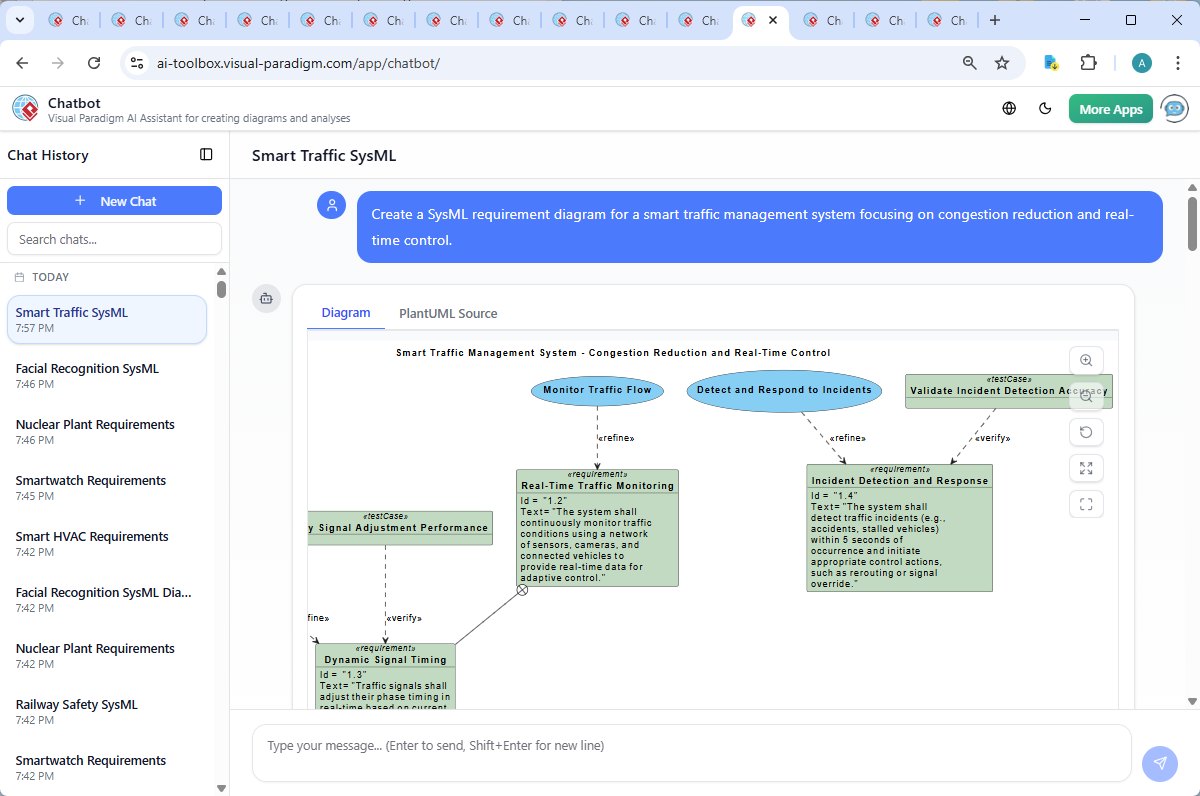
The journey began with a simple prompt: “Create a SysML requirement diagram for a smart traffic management system focusing on congestion reduction and real-time control.” Within moments, the AI delivered a fully structured PlantUML-based SysML Requirement Diagram—complete with requirements, use cases, test cases, and precise relationships.
But the conversation didn’t stop there. When the user asked, “Explain this diagram,” the AI responded not with a static caption, but with a detailed, layered breakdown—revealing the strategic intent behind each element. It didn’t just describe the diagram; it interpreted it.
For instance, when the user queried the meaning of $deriveReqt(req08, req01), the AI explained that the AI-based prediction capability (req08) is not an add-on—it’s a derived requirement rooted in the core objective of congestion reduction. This insight highlights the AI’s ability to understand dependency hierarchies and model traceability with purpose.
Further refinements followed: the user requested clarification on $containment(req02, req03), prompting the AI to explain how real-time monitoring (req02) enables dynamic signal timing (req03)—a foundational relationship in adaptive traffic systems. These back-and-forth exchanges aren’t just answers; they’re design dialogues, where the AI acts as a domain expert, ensuring each element serves a functional and strategic purpose.
Decoding the Logic: Why This Requirement Diagram Works
The diagram is built on the SysML Requirement Diagram standard, which is ideal for capturing both functional and non-functional requirements in a structured, traceable way. Here’s how each component contributes:
Core Requirements: The System’s Purpose
- req01 (Congestion Reduction Objective): The north star—20% reduction in peak-hour congestion.
- req02 (Real-Time Traffic Monitoring): The data backbone. Without live inputs, adaptive control is impossible.
- req03 (Dynamic Signal Timing): The primary mechanism for congestion relief—signals that respond to flow, not schedules.
- req04 (Incident Detection and Response): Critical for safety and system resilience. Detects accidents in under 5 seconds.
- req05 (Data Privacy and Security): Ensures compliance with regulations and public trust.
- req06 (System Reliability): 99.9% uptime guarantees the system remains operational during disruptions.
- req07 (Integration with Navigation Apps): Extends impact beyond intersections—drivers are informed and rerouted.
- req08 (AI-Based Traffic Prediction): The future-forward capability—predicting congestion 15 minutes ahead enables proactive intervention.
Use Cases: How the System Delivers Value
Each use case maps to a requirement and defines a user or system interaction:
- Monitor Traffic Flow → supports req02
- Adjust Signal Phases → enables req03
- Detect and Respond to Incidents → drives req04
- Provide Route Updates → fulfills req07
Test Cases: Validation and Assurance
These ensure requirements aren’t just written—they’re proven:
- Verify Signal Adjustment Performance → confirms req03 is met
- Validate Incident Detection Accuracy → ensures req04 works in practice
- Test Data Encryption Compliance → verifies req05 and req08 data handling
Relationships: The Intelligence Behind the Structure
The diagram’s power lies in its relationships:
$refine: Shows how use cases refine requirements (e.g., monitoring refines real-time data needs).$verify: Links test cases to requirements—ensuring every claim can be validated.$deriveReqt: Reveals that AI prediction (req08) is a logical outcome of the congestion reduction goal (req01).$containment: Demonstrates that dynamic signal control (req03) depends on real-time monitoring (req02).$trace: Shows that signal adjustment (req03) must be reliable (req06).$copy: Ensures privacy (req05) applies to both data and AI models (req08).
These aren’t arbitrary links—they reflect real-world system behavior and engineering discipline.
Conversational Intelligence: The AI Chatbot as Your Modeling Partner
What sets this process apart is the interactive intelligence of the Visual Paradigm AI Chatbot. It doesn’t just output a diagram—it engages in a design conversation. When the user asked for an explanation, the AI didn’t default to a generic summary. Instead, it:
- Explained the purpose of each requirement in context
- Clarified the semantics of relationship symbols
- Highlighted strategic implications (e.g., AI prediction enabling proactive control)
- Offered next steps: export, annotation, stakeholder modeling
This level of engagement turns the AI into a collaborative modeling expert—someone who doesn’t just follow instructions, but enhances them.
Beyond SysML: A Unified Platform for Enterprise Modeling
The Visual Paradigm AI Chatbot isn’t limited to SysML. It supports a full suite of modeling standards, making it the central hub for enterprise architecture and system design:
- UML: For software and system design
- ArchiMate: For enterprise architecture and business-IT alignment
- C4 Model: For software architecture and context visualization
- Mind Maps: For brainstorming and idea structuring
- PERT Chart, Org. Chart, SWOT, PEST: For project planning, organizational analysis, and strategic assessment
Whether you’re modeling a smart city’s traffic system, designing a banking platform, or mapping a digital transformation strategy, the AI Chatbot adapts to your standard and your intent.
Conclusion: From Vision to Verified System
Building a smart traffic management system isn’t just about technology—it’s about clarity, traceability, and trust. The SysML Requirement Diagram crafted here is more than a diagram; it’s a living blueprint for a resilient, adaptive, and intelligent urban infrastructure.
With the Visual Paradigm AI Chatbot, you don’t need to be a modeling expert to create such a system. You only need to describe your vision—and the AI handles the rest, with precision, depth, and collaborative intelligence.
Ready to model your next system? Start your conversation today and see how the AI transforms your ideas into verified, actionable models.