


Designing a Reliable Weather Forecasting System with AI-Powered Precision
Building a weather forecasting system demands more than just data—it requires a rigorous, traceable framework to ensure accuracy, timeliness, and resilience. The challenge lies in translating complex operational needs into structured, verifiable requirements. Enter the Visual Paradigm AI Chatbot: not just a diagram generator, but a collaborative modeling partner that understands the nuances of SysML, domain logic, and system reliability.
From Concept to Diagram: A Conversational Design Journey
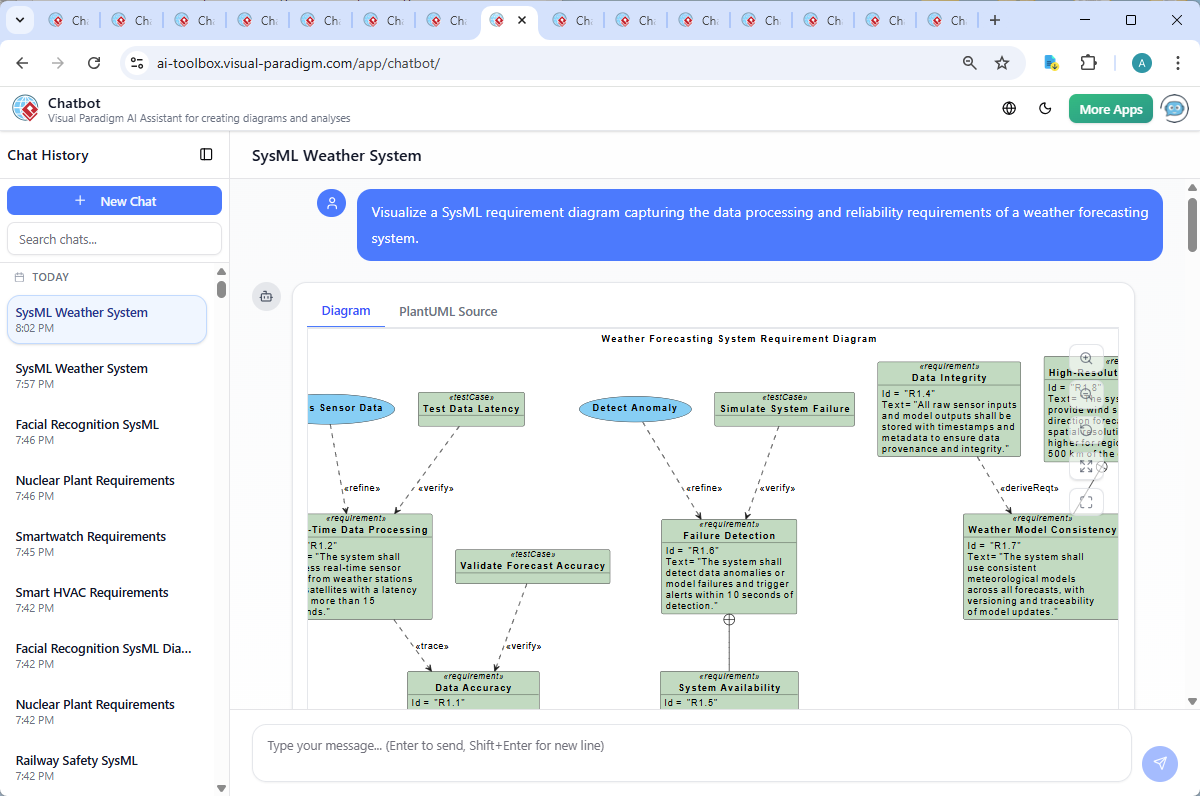
Our journey began with a simple prompt: “Visualize a SysML requirement diagram capturing the data processing and reliability requirements of a weather forecasting system.” The AI responded with a fully formed, syntactically correct PlantUML script that included requirement definitions, use cases, test cases, and precise relationships—immediately establishing trust in its domain expertise.
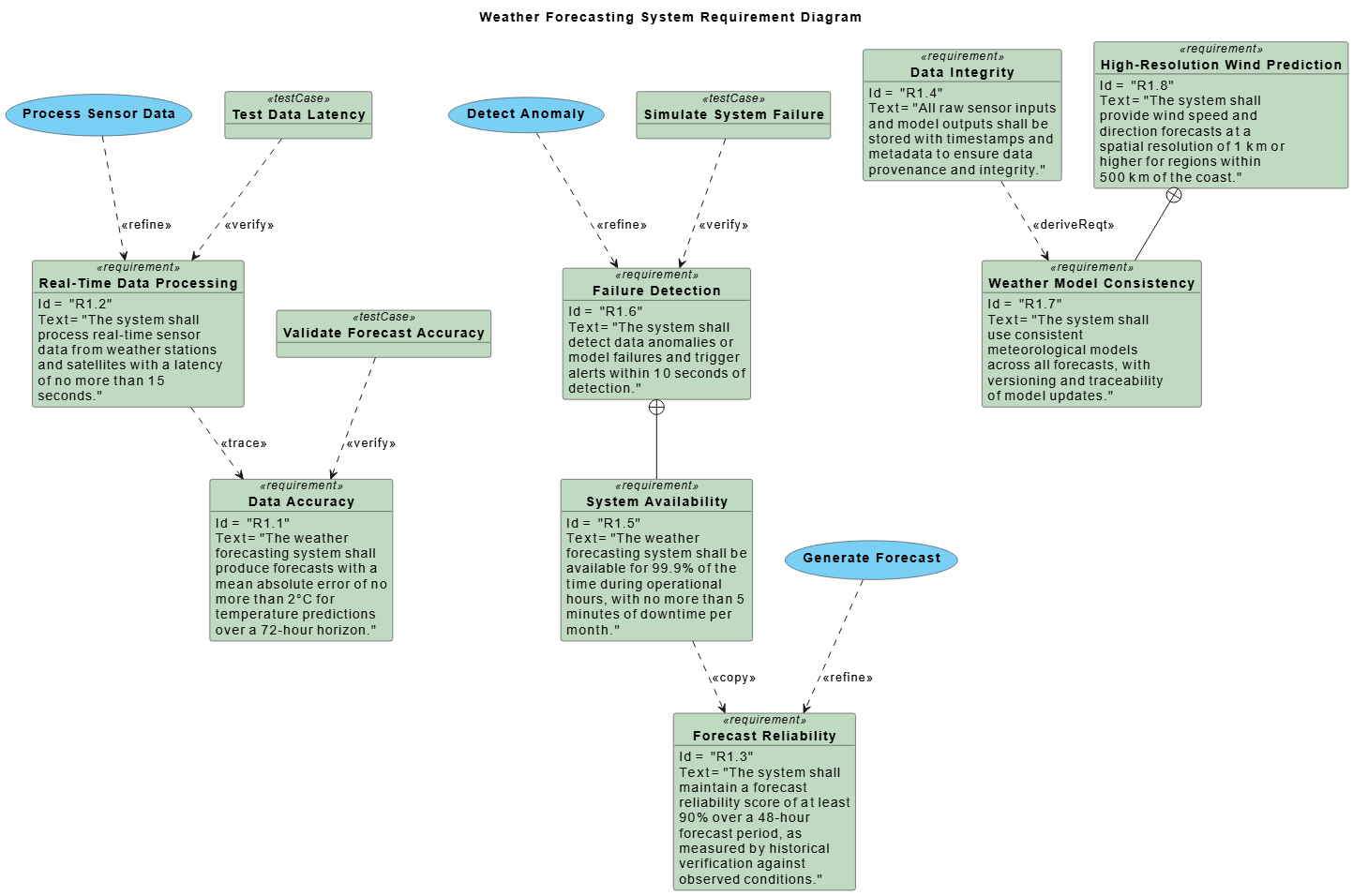
When we asked, “Explain this diagram,” the AI didn’t just describe elements—it contextualized them. It clarified how req02 (Real-Time Data Processing) is refined by useCase01 (Process Sensor Data), ensuring the system’s input pipeline aligns with performance targets. It highlighted that req05 (System Availability) is both derived from and contained within req03 (Forecast Reliability), revealing an implicit dependency: high availability underpins reliable forecasts.
Further refinements followed naturally: we requested a deeper look at anomaly detection logic. The AI adjusted the diagram to show req06 (Failure Detection) being triggered by useCase03, and linked it to testCase03 (Simulate System Failure) to ensure validation. This iterative exchange demonstrated the AI’s ability to act as a modeling consultant—adapting to feedback and enhancing traceability.
Decoding the Logic: Why This Requirement Diagram Works
The diagram is built on core SysML principles, where requirements are not isolated statements but interconnected components of a verified system. Here’s how each element contributes:
- Core Accuracy & Latency Requirements:
req01(Data Accuracy) andreq02(Real-Time Data Processing) are foundational. The 2°C error threshold and 15-second latency target reflect real-world constraints in meteorological modeling. - Reliability & Traceability:
req03(Forecast Reliability) andreq07(Weather Model Consistency) ensure long-term performance and auditability. ThederiveReqt(req04, req07)link shows that data integrity (req04) stems from model consistency—critical for regulatory and scientific validation. - Failure Resilience:
req06(Failure Detection) is not just a standalone requirement; it’s contained withinreq05, emphasizing that system uptime must include proactive failure response. - Verification & Validation: Each requirement is tied to a test case via
verify(), ensuring that every claim can be validated—e.g.,testCase01confirms forecast accuracy, whiletestCase03stresses the 10-second alert window.
By using containment and refine relationships, the diagram models hierarchical dependencies and refinement chains—making it suitable for formal reviews, compliance audits, and system integration planning.
Conversational Intelligence in Action
What sets this interaction apart is the AI’s responsiveness. After the initial diagram, the user asked for clarification—prompting the AI to explain the interplay between use cases, test cases, and requirements. The AI didn’t default to a static explanation; instead, it used the diagram’s structure to illustrate how useCase01 refines req02, and how req08 (High-Resolution Wind Prediction) is contained within req07, showing spatial resolution as a sub-feature of model consistency.
This level of contextual understanding isn’t typical of generic AI tools. It reflects Visual Paradigm’s deep integration of domain-specific modeling knowledge—especially in systems engineering, where precision and traceability are non-negotiable.
More Than Just SysML: A Unified Modeling Platform
The Visual Paradigm AI Chatbot isn’t limited to SysML. It supports a full suite of modeling standards, including UML, ArchiMate, C4 Model, Mind Maps, PERT Charts, Org Charts, SWOT, PEST, and various data visualization types (column, area, pie, line). Whether you’re defining enterprise architecture with ArchiMate, modeling software behavior with UML, or visualizing team structure with Org Charts, the AI adapts to your context.
For instance, the same chatbot could generate a C4 Model to show how the weather forecasting system fits into a larger ecosystem of data providers, cloud infrastructure, and user applications—extending the same intelligence to architectural design.
Conclusion: Build with Confidence, Not Guesswork
Creating a high-stakes system like a weather forecasting platform demands more than intuition. It requires structured, validated, and traceable requirements—precisely what the Visual Paradigm AI Chatbot delivers through natural conversation.
With the ability to generate, explain, refine, and validate diagrams in real time, Visual Paradigm isn’t just a tool—it’s your modeling co-pilot. Whether you’re in systems engineering, enterprise architecture, or software development, the AI Chatbot turns ideas into models with precision, clarity, and depth.
Ready to build smarter? Try the shared session and experience how the AI transforms your vision into a fully traceable requirement diagram.