


Designing a Secure Banking System with AI-Powered Precision
Creating a robust, scalable banking system requires more than just functional code—it demands a clear, structured understanding of its core components and their interactions. The challenge lies in visualizing complex system elements like accounts, transactions, customers, and security services in a way that’s both technically accurate and accessible to stakeholders across engineering, architecture, and business teams.
Enter the Visual Paradigm AI Chatbot—not just a diagram generator, but a conversational modeling expert. By turning natural language prompts into precise, standardized models, it enables rapid design iteration while maintaining architectural integrity. In this case, the user simply asked for a high-level Block Definition Diagram (BDD) of a banking system, and the AI delivered a fully structured, semantically rich visual model—crafted using the Visual Paradigm AI Chatbot.
From Prompt to Precision: The Evolution of the Banking System BDD
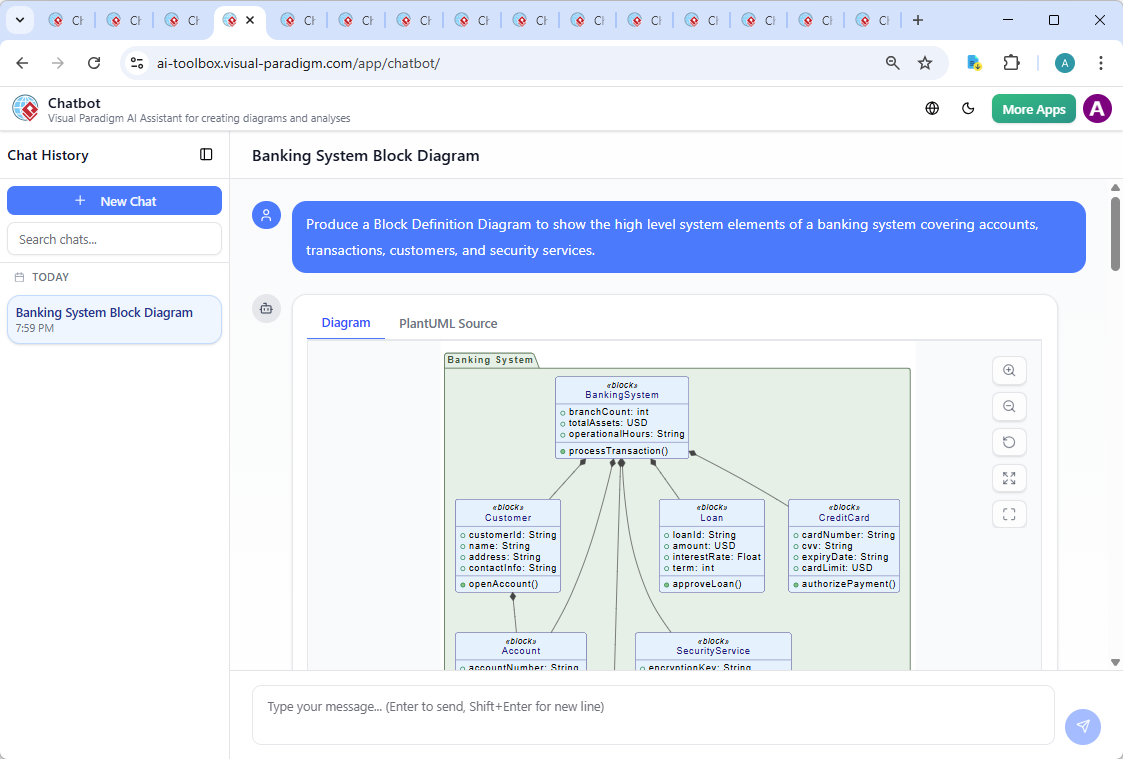
The journey began with a straightforward request: “Produce a Block Definition Diagram to show the high-level system elements of a banking system covering accounts, transactions, customers, and security services.”
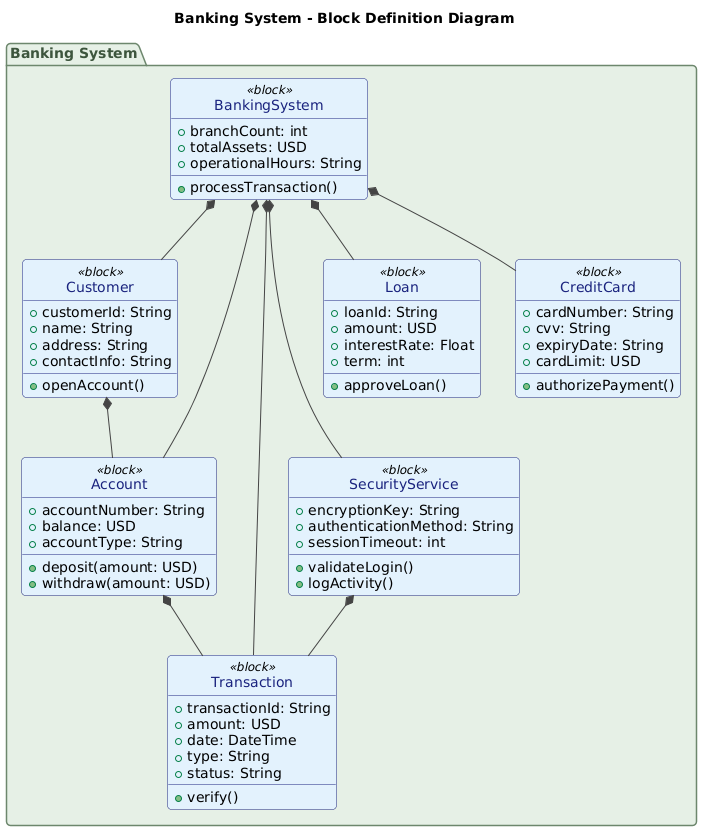
Within seconds, the AI generated a complete PlantUML-based BDD, incorporating:
- Core blocks:
BankingSystem,Customer,Account,Transaction,SecurityService,Loan, andCreditCard - Well-defined attributes and operations for each block
- Clear relationships via composition and association
But the real power emerged in the conversation that followed. When the user asked, “Can you explain the role of the SecurityService block in validating transactions within the banking system?”, the AI didn’t just restate the diagram—it provided a detailed, contextual explanation that deepened the model’s purpose.
It broke down the SecurityService’s role into five key functions:
- Authentication – Verifying user identity before any transaction
- Authorization – Confirming transaction permissions based on account rules
- Encryption – Securing data in transit and at rest
- Session Management – Preventing hijacking with timeouts
- Fraud Detection – Flagging anomalies in real time
This wasn’t just documentation—it was architectural insight, delivered through a back-and-forth dialogue. The AI didn’t stop at rendering the diagram; it became a collaborative design partner, refining logic and explaining intent.
Decoding the Logic: Why This Block Definition Diagram Works
The diagram’s structure is rooted in SysML’s Block Definition Diagram standard, which excels at defining system architecture at a high level. Here’s how each element contributes:
1. BankingSystem – The Root Container
As the top-level block, it encapsulates all other elements, representing the entire banking system as a single, coherent entity. Its attributes (e.g., branchCount, totalAssets) provide operational context, while its operations (e.g., processTransaction()) signal its role in orchestration.
2. Customer – The User Entity
Represents the human actor. It maintains personal data and owns accounts, linking to Account and Transaction through direct associations. This reflects real-world banking dynamics where customers initiate actions.
3. Account – The Core Financial Unit
Stores financial data (balance, type) and supports core operations like deposit() and withdraw(). Its link to Transaction enables auditability and traceability of financial movements.
4. Transaction – The Action Unit
Represents any financial event (transfer, deposit, withdrawal). Its attributes (ID, amount, status) support tracking, while its method verify() signals it’s a candidate for validation—primarily by SecurityService.
5. SecurityService – The Guardian Block
This is the linchpin. It doesn’t just sit in the diagram—it actively enforces security across multiple touchpoints. The AI correctly positioned it as a shared service, interacting with Transaction, Account, and Customer, emphasizing its role as a cross-cutting concern.
6. Loan and CreditCard – Extended Financial Services
These blocks extend the system’s capabilities beyond basic accounts. They’re included as first-class entities, showing that the model isn’t limited to core banking but anticipates broader financial offerings.
The * association from BankingSystem to all child blocks indicates composition—a strong ownership relationship. This signals that the system is responsible for creating, managing, and destroying these elements, aligning with system lifecycle principles.
Conversational Intelligence in Action
What sets Visual Paradigm apart isn’t just the diagram output—it’s the dialogue that surrounds it. The AI Chatbot doesn’t generate static images; it engages in a collaborative modeling conversation, adapting to follow-up questions with expert-level clarity.
For example, when asked to explain the SecurityService’s role, the AI didn’t just list functions—it contextualized them within real-world banking workflows, using examples like session timeouts and fraud detection. This demonstrates the AI’s ability to think like a systems architect, not just a code generator.
Such interactions elevate the design process from drafting to designing with intent. Every block isn’t just a shape on a screen—it’s a purpose-driven component, shaped by conversation and validated by logic.
Beyond BDD: A Unified Modeling Platform
The Visual Paradigm AI Chatbot isn’t limited to SysML or Block Definition Diagrams. It seamlessly supports a full suite of modeling standards, including:
- UML – For software design and behavior modeling
- ArchiMate – For enterprise architecture and business-IT alignment
- C4 Model – For software architecture at multiple levels (Context, Containers, Components, Code)
- Mind Maps – For brainstorming and idea structuring
- SWOT, PEST, Org Charts, PERT Charts – For strategic planning and project management
Whether you’re modeling a microservices backend in SysML, mapping business capabilities in ArchiMate, or visualizing team structure in an Org Chart, the AI Chatbot adapts to your domain and delivers accurate, standardized output—always with the same level of conversational intelligence.
Conclusion: Design with Confidence, Not Guesswork
Building a secure, scalable banking system starts with clarity. The Visual Paradigm AI Chatbot transforms abstract ideas into precise, standardized models—through natural conversation, not rigid templates.
From the initial prompt to the final explanation, every step was guided by AI-powered insight, ensuring that the Block Definition Diagram isn’t just visually appealing—it’s architecturally sound, logically consistent, and ready for stakeholder review.
Ready to design your next system with the same level of intelligence? Explore the live session and experience how the AI Chatbot turns ideas into models—collaboratively, accurately, and at speed.