


Designing a Content Management System with AI-Powered Precision
Creating a robust content management system (CMS) requires more than just listing features—it demands a clear, structured representation of its core components and their relationships. The challenge lies in capturing complex workflows, versioning, and delivery mechanisms in a way that’s both accurate and accessible to stakeholders across technical and non-technical roles.
Enter the Visual Paradigm AI Chatbot—a conversational modeling expert that transforms high-level ideas into precise, standards-compliant diagrams. Instead of starting from scratch or wrestling with syntax, users simply describe their intent in natural language, and the AI delivers a fully structured Block Definition Diagram in SysML, complete with semantic clarity and architectural integrity.
From Idea to Diagram: A Collaborative Design Journey
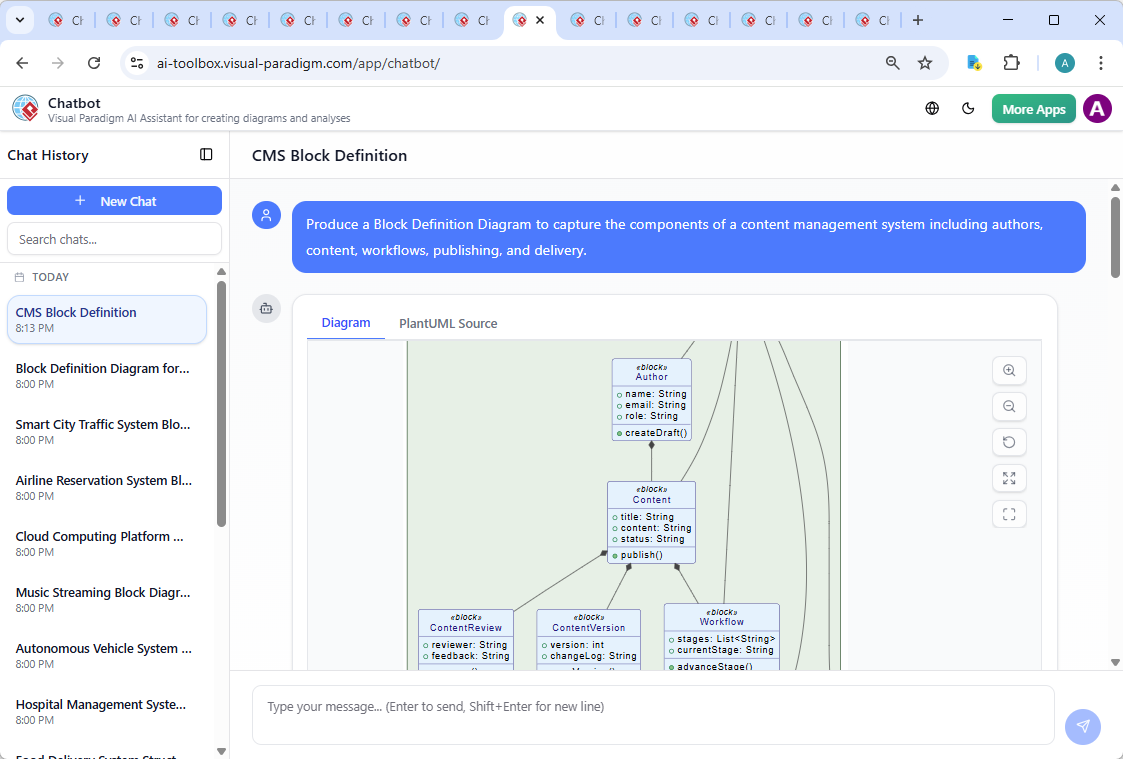
The process began with a simple prompt: “Produce a Block Definition Diagram to capture the components of a content management system including authors, content, workflows, publishing, and delivery.”
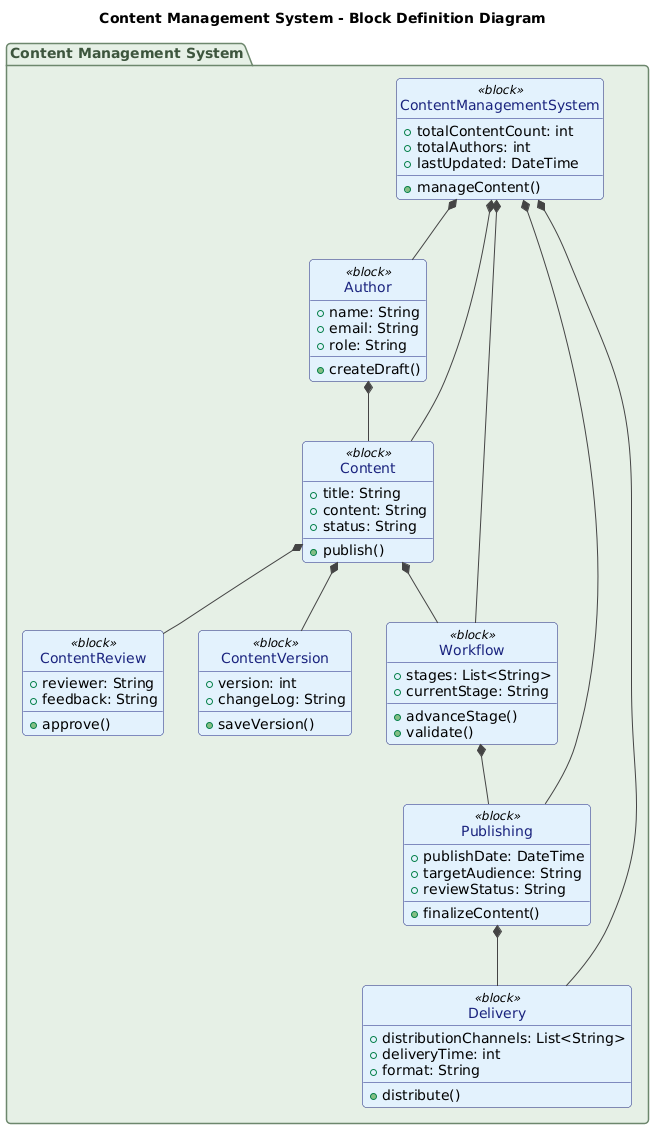
Within seconds, the Visual Paradigm AI Chatbot generated a fully rendered PlantUML code snippet, automatically translated into a clean, professional Block Definition Diagram. The diagram included:
- Core blocks:
ContentManagementSystem,Author,Content,Workflow,Publishing,Delivery - Supporting entities:
ContentReview,ContentVersionfor traceability - Relationships: Clear associations showing data flow and ownership
But the real value emerged in the conversation that followed. When the user asked, “Can you explain the role of the ContentVersion block in tracking changes to content within the workflow?”, the AI didn’t just define the block—it contextualized it, illustrating how versioning enables audit trails, recovery, and transparency.
The AI elaborated on the lifecycle of a content piece: from draft (Version 1.0) to revision (1.1), review (1.2), and final publication. It highlighted how each version is preserved, enabling rollback and compliance—critical for enterprise-grade CMS platforms.
This back-and-forth wasn’t just an explanation; it was a collaborative design session. The AI acted as a modeling consultant, refining logic, clarifying intent, and deepening architectural insight—all through natural language interaction.
Decoding the Block Definition Diagram Logic
The diagram is built on the Block Definition Diagram (BDD) standard in SysML, which is ideal for defining system structure at the conceptual level. Unlike class diagrams in UML, BDDs emphasize blocks—abstract or concrete components that represent system elements, with a focus on composition and relationships.
Here’s how each block contributes:
- ContentManagementSystem: The root block, serving as the container and orchestrator of all other components.
- Author: Represents content creators, with methods like
createDraft()to initiate content creation. - Content: The primary artifact, storing title, body, and status. Its lifecycle is governed by the workflow.
- Workflow: Defines stages like draft, review, approval, and publish. It controls progression and validates transitions.
- ContentReview: Captures feedback and approval status, ensuring quality control before publication.
- ContentVersion: The backbone of traceability. Each edit triggers a new version, preserving history and enabling rollback.
- Publishing: Manages timing, target audience, and final validation before delivery.
- Delivery: Handles distribution across channels, formats, and timing.
The relationships—represented by solid lines with asterisks—show aggregation and composition. For example, a Content is composed of multiple ContentVersion instances, and the Workflow governs the Publishing phase.
This structure ensures that the system is not only logically sound but also scalable, maintainable, and aligned with enterprise architecture standards.
Conversational Intelligence in Action
What sets Visual Paradigm apart is not just the diagram output, but the dialogue that shapes it. The AI Chatbot doesn’t generate static images—it engages in a dynamic, intelligent conversation, refining models based on user feedback.
When the user requested clarification on ContentVersion, the AI didn’t stop at a definition. It provided:
- A real-world example of a blog post evolving through versions
- A comparison table of benefits (audit, recovery, collaboration)
- Explicit linkage to workflow stages
This level of contextual intelligence transforms the AI from a generator into a co-designer—helping users think through system design, not just visualize it.
Beyond SysML: A Unified Modeling Platform
The Visual Paradigm AI Chatbot isn’t limited to SysML. It supports a full suite of modeling standards, making it a unified environment for diverse architectural needs:
- UML: For software design and component modeling
- ArchiMate: For enterprise architecture and business-IT alignment
- C4 Model: For software architecture at different levels of abstraction
- Mind Maps, PERT Charts, Org Charts, SWOT, PEST: For strategic planning and project management
Whether you’re designing a content platform, mapping business processes, or modeling system behavior, the AI Chatbot adapts to your domain—providing accurate, standards-compliant diagrams with minimal effort.
Conclusion: A Smarter Way to Model
Building a content management system isn’t just about features—it’s about structure, traceability, and collaboration. The Visual Paradigm AI Chatbot delivers more than a diagram; it delivers a conversational design environment where ideas evolve through intelligent dialogue.
From initial concept to detailed component logic, the AI supports every step—providing clarity, consistency, and depth. Whether you’re a developer, architect, or product manager, you’re no longer alone in the modeling process.
Ready to design your next system with AI-powered precision? Explore the full session and see how the AI Chatbot turns your vision into a structured, professional model—crafted using the Visual Paradigm AI Chatbot.