


Designing the Backbone of an E-Commerce Platform with AI-Powered Precision
Building a scalable, maintainable e-commerce system requires more than just coding—it demands a clear, structured vision of its core components and their relationships. Traditional modeling approaches often slow down innovation, but with Visual Paradigm’s AI Chatbot, teams can rapidly translate high-level ideas into precise, standardized diagrams—starting with the Block Definition Diagram.
From Idea to Diagram: A Collaborative Design Journey
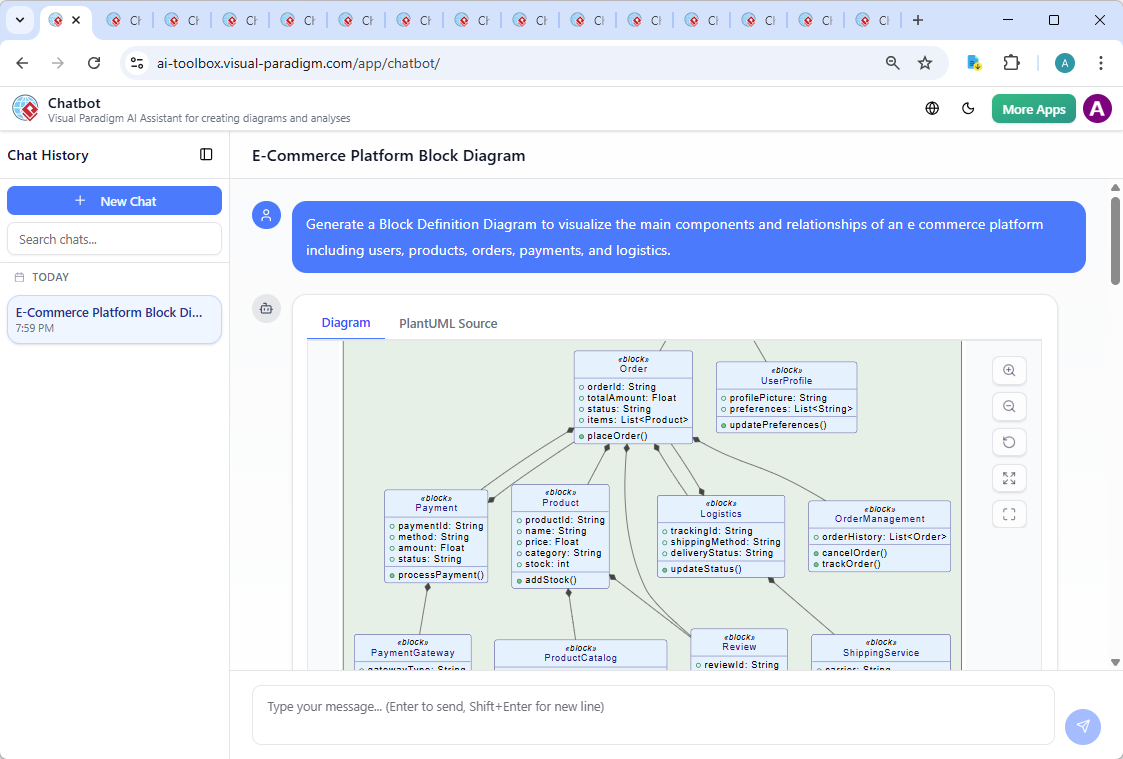
The journey began with a simple request: “Generate a Block Definition Diagram to visualize the main components and relationships of an e-commerce platform including users, products, orders, payments, and logistics.” Within seconds, the Visual Paradigm AI Chatbot responded with a fully structured PlantUML script, automatically generating a clean, semantic representation of the system’s architecture.
But this wasn’t just a diagram—it was the beginning of a conversation. The user asked, “Can you explain how the OrderManagement block interacts with the Payment and Logistics blocks?” Instead of a static answer, the AI delivered a detailed, context-aware breakdown of the coordination logic, revealing how OrderManagement acts as the central orchestrator.
Each follow-up query—like “Refine the logic” or “Explain this branch”—was met with a response that deepened the model’s clarity. The AI didn’t just answer; it guided the design, suggesting improvements such as breaking down high-level blocks into sub-components (e.g., PaymentGateway, ShippingService) and clarifying how each interacts in real-time workflows.
This iterative, conversational approach reflects Visual Paradigm’s core mission: to transform modeling from a technical chore into a collaborative design session.
Decoding the Block Definition Diagram Logic
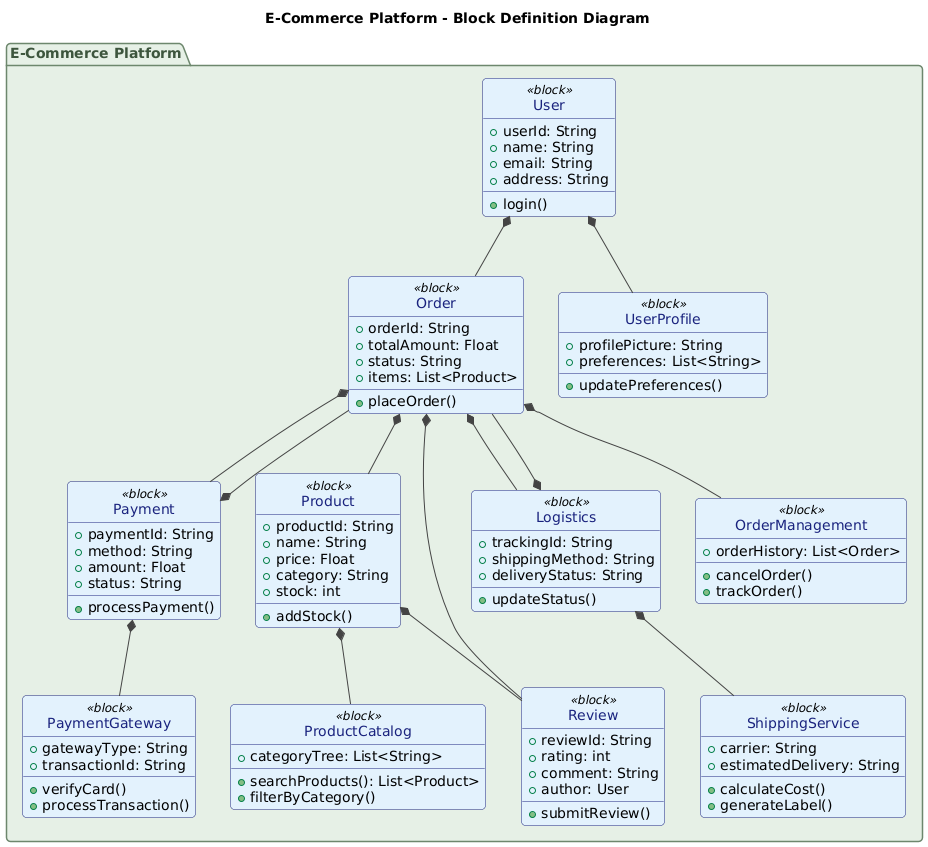
The generated diagram captures the e-commerce platform’s architecture using SysML Block Definition Diagram (BDD) notation—a powerful way to define system components, their structure, and their relationships. Here’s how each element contributes:
Core Blocks and Their Responsibilities
- User: Represents the customer. Holds personal data and authentication logic.
- Product: Stores item details, pricing, and inventory. Includes methods to update stock.
- Order: The central transaction object. Tracks items, total amount, and status.
- Payment: Handles financial transactions, including verification and processing.
- Logistics: Manages shipping, tracking, and delivery status.
- Review: Captures user feedback on products.
Key Structural Relationships
- Composition:
OrdercontainsProductandPayment, indicating that these are internal parts of an order. - Association:
Orderlinks toLogisticsandPaymentvia unidirectional relationships, showing data flow and coordination. - Sub-components: Blocks like
OrderManagement,PaymentGateway, andShippingServiceare nested under their parent blocks, demonstrating hierarchical decomposition.
By using BDD, the model emphasizes what exists in the system—its structural components—rather than how they behave over time. This makes it ideal for early-stage system design, stakeholder alignment, and architectural documentation.
Conversational Intelligence in Action
What sets Visual Paradigm apart is not just the diagram output, but the intelligence behind the conversation. The AI Chatbot doesn’t just generate code—it understands context, interprets intent, and responds with architectural insight.
When the user asked for clarification on interactions between OrderManagement, Payment, and Logistics, the AI didn’t just repeat the diagram. It explained:
- How
OrderManagementtriggers payment processing after order validation. - How payment success triggers logistics coordination.
- Why this sequence ensures data integrity and system reliability.
These insights were not just informative—they were design guidance. The AI acted as a modeling consultant, helping the user anticipate integration challenges and scalability needs.
Beyond BDD: A Full Suite of AI-Powered Modeling Standards
While this example focused on SysML’s Block Definition Diagram, Visual Paradigm’s AI Chatbot is not limited to one standard. It seamlessly supports:
- UML: Class, sequence, and component diagrams for software design.
- ArchiMate: Enterprise architecture modeling with layers for business, application, and technology.
- C4 Model: Context, containers, components, and code views for software architecture.
- Mind Maps, Org Charts, SWOT, PEST, PERT, and Charts: For strategic planning, project management, and business analysis.
This versatility means teams can use the same AI assistant across projects—from technical design to executive strategy—without switching tools.
Conclusion: Where Vision Meets Execution
Visual Paradigm’s AI Chatbot transforms the way teams design complex systems. By combining the precision of SysML BDD with the flexibility of conversational modeling, it turns abstract ideas into actionable blueprints—fast, accurate, and collaborative.
Whether you’re designing an e-commerce platform, a financial system, or a cloud-native architecture, the AI Chatbot is your co-designer, guide, and validator.
Ready to turn your next idea into a fully modeled system? Explore the live session and experience the future of visual modeling.