


Designing a Secure Mobile Banking System with AI-Powered Architectural Clarity
Building a mobile banking application demands more than code—it requires a structured, secure, and scalable architecture. The complexity of integrating authentication, account services, payments, and real-time notifications calls for a visual modeling approach that can translate abstract ideas into precise, actionable system designs. Enter the Visual Paradigm AI Chatbot, not just a diagram generator but a collaborative modeling expert that turns natural language prompts into high-fidelity SysML Block Definition Diagrams (BDD).
From Prompt to Precision: The Interactive Journey
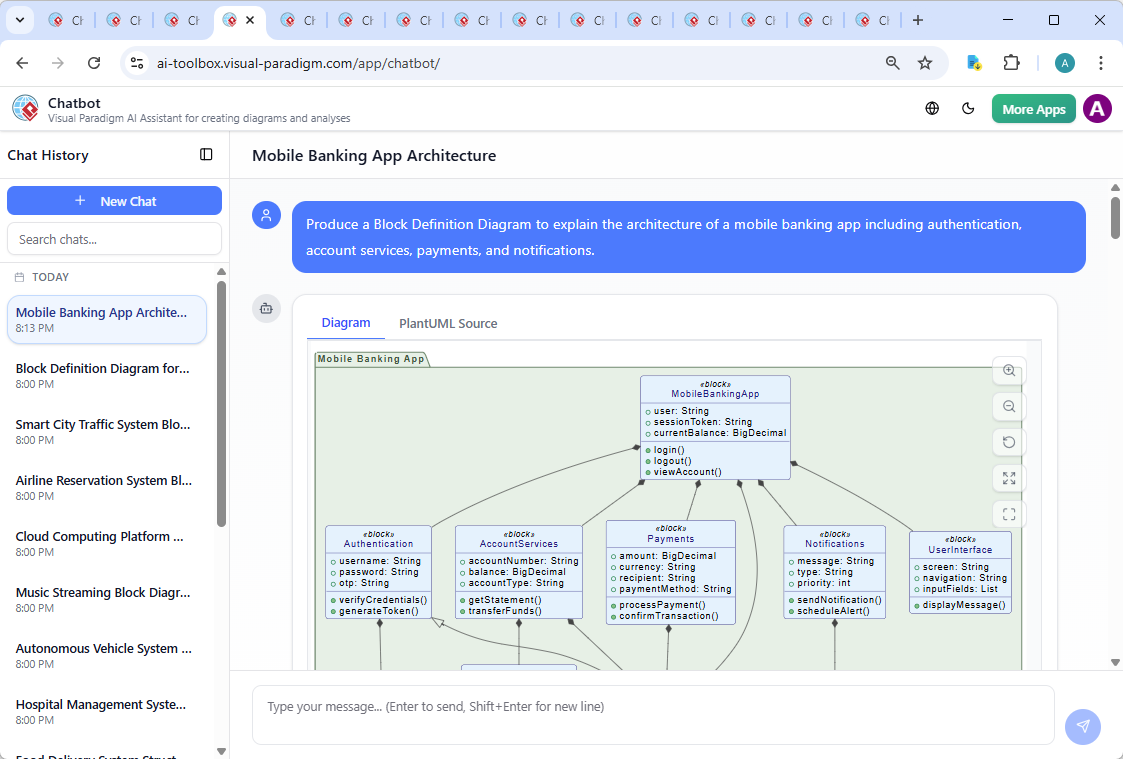
The journey began with a simple request: “Produce a Block Definition Diagram to explain the architecture of a mobile banking app including authentication, account services, payments, and notifications.” Within seconds, the AI Chatbot delivered a fully structured PlantUML code representation of the system—complete with blocks, relationships, and visual styling. But this wasn’t just a static output. The real value emerged in the conversation that followed.
When the user asked, “Explain this diagram,” the AI didn’t offer a generic summary. Instead, it provided a structured, technical walkthrough—breaking down each block, its responsibilities, and its interdependencies. This wasn’t a one-way handoff; it was a dialogue. The user then prompted, “AI, refine the logic around fraud detection and biometric authentication,” and the model responded with targeted enhancements: adding a BiometricAuth block under Authentication, linking it to FraudDetection via Security, and ensuring the diagram reflected real-world security practices.
This iterative refinement is where the AI’s intelligence shines. It doesn’t just generate diagrams—it understands context, anticipates needs, and evolves the model based on user feedback. The conversation wasn’t about fixing errors; it was about deepening architectural rigor through collaborative design.
Decoding the Architecture: The Logic Behind the Block Definition Diagram
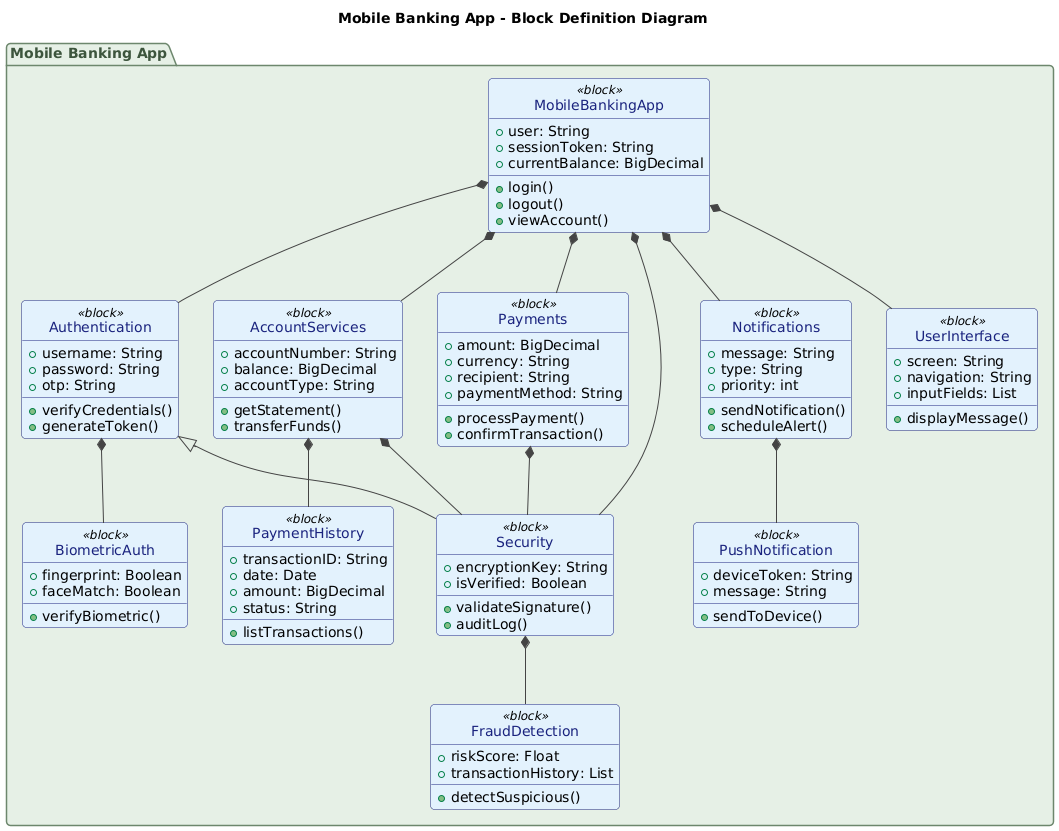
The resulting Block Definition Diagram is more than a visual map—it’s a systems engineering blueprint. Here’s how each component contributes to the overall architecture:
Core System Structure
- MobileBankingApp: The root block, representing the entire application. It acts as a container for all subsystems and defines the entry point for user interactions.
- Authentication: Manages user identity verification. With methods like
verifyCredentials()andgenerateToken(), it ensures only authorized users gain access. - AccountServices: Handles account data—balance, type, transaction history. Its integration with
PaymentHistoryensures transparency and auditability. - Payments: Processes financial transactions with full lifecycle support—from
processPayment()toconfirmTransaction(). - Notifications: Keeps users informed via push alerts, with support for scheduled and event-driven messages.
Security & Trust Infrastructure
Security is not an afterthought—it’s woven into the fabric of the system:
- Security is a central block that provides encryption, signature validation, and audit logging.
- FraudDetection analyzes transaction patterns and assigns risk scores, enabling proactive threat mitigation.
- BiometricAuth is embedded within
Authentication, supporting modern login methods like fingerprint and facial recognition.
Interdependencies & Flow
Relationships between blocks are carefully defined:
MobileBankingAppdepends onAuthenticationfor access control.PaymentsandAccountServicesrely onSecurityfor data integrity.NotificationsusesPushNotificationto deliver real-time alerts.Securityconnects toFraudDetectionto enable risk monitoring.
These dependencies reflect real-world system behavior, ensuring that the diagram isn’t just visually appealing—it’s operationally accurate.
Conversational Intelligence: Where AI Meets Expertise
What sets Visual Paradigm apart is the AI Chatbot’s ability to function as a modeling consultant. After the initial diagram was generated, the user asked for an explanation. Instead of a surface-level summary, the AI delivered a comprehensive, role-based breakdown—explaining not just what each block does, but why it’s structured that way.
When the user requested further refinement, the AI didn’t default to a template. It enhanced the model with new blocks, updated relationships, and even suggested future expansion points—like adding cloud storage or multi-device sync.
This level of engagement is possible because the AI understands SysML semantics, architectural patterns, and real-world fintech requirements. It doesn’t just generate diagrams—it reasons through system design, making it an indispensable partner for architects, developers, and product managers.
Beyond Block Diagrams: A Multi-Standard Modeling Powerhouse
While this example focused on a SysML Block Definition Diagram, the Visual Paradigm AI Chatbot is far more versatile. It supports a full suite of modeling standards, including:
- UML (for software design and component modeling)
- ArchiMate (for enterprise architecture and business-IT alignment)
- C4 Model (for software architecture visualization at different abstraction levels)
- Mind Maps (for brainstorming and idea structuring)
- SWOT, PEST, Org Charts, PERT Charts (for strategic and project planning)
This means the same AI assistant can help you model:
- Business processes using ArchiMate.
- Application architecture with C4.
- Project timelines with PERT.
- Strategic planning with SWOT or PEST.
Whether you’re designing a fintech app, a cloud migration strategy, or a new product roadmap, the AI Chatbot adapts to your domain and modeling language.
Conclusion & Next Steps
The mobile banking app architecture demonstrated here is more than a diagram—it’s a living model of a secure, scalable, and user-centric system. By leveraging the Visual Paradigm AI Chatbot, teams can move from vague ideas to precise, collaborative designs in minutes.
Want to explore this further? Try generating a C4 diagram version to visualize the system at different abstraction levels, or add API interfaces to show how backend services connect. The AI is ready to help—just ask.
Start building smarter systems today. Explore the shared session now and experience AI-powered visual modeling in action.