


Designing a Smart Recommendation Engine: From Idea to Structured Model
Personalized content recommendation systems are no longer a luxury—they’re a necessity for online retailers aiming to boost engagement and conversion. But building one requires modeling complex interactions between user behavior, product catalogs, algorithms, and outputs. The challenge lies not just in capturing these components, but in representing their relationships with precision and clarity.
Enter the Visual Paradigm AI Chatbot—a conversational modeling expert that transforms abstract ideas into structured, standards-compliant diagrams. Instead of starting from scratch or wrestling with syntax, users collaborate with the AI in natural language to design models that reflect real-world system behavior.
From Prompt to Precision: A Collaborative Modeling Journey
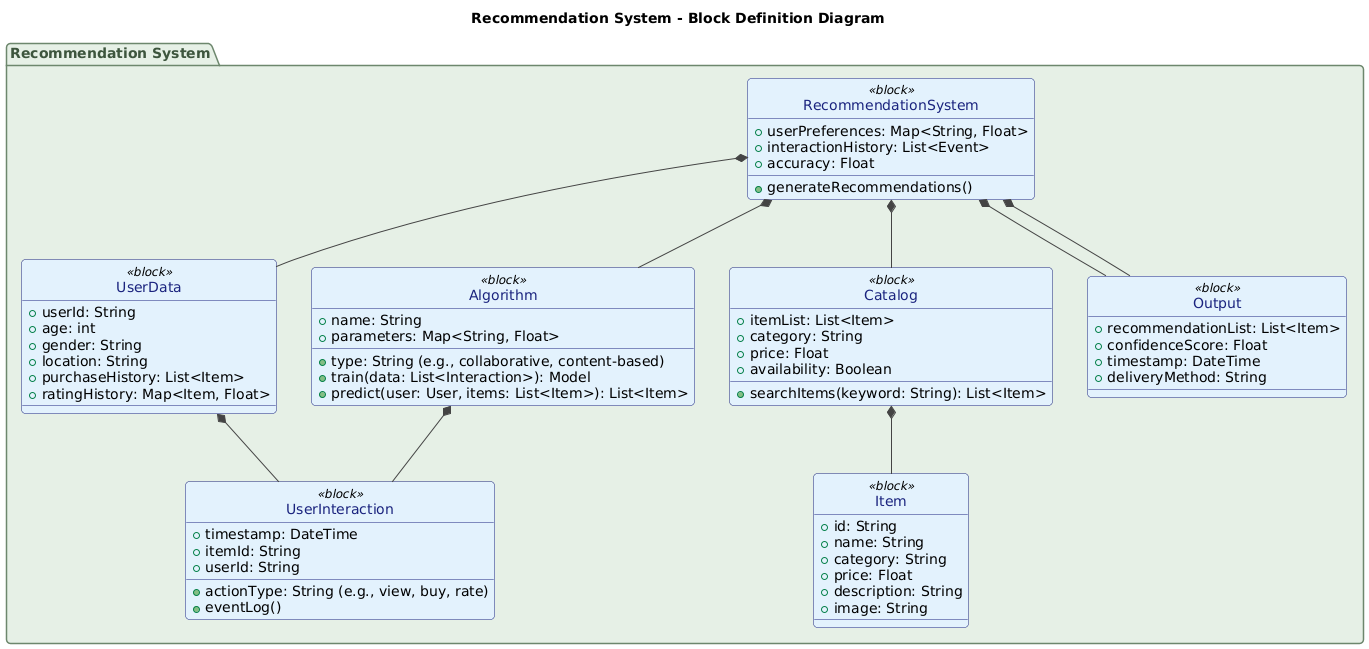
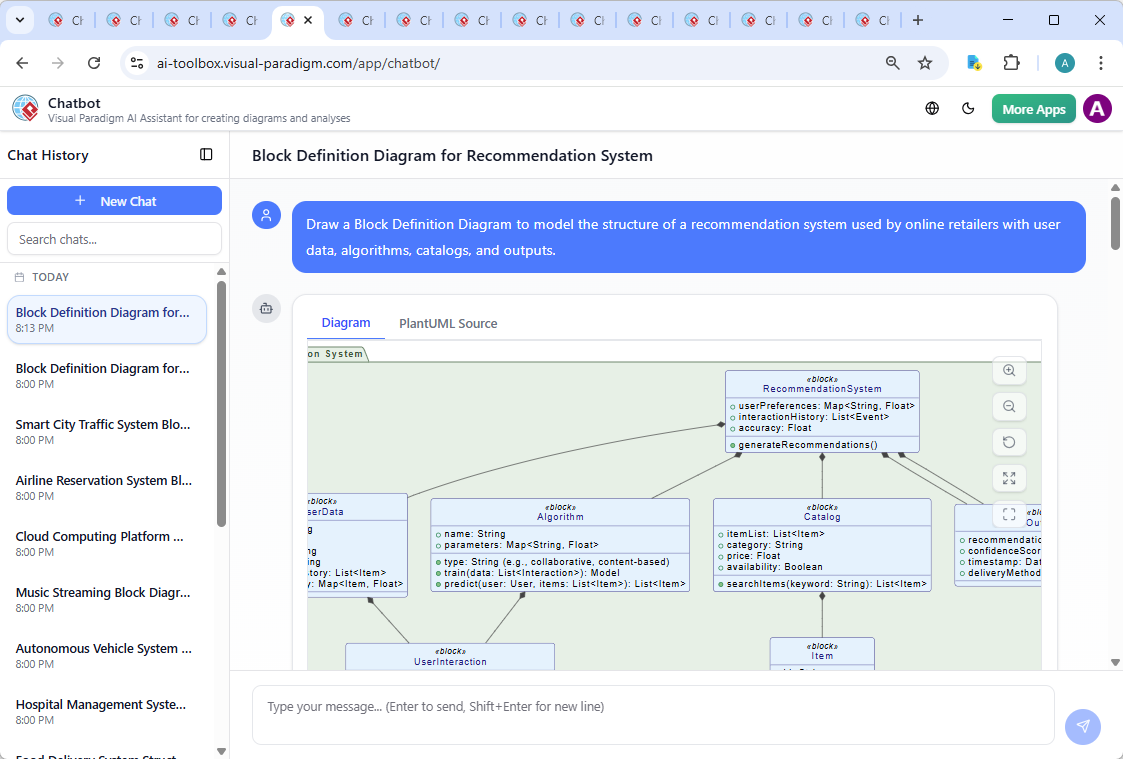
The journey began with a simple request: “Draw a Block Definition Diagram to model the structure of a recommendation system used by online retailers with user data, algorithms, catalogs, and outputs.” The AI instantly interpreted the intent and generated a fully compliant BlockDefinitionDiagram using PlantUML syntax, complete with classes, attributes, operations, and relationships.
But the real value emerged in the conversation that followed. When the user asked, “Can you explain how the Algorithm block uses the userPreferences and interactionHistory data to generate recommendations?”, the AI didn’t just restate the diagram—it delivered a layered, technical explanation that clarified the system’s intelligence.
It broke down how userPreferences (static profile data) and interactionHistory (dynamic behavioral logs) are fed into the Algorithm block to power personalized predictions. It explained the role of collaborative filtering, content-based matching, and hybrid modeling—each supported by concrete examples like recommending *The Expanse* after a user rated *The Martian* highly.
When the user requested refinements—such as “Explain this branch” or “Refine the logic of the prediction flow”—the AI responded with targeted clarifications, demonstrating its ability to act as a modeling consultant rather than a passive generator.
Decoding the Block Definition Diagram: Structure and Intent
The Block Definition Diagram (BDD) is ideal for defining the static structure of a system. In this case, it captures the core components and their relationships within a recommendation engine—making it easier to reason about scalability, integration, and evolution.
Here’s how each block contributes:
RecommendationSystem– The central orchestrator. It aggregatesUserData,Catalog,Algorithm, andOutputto form a complete recommendation pipeline.UserData– Stores user-specific attributes (age, location, gender) and behavioral traces (purchase history, ratings).Catalog– Represents the product inventory, enriched with metadata like category, price, and availability.Algorithm– The intelligence engine. It processes user preferences and interaction history to generate ranked recommendations.Output– The final deliverable: a list of recommended items with confidence scores and delivery metadata.UserInteraction– Tracks real-time user actions (view, buy, rate), feeding into bothUserDataandAlgorithm.Item– A fundamental data entity, carrying attributes like name, description, and image.
Relationships are carefully defined:
RecommendationSystemaggregates all other blocks via*associations (composition).AlgorithmconsumesUserInteractionandUserDatadata.CatalogcontainsIteminstances.UserDatais linked toUserInteractionto track behavioral history.
The choice of BDD over other diagrams (like Component or Class Diagrams) was strategic: BDD excels at modeling system architecture at a high level, showing how blocks are structured and related—perfect for enterprise-grade systems where clarity and scalability matter.
Conversational Intelligence in Action
What sets Visual Paradigm apart is not just the diagram output—but the dialogue that shapes it. The AI Chatbot doesn’t just render diagrams; it engages in a technical conversation that elevates the design process.
For instance, when the user asked for an explanation of the algorithm’s logic, the AI didn’t stop at listing attributes. It:
- Explained how
userPreferencesguides filtering and similarity computation. - Clarified how
interactionHistoryreveals intent through patterns (e.g., abandoned carts signal interest). - Walked through a real-world scenario: a user who rated *The Martian* highly is likely to enjoy *Dune* and *The Expanse*.
- Provided a comparison table showing how different data types contribute to recommendation accuracy.
This kind of insight transforms the diagram from a static artifact into a living design document—one that evolves with user questions and domain knowledge.
Beyond SysML: A Unified Modeling Platform
The Visual Paradigm AI Chatbot isn’t limited to SysML. It supports a full spectrum of modeling standards, making it a unified environment for architects and developers alike:
- UML: For detailed system design and behavioral modeling.
- ArchiMate: For enterprise architecture, mapping business, application, and technology layers.
- C4 Model: For clear, scalable software architecture documentation (Context, Containers, Components, Code).
- Mind Maps: For brainstorming and idea structuring.
- SWOT, PEST, Org. Charts, PERT Charts: For strategic planning and project management.
- Charts (column, area, pie, line): For data visualization and reporting.
Whether you’re modeling a retail recommendation engine, designing a cloud-native microservices architecture, or mapping a digital transformation strategy, the AI Chatbot adapts to your needs—understanding context, suggesting improvements, and generating accurate diagrams in real time.
Conclusion: Your AI Modeling Partner
Creating a robust recommendation system requires more than code—it demands clear, collaborative design. With Visual Paradigm’s AI Chatbot, you’re not just generating diagrams. You’re co-designing with a modeling expert that understands your domain, responds to your questions, and evolves the model with you.
Ready to turn your next idea into a structured, intelligent system? Start your session today and experience the future of visual modeling.