


Designing a Smart Navigation System with AI-Powered Precision
Creating a robust architecture for a real-time traffic-aware route planning system demands more than static diagrams — it requires a dynamic, intelligent design process. Traditional modeling tools often stall at the initial sketch, leaving architects to interpret abstract symbols without context. But with the Visual Paradigm AI Chatbot, the process becomes a collaborative conversation, transforming vague ideas into precise, actionable models — all in natural language.
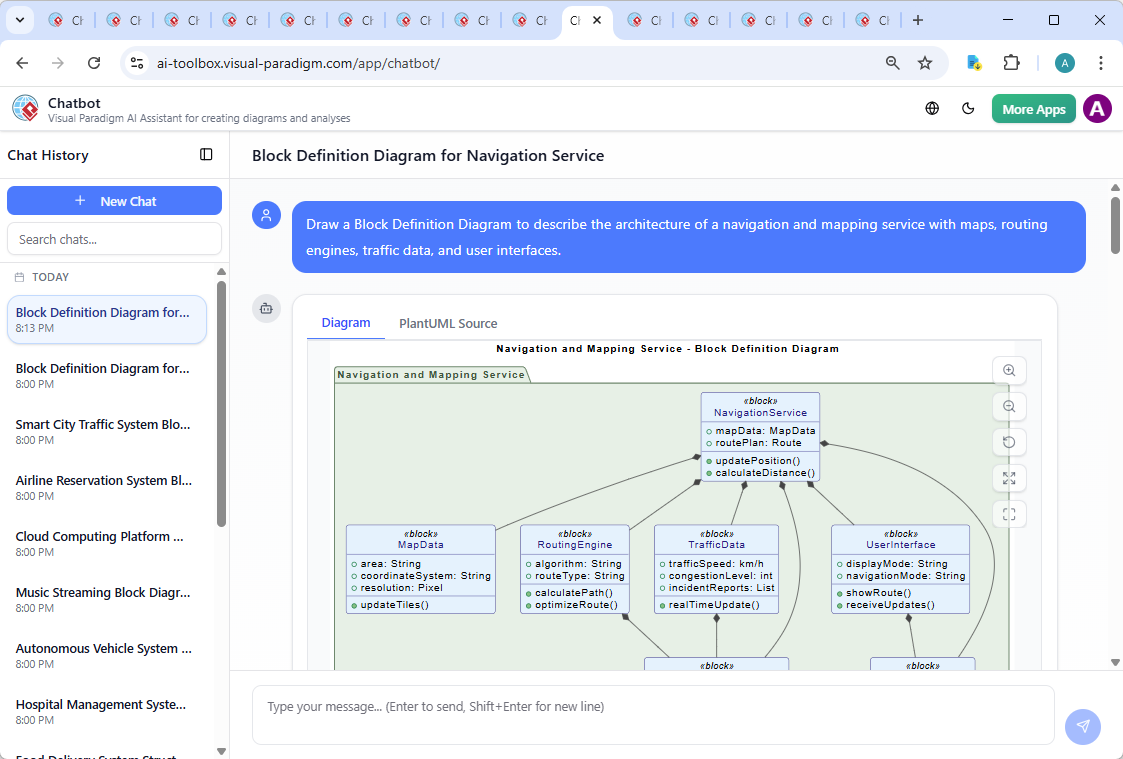
When a user asked to “draw a Block Definition Diagram to describe the architecture of a navigation and mapping service with maps, routing engines, traffic data, and user interfaces,” the AI didn’t just generate a diagram. It began a dialogue — clarifying intent, refining structure, and delivering a complete SysML-based blueprint. This isn’t automation. It’s co-creation.
From Prompt to Architecture: A Collaborative Modeling Journey
The journey began with a simple request. The user’s prompt was clear: model a navigation service with core components. The AI Chatbot responded not with a generic template, but with a fully formed Block Definition Diagram (BDD) in PlantUML syntax — a precise, executable representation of the system’s structure.
But the real value emerged in the follow-up. When the user said, “Explain this diagram,” the AI didn’t just list components. It provided a structured breakdown — defining each block, its responsibilities, and how they interact. This wasn’t a static explanation; it was a guided walkthrough, revealing the logic behind the architecture.
For example, the AI highlighted that NavigationService acts as the central orchestrator, while RouteOptimizer refines routes based on user preferences. It clarified that TrafficData feeds dynamically into the RoutingEngine to enable real-time adjustments — a key feature for modern navigation systems.
When the user asked for deeper insight, the AI offered to expand the model — suggesting sequence diagrams, C4 views, or enhanced data flows. This level of responsiveness isn’t just helpful; it’s transformative. The chatbot doesn’t just draw diagrams — it thinks like an architect.
Decoding the Block Definition Diagram: Structure and Logic
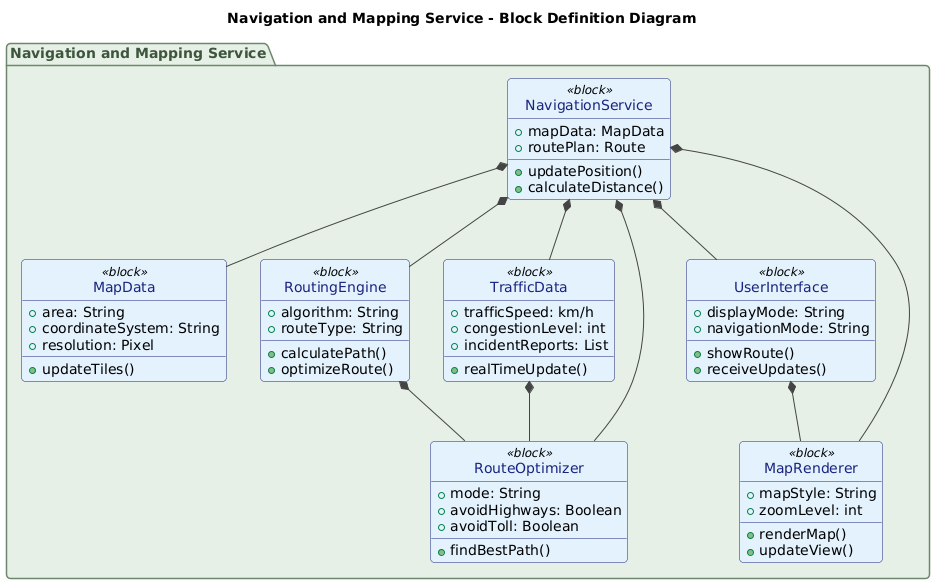
The generated Block Definition Diagram captures the core architecture of a real-time traffic-aware route planning system using SysML’s structural modeling language. Here’s a detailed breakdown of its components and their roles:
- NavigationService (central block): The system’s nucleus. It coordinates map retrieval, route calculation, and UI updates. Its public operations like
calculateDistance()andupdatePosition()reflect real-time tracking and navigation logic. - MapData: Stores the digital foundation — geographic data, coordinate systems, and tile updates. This block ensures the system has accurate spatial context.
- RoutingEngine: Implements pathfinding algorithms (e.g., A*, Dijkstra). It computes the best path based on distance, speed, and road type.
- TrafficData: Captures real-time conditions — congestion levels, speed, incidents. Its
realTimeUpdate()method enables dynamic route recalculations. - RouteOptimizer: A specialized block that enhances routing based on user preferences (e.g., avoid tolls, highways). It works in tandem with the RoutingEngine to deliver personalized routes.
- MapRenderer and UserInterface: Deliver the visual experience. The
renderMap()andshowRoute()methods ensure the user sees accurate, up-to-date navigation guidance.
The relationships between blocks are critical:
NavigationServicedepends onMapData,RoutingEngine,TrafficData, andUserInterface— showing its role as an integration hub.RoutingEngineandTrafficDataboth connect toRouteOptimizer, emphasizing that real-time data and algorithmic logic converge to produce optimal paths.UserInterfaceusesMapRendererto visualize the route — illustrating the separation between logic and presentation.
Choosing a Block Definition Diagram over a class diagram was intentional. BDDs are ideal for SysML-based system modeling, where blocks represent physical or conceptual components — not just classes. This makes the diagram more aligned with real-world system architecture, especially in domains like transportation, IoT, and enterprise software.
Conversational Intelligence: The AI That Designs with Purpose
What sets the Visual Paradigm AI Chatbot apart is its ability to function as a modeling consultant. The chat history proves it: it didn’t just generate a diagram — it interpreted intent, responded to follow-ups, and offered expert-level insights.
When the user requested an explanation, the AI didn’t default to a textbook definition. Instead, it provided a narrative-driven walkthrough — connecting technical blocks to real-world use cases. It even anticipated next steps: offering to generate sequence diagrams or C4 models for deeper analysis.
This is not a passive tool. It’s an active collaborator. Whether refining logic, clarifying relationships, or suggesting enhancements, the AI adapts to the user’s needs — much like a senior architect guiding a junior designer.
Beyond Block Diagrams: A Full Modeling Suite
While this example focused on a SysML Block Definition Diagram, the Visual Paradigm AI Chatbot is built to support a full spectrum of modeling standards. It seamlessly handles:
- UML (Class, Sequence, Use Case, Activity diagrams)
- ArchiMate (Enterprise architecture, business process modeling)
- C4 Model (Software architecture at multiple abstraction levels)
- Mind Maps (Ideation and brainstorming)
- SWOT, PEST, Org Charts, PERT Charts (Strategic planning and project management)
Whether you’re designing a smart city traffic system, modeling a digital transformation initiative, or mapping a startup’s product roadmap, the AI Chatbot adapts. It doesn’t force a one-size-fits-all approach — it learns your domain and responds accordingly.
Conclusion: The Future of Visual Modeling Is Conversational
The real-time traffic-aware route planning system example demonstrates more than a diagram — it shows a new paradigm in system design. With the Visual Paradigm AI Chatbot, modeling isn’t a chore. It’s a dialogue. A process where ideas evolve through intelligent conversation, resulting in accurate, professional-grade models — crafted using the Visual Paradigm AI Chatbot.
Whether you’re an architect, developer, or product manager, the platform empowers you to design with clarity, speed, and confidence. No more guessing. No more manual drafting. Just a smart, intuitive environment where your vision becomes structure — one conversation at a time.
Ready to transform your next system design? Try the AI Chatbot and experience how a truly intelligent modeling platform accelerates innovation.