


Designing a Ride Sharing Ecosystem: An AI-Powered Block Definition Diagram Journey
Creating a structured, scalable model for a ride-sharing application demands precision in capturing the interplay between users, vehicles, pricing logic, and trip lifecycle. The complexity increases when balancing real-time coordination, dynamic pricing, and user trust. Instead of manually drafting diagrams from scratch, the Visual Paradigm AI Chatbot transforms this challenge into a collaborative design conversation—turning high-level ideas into a fully realized SysML Block Definition Diagram (BDD).
From Idea to Diagram: A Conversational Design Journey
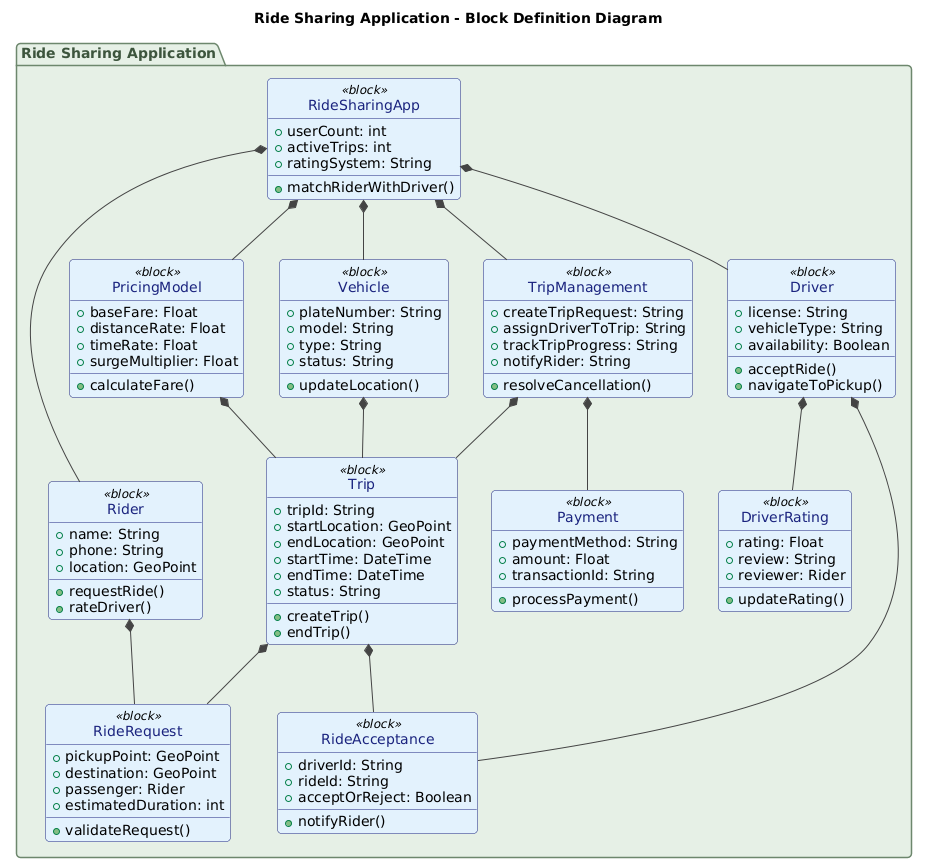
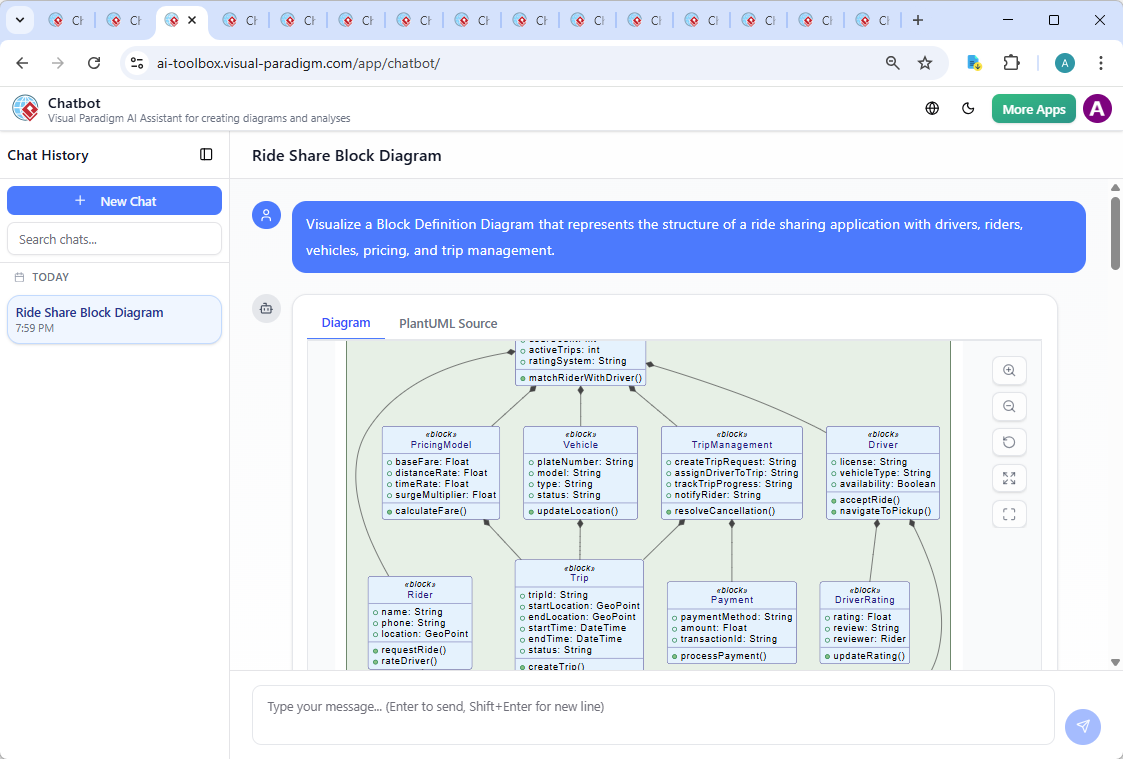
The journey began with a simple prompt: “Visualize a Block Definition Diagram that represents the structure of a ride sharing application with drivers, riders, vehicles, pricing, and trip management.” Within seconds, the Visual Paradigm AI Chatbot delivered a complete, syntactically valid PlantUML representation of the system, already structured with semantic clarity and proper SysML block notation.
But the real value emerged in the follow-up. When the user asked, “How does the TripManagement block coordinate with the Rider and Driver blocks during the ride acceptance phase?”, the AI didn’t just restate the diagram—it explained the logic behind the relationships, breaking down the workflow into actionable steps:
- Rider submits a ride request → TripManagement validates and matches it with a driver.
- Driver receives the request via RideAcceptance → Accepts or rejects.
- Upon acceptance, TripManagement creates a Trip object, assigns the driver, and notifies both parties.
This wasn’t a static diagram—it was a living model, refined through dialogue. The AI didn’t just draw lines; it explained why they mattered, what each block did, and how they interacted under real-world constraints like availability, surge pricing, and feedback loops.
Decoding the Block Definition Diagram Logic
The resulting BDD captures the core structural components of a modern ride-sharing platform using SysML’s block modeling language. Each block represents a self-contained, reusable system component with its own attributes and operations, while the relationships define how they collaborate.
Core Blocks and Their Roles
- RideSharingApp: The top-level container, aggregating all key components and serving as the system’s root.
- Rider and Driver: User-facing entities with location, availability, and action methods (e.g., requestRide, acceptRide).
- Vehicle: Represents the physical asset, with attributes like plate number, model, and status tracking.
- PricingModel: Encapsulates fare logic—base fare, distance/time rates, and surge multipliers—ensuring dynamic pricing is modular and testable.
- Trips and TripManagement: The heart of the system. TripManagement orchestrates the lifecycle: request, assignment, tracking, and completion. It acts as a coordinator, not a controller—ensuring fairness and transparency.
- RideRequest and RideAcceptance: Sub-blocks that encapsulate specific phases of the ride journey, enabling fine-grained modeling of user interactions.
- Payment and DriverRating: Post-ride components that close the loop—ensuring financial and reputational accountability.
Why Block Definition Diagrams?
Unlike traditional class diagrams, SysML Block Definition Diagrams are purpose-built for system architecture. They support:
- Modularity: Each block can be developed, tested, and evolved independently.
- Interoperability: Clear relationships (e.g., association, dependency) define how components interact without tight coupling.
- Traceability: The diagram serves as a blueprint for implementation, documentation, and stakeholder alignment.
The choice of BDD over a standard UML class diagram reflects a deeper architectural maturity—especially critical in complex, real-time systems like ride-sharing.
Conversational Intelligence: The AI Chatbot as Your Modeling Partner
What makes this process transformative isn’t just the diagram—it’s the dialogue. The Visual Paradigm AI Chatbot didn’t generate a diagram and stop. It responded to nuanced questions with expert-level clarity, turning a technical sketch into a strategic blueprint.
For example, when asked about the ride acceptance phase, the AI didn’t just show the associations—it explained the workflow, highlighted the role of TripManagement as a coordinator, and even referenced real-world parallels to Uber and Lyft. This level of contextual intelligence is rare in diagramming tools.
Even more powerful: the ability to refine the model in real time. If the user had said, “AI, refine the logic around surge pricing” or “Explain this branch in the TripManagement flow,” the AI would have responded with updated PlantUML code and a detailed rationale—making the chatbot not just a generator, but a collaborative modeling expert.
Beyond BDD: A Unified AI-Powered Modeling Platform
The Visual Paradigm AI Chatbot isn’t limited to SysML. It supports a full spectrum of modeling standards, including:
- UML: For software design and system behavior.
- ArchiMate: For enterprise architecture, business-IT alignment, and strategy modeling.
- C4 Model: For software architecture at scale—context, containers, components, and code.
- Mind Maps, Org Charts, SWOT, PEST, PERT, and Charts: For strategy, planning, and stakeholder communication.
This versatility means that whether you’re modeling a mobile app, designing a digital transformation strategy, or planning a new product launch, the AI Chatbot adapts to your needs—delivering accurate, standardized diagrams in seconds.
Conclusion: Design with Intelligence, Not Just Tools
The ride-sharing application model isn’t just a diagram—it’s a living blueprint of a modern digital service. With the Visual Paradigm AI Chatbot, this blueprint emerges through intelligent conversation, not just syntax. The AI doesn’t replace the designer; it elevates the design process by providing instant expertise, real-time refinement, and deep system insight.
Ready to model your next system with confidence? Explore the full conversation and try it yourself at this shared session.