


Designing a Social Media Platform with AI: From Concept to Block Definition Diagram
Creating a structured, scalable architecture for a social media platform demands more than visual intuition—it requires precise modeling of components, their relationships, and data flows. The challenge lies in translating abstract concepts like user engagement, content moderation, and real-time analytics into a coherent system blueprint. That’s where the Visual Paradigm AI Chatbot steps in: not as a diagram generator, but as a collaborative modeling partner.
By engaging in a natural conversation, users guide the AI to generate a SysML Block Definition Diagram that reflects the platform’s core components—users, posts, interactions, moderation, and analytics. The AI doesn’t just draw a diagram; it interprets intent, refines structure, and explains design decisions, turning the modeling process into a dynamic, intelligent dialogue.
From Prompt to Precision: The Interactive Journey
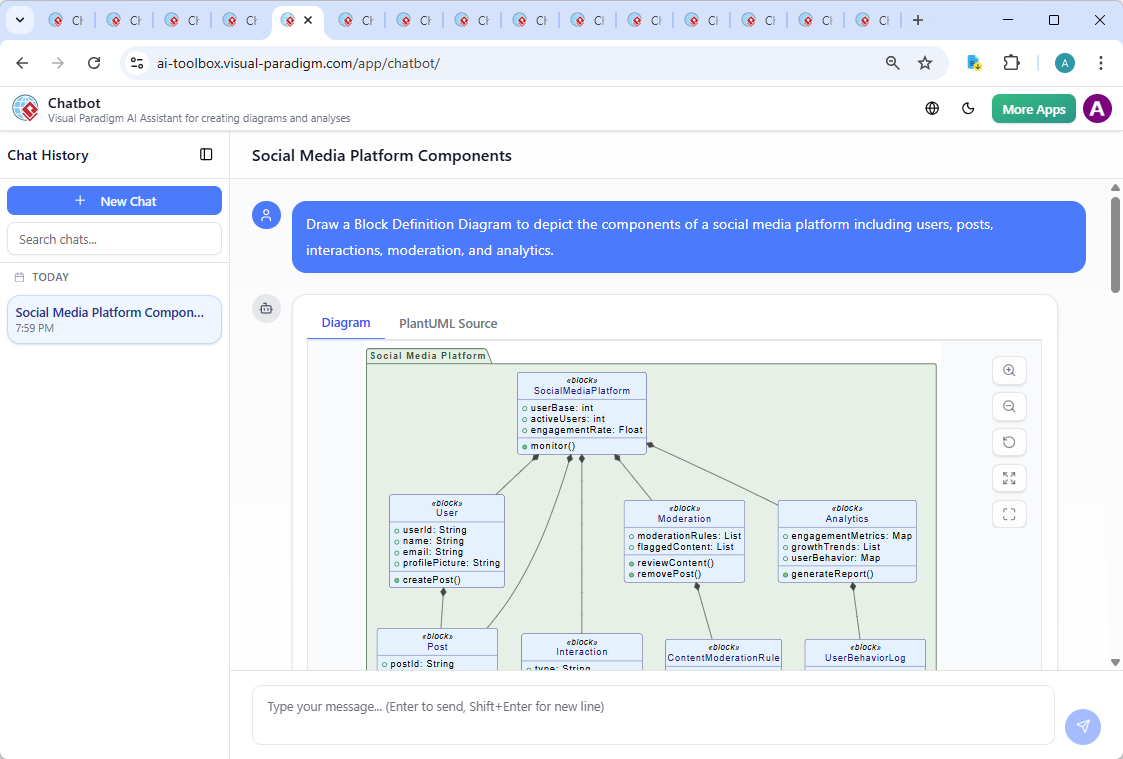
The session began with a simple request: “Draw a Block Definition Diagram to depict the components of a social media platform including users, posts, interactions, moderation, and analytics.”
Within seconds, the Visual Paradigm AI Chatbot delivered a fully rendered PlantUML-based Block Definition Diagram. But this wasn’t a static output—it was the first step in a conversational refinement cycle. The user followed up with a deeper question: “Can you explain how the ‘UserBehaviorLog’ block contributes to the ‘Analytics’ component in the diagram?”
The AI responded with a detailed, contextual explanation, clarifying that UserBehaviorLog acts as the data foundation for analytics. It highlighted how behavioral events—like likes, comments, and views—are captured and processed to generate engagement metrics, growth trends, and user retention insights. This wasn’t just a definition; it was a design justification.
When the user asked for clarification on the role of ContentModerationRule in the moderation layer, the AI expanded on its function—how rules are applied dynamically to flagged content and how thresholds trigger automated actions. These exchanges weren’t just Q&A; they were iterative modeling decisions shaped by real-time feedback.
The AI’s ability to maintain context across multiple rounds, adjust relationships, and explain the why behind each block demonstrates its role as a modeling expert, not just a tool.
Understanding the Logic: Why Block Definition Diagrams?
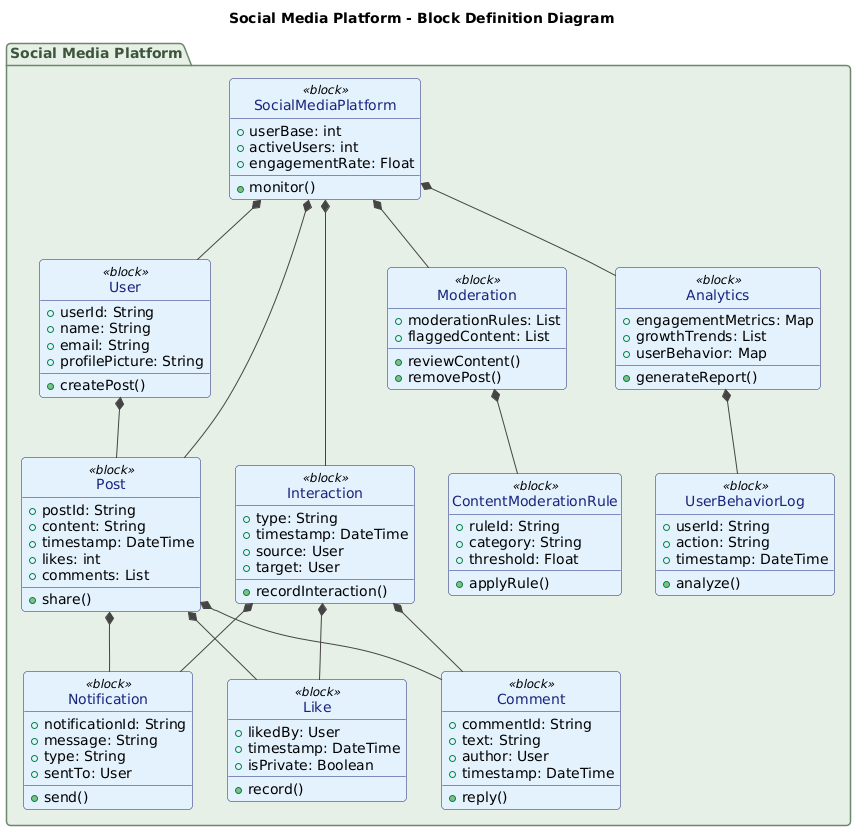
The Block Definition Diagram (BDD) is the ideal choice for this architecture because it defines the static structure of a system—what components exist, how they’re grouped, and how they relate. In this case, the BDD captures:
- Core System Block:
SocialMediaPlatformserves as the top-level container, aggregating all other components. - First-Class Entities:
User,Post, andInteractionrepresent the primary actors and actions in the system. - Sub-Components:
Like,Comment, andNotificationare specialized interaction types nested underPostandInteraction, reflecting their role as derived behaviors. - Supporting Services:
ModerationandAnalyticsare non-interactive but critical for governance and intelligence. - Data Sources:
UserBehaviorLogandContentModerationRuleare specialized blocks that represent persistent data and policy logic, respectively.
The diagram uses association lines to show dependencies: for example, Post owns Like and Comment, while Analytics consumes UserBehaviorLog. These relationships are not arbitrary—they reflect how data flows and responsibilities are distributed in a real-world platform.
By using <> stereotypes, the diagram adheres to SysML standards, enabling precise modeling of system architecture with support for constraints, properties, and internal structure—critical for enterprise-scale design.
Conversational Intelligence: The AI as a Modeling Consultant
What sets this process apart is the depth of insight the AI provides during the conversation. When the user questioned the role of UserBehaviorLog, the AI didn’t just describe it—it explained its strategic value:
- It enables real-time tracking of user actions.
- It feeds into engagement metrics and growth trends.
- It supports personalization engines and moderation heuristics.
This level of contextual understanding transforms the AI from a diagram tool into a modeling consultant. It anticipates follow-up questions, suggests refinements, and even offers to highlight relationships visually—a feature that shows the AI’s awareness of both technical and presentation needs.
The chat history reveals a seamless flow of collaboration: the user poses a question, the AI delivers a clear, structured explanation, and the user gains confidence in the model’s design. This isn’t just automation—it’s co-creation.
Beyond Block Definition: The Full Modeling Power of Visual Paradigm
While this example focused on a SysML Block Definition Diagram, the Visual Paradigm AI Chatbot is not limited to one standard. It seamlessly supports:
- UML: Class, sequence, activity, and component diagrams for software design.
- ArchiMate: Enterprise architecture modeling with business, application, and technology layers.
- SysML: Full support for requirements, parametric, and internal block diagrams.
- C4 Model: Context, containers, components, and code views for software architecture.
- Visual Thinking Tools: Mind maps, org charts, SWOT, PEST, and various chart types (column, area, pie, line).
Whether you’re designing a new feature, documenting system architecture, or aligning stakeholders across business and IT, the AI Chatbot adapts to your needs—no matter the modeling standard.
Conclusion: Design Smarter, Faster, Together
The social media platform example demonstrates how the Visual Paradigm AI Chatbot turns abstract ideas into precise, actionable models through natural conversation. It doesn’t just generate diagrams—it guides, explains, and refines, making complex system design accessible to both technical and non-technical users.
Whether you’re modeling a startup’s MVP or a global enterprise platform, the AI Chatbot ensures your models are not only visually accurate but also logically sound and strategically aligned.
Ready to transform your next design session? Explore the live session and experience how AI-powered visual modeling works in real time.