


Designing a Scalable Video Conferencing Platform with AI-Powered Modeling
Creating a robust architecture for a modern video conferencing platform demands more than just visual clarity—it requires a deep understanding of system components, their interactions, and how they scale under real-world conditions. The challenge lies in translating abstract requirements into a structured, maintainable model that reflects both functional and technical realities.
Enter the Visual Paradigm AI Chatbot—not just a diagram generator, but a collaborative modeling partner. By engaging in a natural, conversational workflow, users can evolve their ideas into precise, standards-compliant models. In this case, the task was to design a Block Definition Diagram (BDD) that captures the high-level organization of a video conferencing platform, including users, sessions, media services, and collaboration tools.
From Prompt to Precision: The Evolution of the BDD
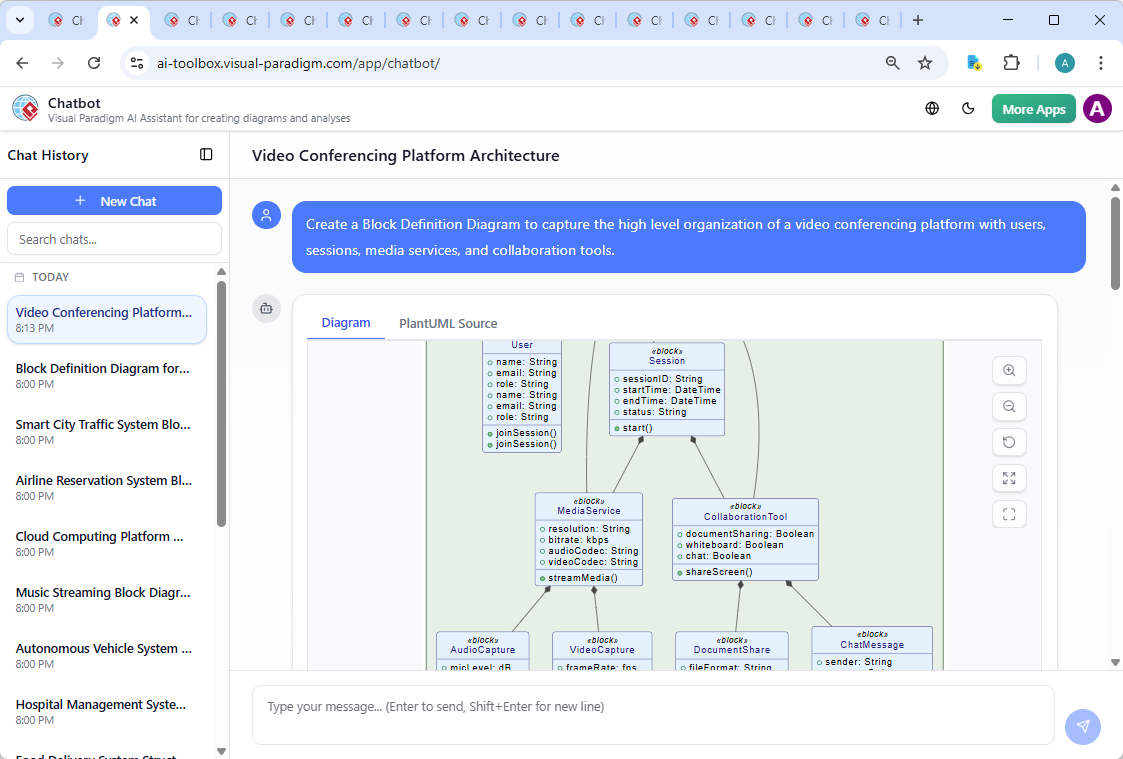
The journey began with a simple request: “Create a Block Definition Diagram to capture the high-level organization of a video conferencing platform with users, sessions, media services, and collaboration tools.” The AI Chatbot responded immediately with a fully rendered PlantUML-based BDD, complete with semantic structure, clear relationships, and detailed block attributes.
But the real value emerged in the conversation that followed. The user asked: “Can you explain the role of the MediaService block in handling audio and video streams during a session?”
The AI didn’t just restate the diagram—it provided a technical deep dive, explaining how the MediaService block manages encoding, resolution control, real-time streaming, and network adaptation. It clarified that the MediaService is not just a container, but the central engine for media delivery, dynamically adjusting to network conditions while ensuring synchronization between audio and video.
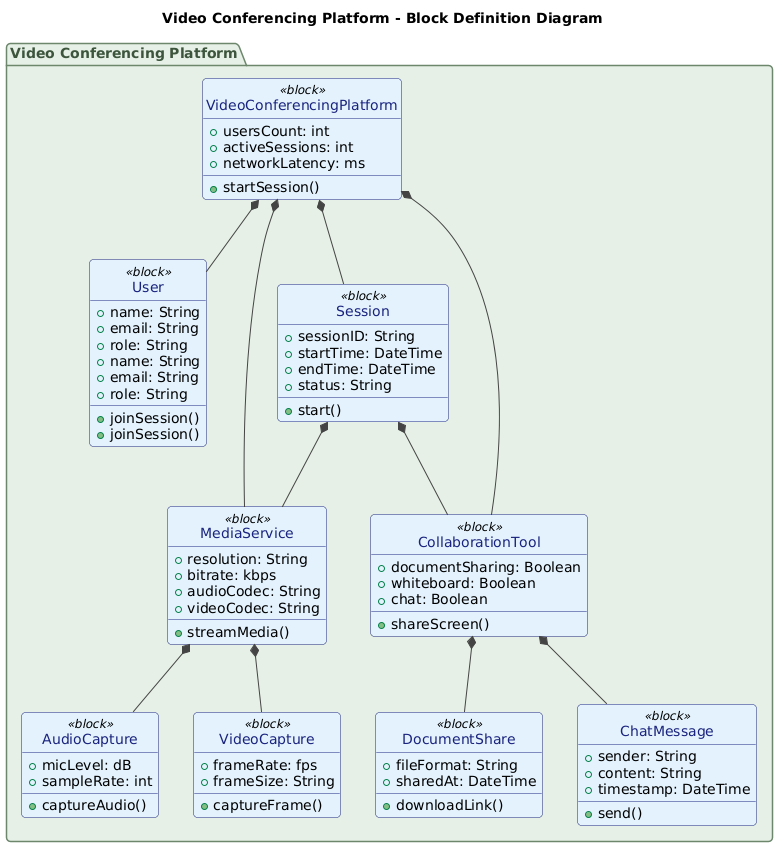
Further refinement came when the user requested deeper insight into sub-components. The AI responded by introducing AudioCapture, VideoCapture, DocumentShare, and ChatMessage blocks—each with domain-specific properties and behaviors. These weren’t added arbitrarily; they were logically nested under their parent blocks to reflect hierarchical composition, a hallmark of SysML BDDs.
This back-and-forth wasn’t just about answering questions—it was about co-creating a model with intent. The AI acted as a modeling consultant, anticipating needs, suggesting structure, and validating design decisions through explanation and context.
Decoding the Block Definition Diagram Logic
The resulting Block Definition Diagram is a structured representation of the platform’s core building blocks and their relationships. Here’s a breakdown of the key elements and their significance:
Core Blocks and Their Roles
VideoConferencingPlatform: The root block that encapsulates the entire system. It contains references toUser,Session,MediaService, andCollaborationTool, defining the platform’s top-level structure.Session: Represents a live meeting instance. It manages the lifecycle (start, end), tracks participants, and coordinates media and collaboration flows.MediaService: The central hub for audio and video processing. It handles capture, encoding, compression, transmission, and synchronization—ensuring high-quality real-time delivery.CollaborationTool: Enables shared experiences such as document sharing and real-time chat, with dedicated sub-blocks forDocumentShareandChatMessage.
Composition and Relationships
Key relationships are defined using composition (solid lines with hollow diamonds):
VideoConferencingPlatformcontainsSession,MediaService, andCollaborationTool—indicating that these are integral to the platform’s existence.SessioncontainsMediaServiceandCollaborationTool, showing that these services are instantiated per session.MediaServicecontainsAudioCaptureandVideoCapture, reflecting how raw media is captured before processing.CollaborationToolcontainsDocumentShareandChatMessage, illustrating how collaboration features are implemented.
The choice of Block Definition Diagram over other UML diagrams was intentional. BDDs are ideal for modeling the structure of complex systems at a high level, especially when dealing with components that may be reused across multiple contexts—such as media services in different types of applications.
Conversational Intelligence in Action
What sets Visual Paradigm apart is the depth of insight the AI Chatbot provides during the design process. The ability to ask follow-up questions like “Explain this branch” or “Refine the logic” isn’t just a feature—it’s a design accelerator.
In this case, the AI didn’t stop at diagram rendering. It explained:
- How
MediaServicedynamically adapts to network latency. - Why audio-video synchronization is critical for user experience.
- How the platform abstracts device differences to ensure cross-platform consistency.
This conversational depth transforms the AI from a tool into a co-designer—one that understands not just syntax, but system behavior and architectural intent.
Beyond BDD: A Full-Spectrum Modeling Platform
While this example focuses on SysML Block Definition Diagrams, the Visual Paradigm AI Chatbot is built to support a full range of modeling standards:
- UML: For object-oriented design and system behavior modeling.
- ArchiMate: For enterprise architecture, capturing business, application, and technology layers.
- C4 Model: For software architecture, enabling clear context diagrams and container-level views.
- Mind Maps, Org Charts, SWOT, PEST, PERT Charts: For strategic planning, team structure, and project scheduling.
This versatility means the AI Chatbot isn’t limited to one type of diagram—it’s a unified, intelligent environment for visual modeling across domains, from software engineering to enterprise strategy.
Conclusion: Design with Intelligence, Not Just Tools
Building a scalable video conferencing platform isn’t just about features—it’s about structure, clarity, and foresight. The Visual Paradigm AI Chatbot enables teams to design with confidence, turning abstract ideas into precise, standards-compliant models through natural conversation.
Whether you’re defining system boundaries, refining component behavior, or exploring architectural trade-offs, the AI doesn’t just draw diagrams—it helps you think through them.
Ready to design your next system with AI-powered precision? Explore Visual Paradigm today and experience the future of visual modeling.