


Designing Secure ATM Systems with AI: A SysML Internal Block Diagram Journey
Creating a precise and secure model of an ATM’s internal operations is no small task—especially when the system must handle financial transactions, user authentication, and real-time cash dispensing. Traditional modeling tools often require deep expertise in SysML and meticulous manual configuration. But with Visual Paradigm’s AI Chatbot, the process transforms into a collaborative conversation, where domain knowledge and technical precision converge.
When the user requested a SysML Internal Block Diagram (IBD) for an ATM cash withdrawal system, the AI Chatbot didn’t just generate a static diagram. It engaged in a dynamic, iterative dialogue—understanding intent, refining logic, and explaining architectural decisions in real time. This isn’t a diagram generator; it’s a conversational modeling partner.
From Prompt to Precision: The Evolution of the ATM IBD
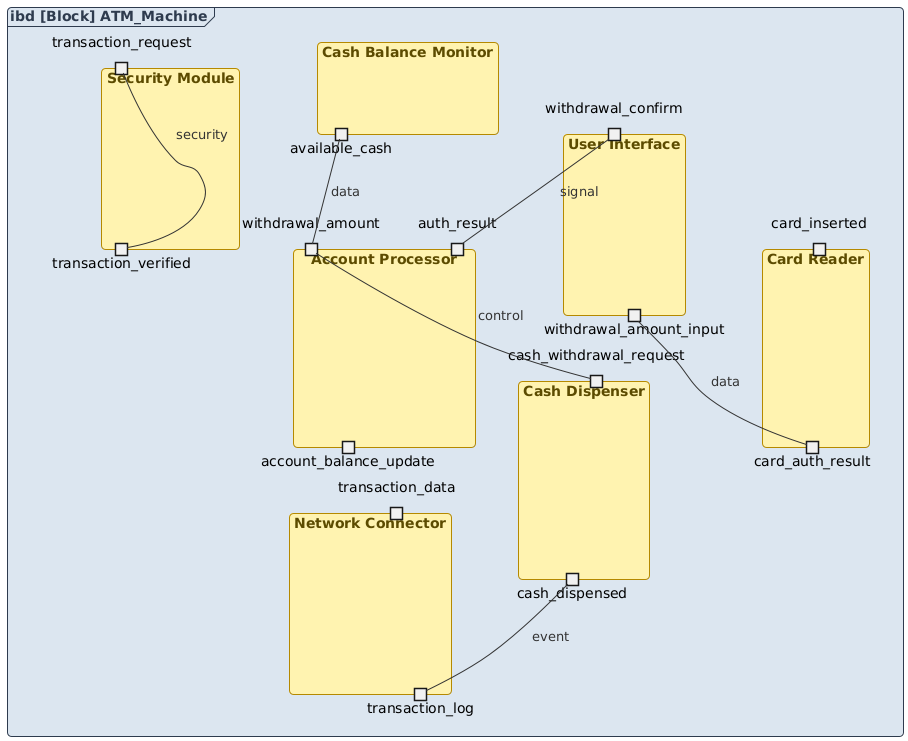
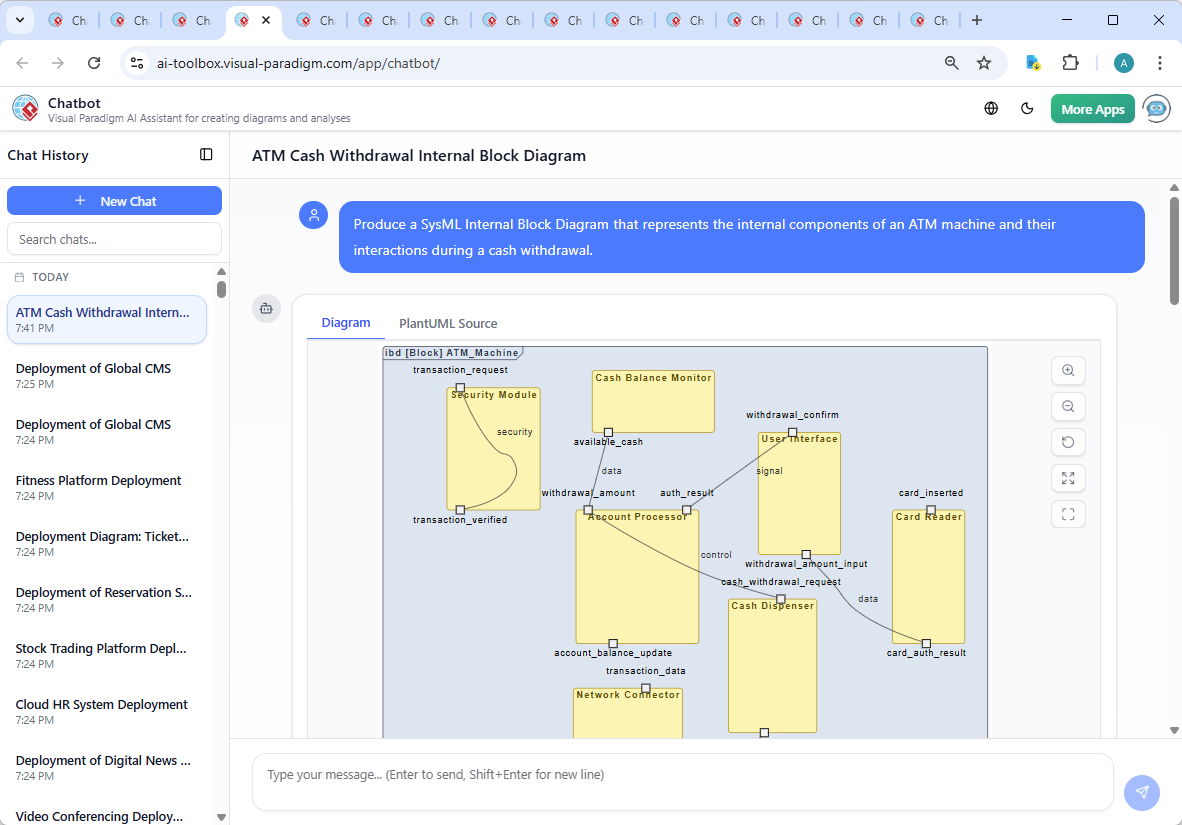
The journey began with a simple request: “Produce a SysML Internal Block Diagram that represents the internal components of an ATM machine and their interactions during a cash withdrawal.” The AI responded with a fully structured PlantUML-based IBD, accurately capturing the core components—Cash Dispenser, Card Reader, User Interface, Account Processor, Security Module, Cash Balance Monitor, and Network Connector—each defined with ports and interaction flows.
But the real value emerged in the follow-up. The user asked: “Can you explain how the Security Module verifies a transaction request during a cash withdrawal?” Instead of a generic answer, the AI delivered a detailed, step-by-step breakdown of the verification logic:
- How the
transaction_requestport receives data from the Account Processor. - What checks the Security Module performs: PIN validation, session integrity, fraud detection, and transaction limits.
- How the
transaction_verifiedsignal acts as a gatekeeper—only allowing the withdrawal to proceed if all conditions are met.
This wasn’t just an explanation; it was a modeling insight. The AI didn’t just describe the diagram—it validated the design’s intent and reinforced its correctness through context-aware reasoning.
Decoding the Logic: Why IBDs Are Ideal for ATM Architecture
Internal Block Diagrams (IBDs) in SysML are specifically designed to represent the internal structure of a system—its components, ports, and the interactions between them. This makes them ideal for modeling complex systems like ATMs, where multiple subsystems must coordinate under strict security and timing constraints.
Key design choices in this IBD include:
- Component Abstraction: Each functional unit (e.g., Card Reader, Security Module) is modeled as a component, clearly delineating responsibilities.
- Port-Based Communication: Ports like
cash_withdrawal_requestandtransaction_verifieddefine how components interact—ensuring clarity on data and control flow. - Signal and Data Flow Semantics: The use of
: data,: control, and: eventannotations clarifies the nature of each interaction, which is critical in financial systems where timing and correctness are paramount. - Security as a First-Class Component: The Security Module is not an afterthought—it’s a central, dedicated component with explicit input and output ports, reflecting its critical role in the transaction lifecycle.
These choices aren’t arbitrary. They reflect the AI’s understanding of both SysML best practices and the operational realities of ATM systems—where a single failure in verification can lead to financial loss or fraud.
Conversational Intelligence in Action
What sets Visual Paradigm apart is that the AI Chatbot doesn’t just generate diagrams—it collaborates. The user’s follow-up question wasn’t just answered; it was used to deepen the model’s credibility and educational value. The AI didn’t stop at listing checks—it explained their purpose, their order, and their impact on system behavior.
This kind of interaction is what makes the AI a true modeling consultant. It anticipates questions, provides context, and even suggests next steps—like creating a sequence diagram to visualize the security flow.
More Than Just IBDs: A Multi-Standard AI Modeling Suite
While this example focused on SysML, the Visual Paradigm AI Chatbot is not limited to one standard. It seamlessly supports:
- UML: For object-oriented design and behavioral modeling.
- ArchiMate: For enterprise architecture, enabling modeling of business, application, and technology layers.
- C4 Model: For software architecture, supporting Context, Containers, Components, and Code views.
- Visual Diagrams: Including Mind Maps, Org Charts, SWOT, PEST, and various data charts (column, area, pie, line).
Whether you’re designing a banking system, a cloud infrastructure, or a product roadmap, the AI Chatbot adapts to your domain and standard of choice—offering consistent, accurate, and intelligent modeling support.
Conclusion: Design with Confidence, Powered by AI
Modeling complex systems like an ATM isn’t just about drawing boxes and lines. It’s about understanding how components interact, how failures are prevented, and how security is embedded into the design. Visual Paradigm’s AI Chatbot transforms this process into a natural, conversational journey—where every question leads to deeper clarity and every refinement strengthens the model.
Whether you’re a systems engineer, enterprise architect, or software designer, the ability to co-create models through dialogue is a game-changer. The AI doesn’t just generate diagrams—it understands them, explains them, and evolves them with you.
Ready to build smarter systems? Explore the full ATM IBD session and experience how AI is redefining visual modeling.