


Designing Intelligent Cooling: A SysML Internal Block Diagram for Data Center Thermal Management
Managing heat in modern data centers is no longer just about airflow—it’s about intelligent, adaptive control. With servers generating increasing heat under heavy workloads, traditional cooling systems struggle to maintain efficiency and stability. This is where SysML’s Internal Block Diagram (IBD) becomes essential: it enables precise modeling of system components, their interactions, and the flow of physical entities like heat and control signals.
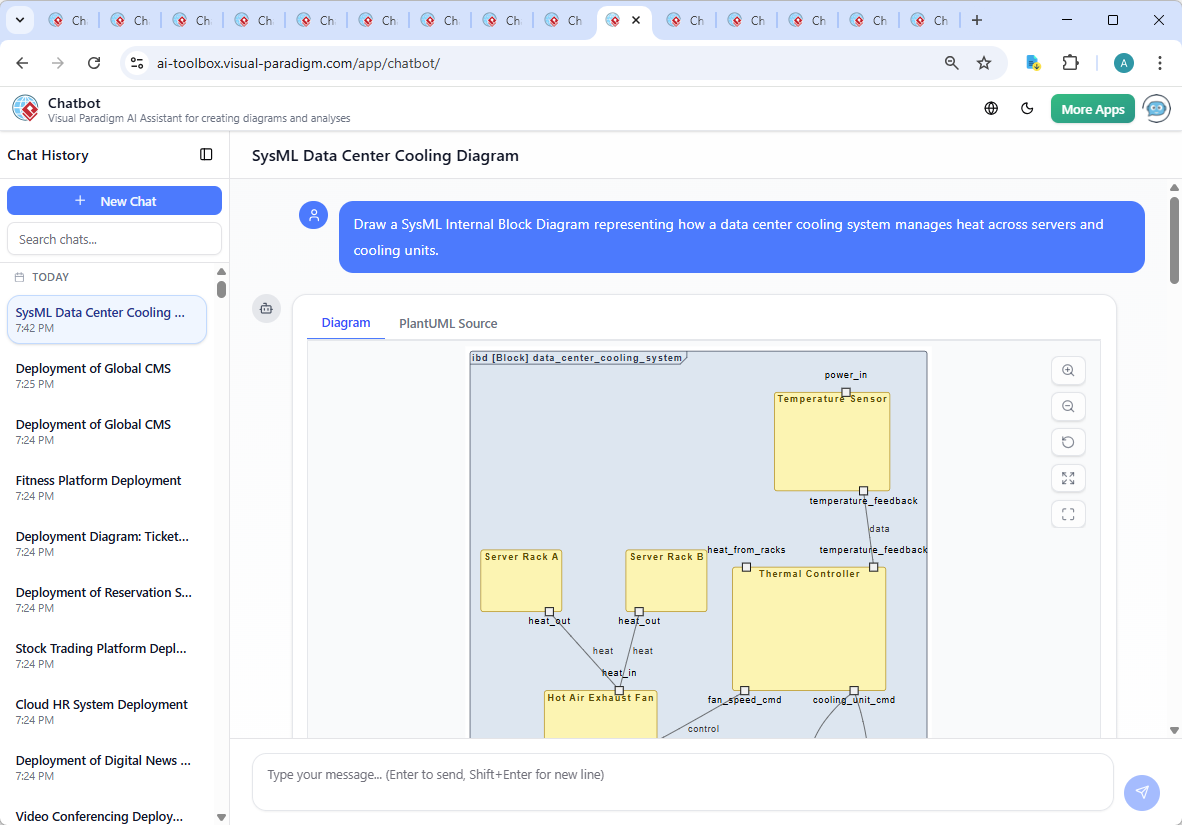
Enter the Visual Paradigm AI Chatbot—an intelligent, conversational modeling partner that transforms high-level ideas into structured, standards-compliant diagrams. Rather than requiring users to master complex notation, the AI interprets natural language prompts and delivers accurate, production-ready IBDs. In this case, the prompt was simple: “Draw a SysML Internal Block Diagram representing how a data center cooling system manages heat across servers and cooling units.” The result? A dynamic, real-time visual model of a self-regulating thermal control system.
From Prompt to Precision: A Collaborative Modeling Journey
The process began with a clear request. The AI Chatbot immediately generated a structured IBD using PlantUML syntax, capturing the core components of the system: server racks, cooling units, exhaust fans, temperature sensors, and the central Thermal Controller. But this wasn’t the end—it was just the beginning of a dialogue.
When the user asked, “How does the Thermal Controller determine the fan speed and cooling unit commands based on the temperature feedback?”, the AI didn’t just repeat the diagram. It responded with a detailed, step-by-step explanation of the control logic—complete with decision rules, feedback loops, and real-world operational scenarios. This level of insight demonstrates the AI’s role not as a diagram generator, but as a modeling expert.
The conversation continued with targeted refinements: the AI clarified how heat flows from server racks to exhaust fans, how cooling units receive commands based on load, and how temperature feedback triggers adaptive responses. Each follow-up—such as “Explain this branch” or “Refine the logic”—was met with deeper technical clarity, proving the AI’s ability to reason through system behavior.
Decoding the System Logic: Why This IBD Works
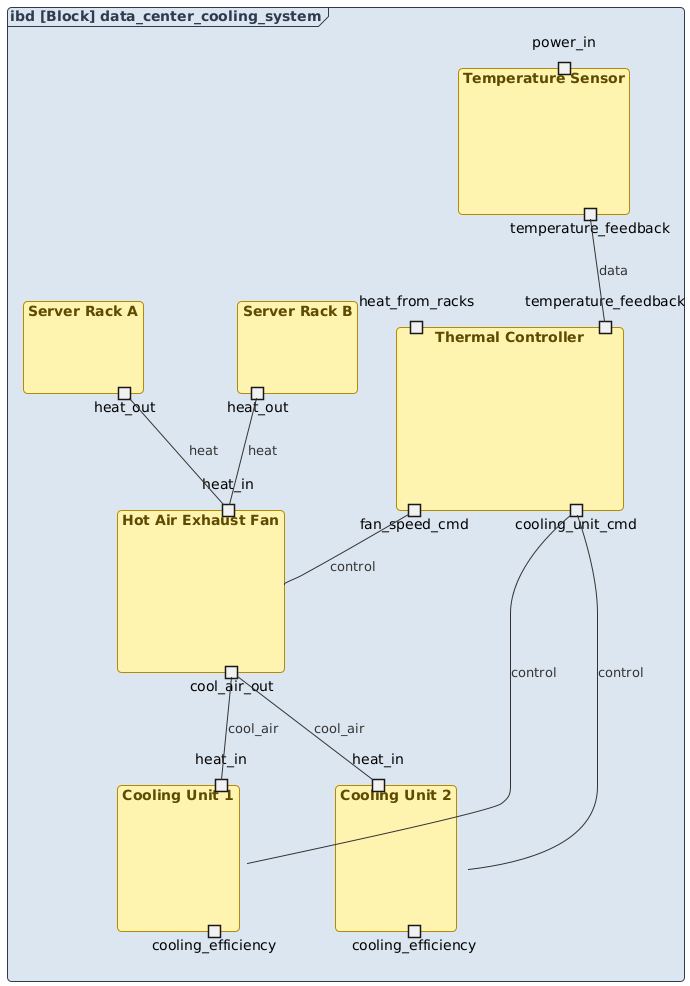
The generated IBD is more than a visual map—it’s a functional blueprint of a closed-loop control system. Let’s break down its key elements:
Core Components and Their Roles
- Server Racks (A and B): Generate heat during operation. Their
heat_outports deliver thermal energy to the cooling path. - Hot Air Exhaust Fan: Receives hot air from the server racks via
heat_inand outputs cooled air viacool_air_out. It’s controlled by the Thermal Controller. - Cooling Units 1 & 2: Absorb heat from the air stream. They respond to control commands to adjust cooling capacity based on demand.
- Temperature Sensor: Monitors ambient temperature and sends feedback to the Thermal Controller. This enables real-time adaptation.
- Thermal Controller: The brain of the system. It processes temperature data and heat load signals to issue commands for fan speed and cooling unit activation.
Flow of Control and Physical Entities
The IBD uses SysML’s internal block notation to model how components are connected and interact:
heatflows from server racks to the exhaust fan.cool_airis delivered from the fan to both cooling units.temperature_feedbackis sent from the sensor to the controller.fan_speed_cmdandcooling_unit_cmdare control signals sent from the controller to its actuators.
These flows are not arbitrary—they represent the actual physical and logical interactions in a real data center. By using IBD, the model captures both the structure and behavior of the system in a single, coherent view, making it ideal for architecture reviews, system verification, and stakeholder communication.
Why IBD Over Other Diagrams?
While a simple block diagram might show components, the IBD adds critical depth: it reveals how components are interconnected, what flows through those connections, and how control signals influence behavior. This makes it indispensable for complex systems like data center cooling, where failure to balance heat and cooling leads to equipment damage or energy waste.
Conversational Intelligence: The AI as Your Modeling Partner
What sets Visual Paradigm apart is not just the diagram output—but the way the AI supports the entire design process. The chat history shows a true collaboration: the user posed a question, the AI responded with technical depth, and the conversation evolved into a co-creation of a reliable system model.
For instance, when the user asked for clarification on the control logic, the AI didn’t just explain—it contextualized the behavior with real-world scenarios: high load triggers more cooling; low load reduces power use. This level of reasoning ensures the model isn’t just visually accurate but functionally sound.
Beyond IBD: A Unified Modeling Platform
The Visual Paradigm AI Chatbot isn’t limited to SysML. It supports a full suite of modeling standards, including:
- UML: For software and system design.
- ArchiMate: For enterprise architecture and business-IT alignment.
- C4 Model: For software architecture visualization at multiple levels.
- Mind Maps, Org Charts, PEST, SWOT: For strategic planning and idea structuring.
This versatility means users can switch between standards seamlessly—whether designing a cloud architecture, analyzing market risks, or modeling system behavior. The AI adapts to each context, ensuring consistency and accuracy across the board.
Conclusion: Building Smarter Systems, One Conversation at a Time
Designing a resilient, energy-efficient data center cooling system demands more than static diagrams. It requires a deep understanding of physical flows, control logic, and adaptive behavior. The Visual Paradigm AI Chatbot delivers that understanding—transforming natural language into precise, intelligent models that evolve through conversation.
Whether you’re an architect, engineer, or business strategist, the ability to co-design with an AI that understands both the technical and strategic dimensions of your system is a game-changer.
Ready to model your next system? Explore the shared session and see how the AI brings your vision to life—step by step, conversation by conversation.