


Designing a Safer Drive: AI-Powered SysML Internal Block Diagram of a Passenger Car Braking System
Designing a robust braking system requires more than just assembling components—it demands a precise understanding of how each part interacts under real-world stress. Engineers and architects face the challenge of modeling complex, interdependent systems where timing, feedback loops, and safety-critical logic must be clearly visualized. With the rise of advanced driver-assistance systems (ADAS), the need for accurate, dynamic modeling has never been greater.
Enter the Visual Paradigm AI Chatbot—not just a diagram generator, but a conversational design partner. When prompted to visualize a passenger car braking system, the AI didn’t just produce a static diagram. It engaged in a collaborative dialogue, refining the model based on real-time feedback, ensuring every component’s role and interaction was logically sound and technically accurate.
From Prompt to Precision: The Interactive Journey of Model Creation
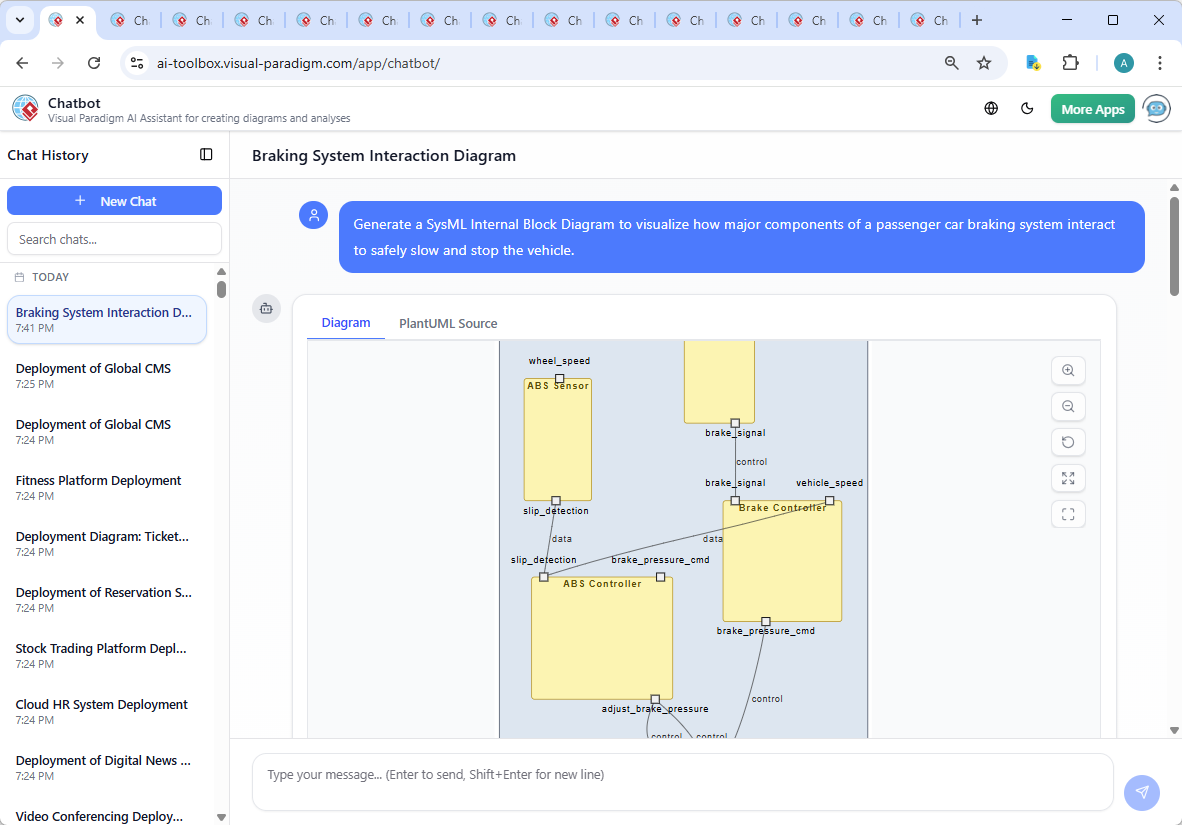
The process began with a simple request: “Generate a SysML Internal Block Diagram to visualize how major components of a passenger car braking system interact to safely slow and stop the vehicle.” Within seconds, the AI delivered a fully structured SysML IBD, complete with components, ports, and connection types—using the plantuml syntax standard for precise modeling.
But the conversation didn’t end there. The user followed up with a critical question: “Can you explain how the ABS controller uses slip detection data to adjust brake pressure in real time?” This wasn’t a request for a diagram update—it was a request for deeper technical insight.
The AI responded with a layered explanation that unpacked the physics and control logic behind ABS operation. It clarified how wheel speed sensors detect slip, how the ABS controller interprets this as a risk, and how it dynamically adjusts brake pressure through rapid pulsing—ensuring wheel rotation is maintained during hard braking.
This wasn’t just a description. It was a model-informed explanation, rooted in the structure of the diagram itself. The AI referenced the abs_sensor_slip_detection port, the abs_controller_slip_detection input, and the abs_controller_adjust_brake_pressure output—showing how the data flow and control loop were not just drawn, but functionally coherent.
That’s the power of the Visual Paradigm AI Chatbot: it doesn’t just generate diagrams—it understands them, and can explain them in context, making it an indispensable collaborator in system design.
Decoding the Logic: Why This Internal Block Diagram Works
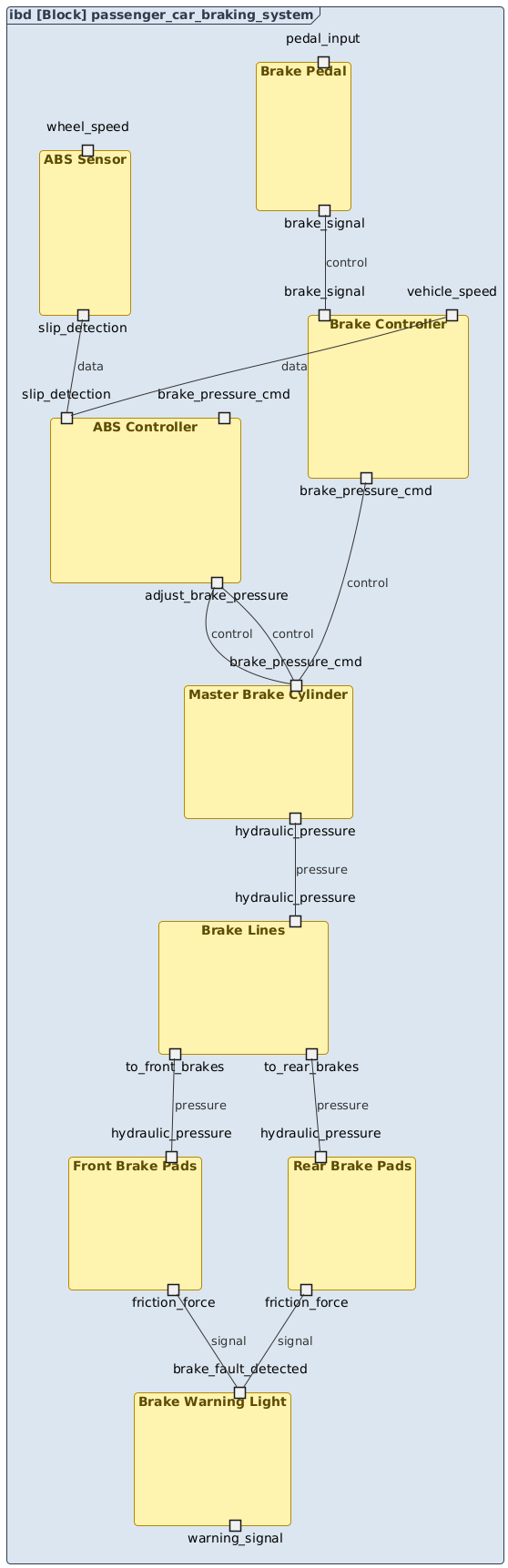
The diagram captures the internal structure and interactions of the braking system using SysML’s Internal Block Diagram (IBD) standard. Unlike traditional block diagrams, IBDs show both the components and their internal connections, making them ideal for modeling systems with complex control and data flows.
Here’s how the key elements align with the real-world function:
- Brake Pedal → Brake Controller: The driver’s input is converted into a control signal. This is the primary trigger for braking.
- Brake Controller → Master Brake Cylinder: The controller sends a pressure command based on pedal force and vehicle speed. This is where hydraulic pressure is generated.
- Master Brake Cylinder → Brake Lines: Hydraulic pressure is transmitted through the brake lines to both front and rear brakes.
- Front/Rear Brake Pads → Friction Force: The pads apply friction to the rotors, slowing the wheels. This force is also used as a feedback signal for the warning system.
- ABS Sensor → ABS Controller: Real-time wheel speed data is fed into the controller to detect slip.
- ABS Controller → Master Brake Cylinder (via pressure adjustment): The controller sends a dynamic signal to modulate brake pressure, preventing lock-up.
What makes this IBD particularly effective is its use of port-based connections with semantic labels:
controlfor command signals (e.g., brake pressure command)pressurefor hydraulic transmissiondatafor sensor input (e.g., wheel speed)signalfor fault detection (e.g., low friction)
This notation ensures clarity and traceability—critical when validating safety requirements or performing system-level analysis.
Conversational Intelligence: The AI as a Modeling Consultant
The true value of the Visual Paradigm AI Chatbot lies in its ability to function as a technical collaborator. When the user asked for an explanation of the ABS logic, the AI didn’t default to generic text. Instead, it:
- Referenced specific ports and connections from the diagram.
- Explained the real-time control loop with measurable timing (e.g., 100 cycles per second).
- Connected the technical behavior to safety outcomes (e.g., maintaining steering control).
- Provided a concrete example of how the system behaves during an emergency stop.
This level of contextual understanding is rare in AI tools. The Visual Paradigm AI Chatbot doesn’t just generate models—it reasons about them, enabling users to explore edge cases, validate assumptions, and refine designs through conversation.
Beyond IBD: A Unified Platform for System Modeling
While this example focused on a SysML Internal Block Diagram, the Visual Paradigm AI Chatbot is not limited to one standard. It seamlessly supports a wide range of modeling languages and diagram types, including:
- UML (Class, Sequence, Use Case, Activity diagrams)
- ArchiMate (Enterprise architecture, business processes, IT layers)
- Systems Modeling Language (SysML) (with full support for IBD, Block Definition Diagrams, Requirement diagrams)
- C4 Model (Context, Containers, Components, Code)
- Visual Diagrams (Mind Maps, Org Charts, SWOT, PEST, PERT, and various Charts: column, line, pie, area)
Whether you’re designing a software system, mapping enterprise architecture, or modeling automotive safety systems, the AI Chatbot adapts to your needs—providing consistent, accurate, and conversationally guided modeling support across the entire spectrum.
Conclusion: Design Smarter, Collaborate Faster
The passenger car braking system is a high-stakes system where every component and connection must perform reliably. The Visual Paradigm AI Chatbot transforms the modeling process from a static task into an interactive, intelligent dialogue—ensuring that your diagrams aren’t just visual, but functionally correct and deeply understandable.
By combining the precision of SysML with the conversational intelligence of AI, Visual Paradigm empowers engineers, architects, and designers to build safer, smarter systems—faster and with greater confidence.
Ready to model your next system with AI-driven clarity? Explore the live session and see how the AI Chatbot turns your ideas into actionable models.