


Designing a Smart Home’s Brain: How AI Transforms Sensor Data into Intelligent Automation
Creating a cohesive, intelligent smart home system requires more than just connecting devices—it demands a clear understanding of how sensors, controllers, and appliances interact in real time. The challenge lies in modeling these complex interactions with precision while ensuring the system remains responsive, efficient, and context-aware.
Enter the Visual Paradigm AI Chatbot—not just a diagram generator, but a collaborative modeling partner. When prompted to visualize a SysML Internal Block Diagram (IBD) for a smart home temperature monitoring system, the AI didn’t just produce a static image. It began a dynamic conversation, refining logic, clarifying relationships, and deepening the design with every exchange.
From Prompt to Precision: A Collaborative Design Journey
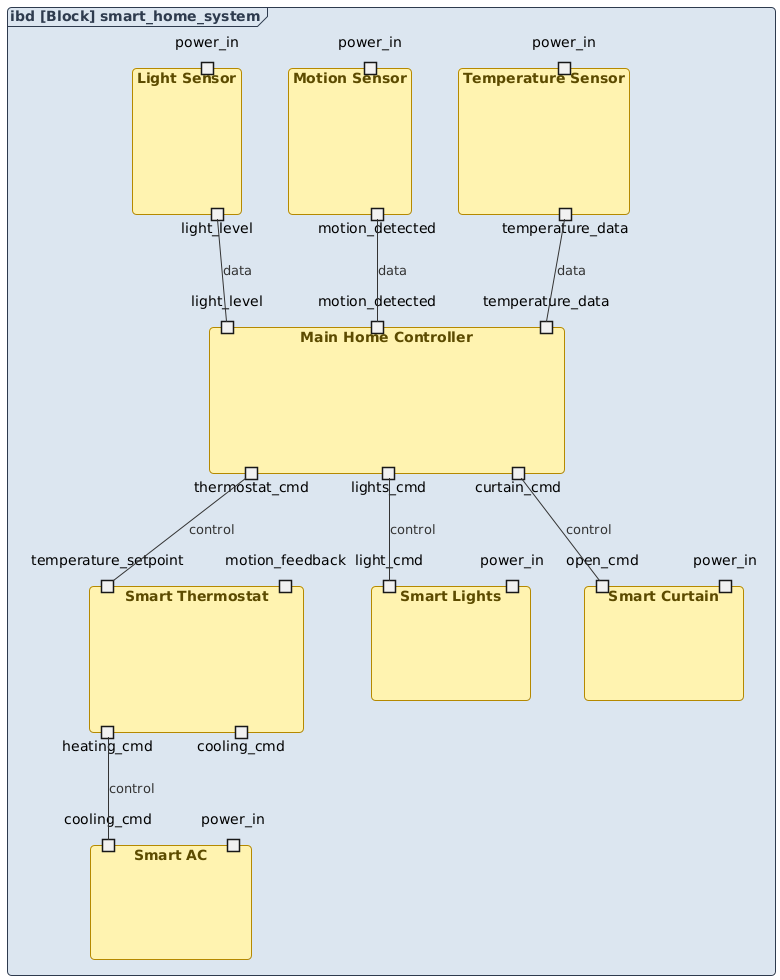
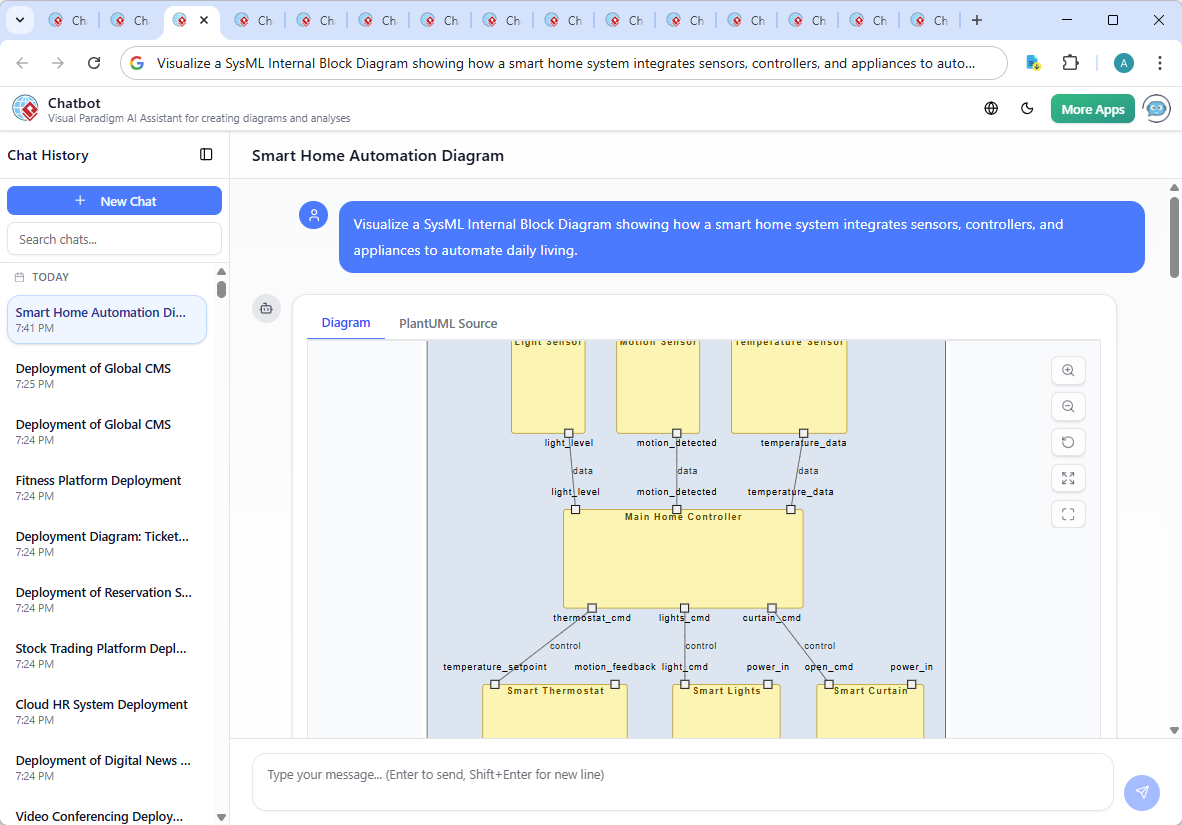
The journey started with a simple request: “Visualize a SysML Internal Block Diagram showing how a smart home system integrates sensors, controllers, and appliances to automate daily living.” Within seconds, the AI delivered a fully structured IBD using PlantUML syntax, already showing key components like the Temperature Sensor, Motion Sensor, Smart Thermostat, and Main Home Controller.
But the real value emerged in the follow-up. The user asked: “Can you explain how the Main Home Controller processes data from the Temperature Sensor, Motion Sensor, and Light Sensor to generate control commands?”
Instead of a generic answer, the AI delivered a layered breakdown—mapping data flow, decision logic, and automation triggers. It didn’t just describe the diagram; it explained the intent behind each port, connection, and control signal, turning the IBD into a living blueprint of intelligent behavior.
For instance, it clarified that the controller doesn’t act on individual sensor data in isolation. Instead, it evaluates combinations of inputs—such as motion + low light + cold temperature—to trigger context-aware actions like turning on lights, adjusting the thermostat, or opening curtains.
This wasn’t a one-way output. The AI invited further exploration: “Let me know if you’d like this visualized in a sequence diagram or a state machine!”—proving its role as a true design consultant, not just a tool.
Decoding the Logic: Why This IBD Works
The Internal Block Diagram (IBD) is ideal for this use case because it reveals the internal structure of a system—not just its components, but how they interact through ports and interfaces. In this smart home model, each component has clearly defined ports:
- Input ports (e.g.,
temperature_data,motion_detected) receive real-time sensor data. - Output ports (e.g.,
heating_cmd,lights_cmd) send control signals to actuators.
Connections between ports represent data or control flows. For example:
Temperature Sensor → Main Home Controller: Sends ambient temperature data.Main Home Controller → Smart Thermostat: Sends atemperature_setpointcommand.Smart Thermostat → Smart AC: Sends acooling_cmdto activate cooling.
These flows are not arbitrary. They reflect real-world automation logic:
- If motion is detected at night, lights turn on.
- If the room is cold and someone is present, the thermostat adjusts.
- If no motion is detected for 10 minutes, lights and heating enter energy-saving mode.
The IBD makes these dependencies visible at a glance—something traditional diagrams often obscure. It’s not just a visual; it’s a functional specification in diagram form.
Conversational Intelligence: The AI That Designs With You
What sets Visual Paradigm apart is how the AI Chatbot evolves with the conversation. After the initial diagram, the user didn’t need to re-engage the tool—just ask a question, and the AI responded with expert-level insight, treating the model as a living system to be discussed, refined, and optimized.
For example, when asked to explain the data processing logic, the AI didn’t just list inputs and outputs. It provided a decision flow model, showing how the controller combines sensor data into context-aware actions. It even suggested future modeling options—sequence diagrams or state machines—demonstrating its deep understanding of SysML and modeling best practices.
This level of collaboration is rare. Most tools generate diagrams and stop. Visual Paradigm’s AI doesn’t just draw—it reasons, explains, and evolves the design with you.
More Than Just IBD: A Full Modeling Suite
The AI Chatbot isn’t limited to SysML. It supports a full spectrum of modeling standards, making Visual Paradigm the complete AI-powered visual modeling platform for enterprise and software architects:
- UML: Use cases, class diagrams, sequence diagrams.
- ArchiMate: Enterprise architecture modeling with business, application, and technology layers.
- SysML: Internal Block Diagrams, activity diagrams, parametric models.
- C4 Model: Context, containers, components, and code-level views for software architecture.
- Other Visual Tools: Mind maps, PERT charts, organizational charts, SWOT, and data visualizations (column, area, pie, line).
Whether you’re designing a smart home, a cloud-native application, or a digital transformation strategy, the AI Chatbot adapts to your domain—providing accurate, context-aware modeling support across standards.
Conclusion: Your Smart Home, Designed with Intelligence
Building a smart home isn’t just about wiring devices. It’s about creating a system that thinks, reacts, and learns. The SysML Internal Block Diagram generated here is more than a diagram—it’s a blueprint for intelligent automation.
With Visual Paradigm’s AI Chatbot, you don’t need to be a modeling expert. You just need a vision. The AI handles the complexity, refines the logic, and delivers a professional-grade model—crafted using the Visual Paradigm AI Chatbot.
Ready to design your next intelligent system? Start the conversation today.