


Designing a Smart Washing Machine: An AI-Powered SysML Internal Block Diagram
Designing complex electromechanical systems like a washing machine demands precision in modeling how subsystems interact—especially when balancing water intake, drum motion, and control logic. Traditional diagramming tools often require deep expertise and manual effort. But with the Visual Paradigm AI Chatbot, this process transforms into a collaborative conversation.
Instead of wrestling with syntax or component placement, users simply describe their intent in natural language. The AI interprets the request, generates a structured SysML Internal Block Diagram (IBD), and refines it through iterative feedback—making it ideal for engineers, product designers, and system architects who need clarity without the overhead.
From Prompt to Precision: The Interactive Design Journey
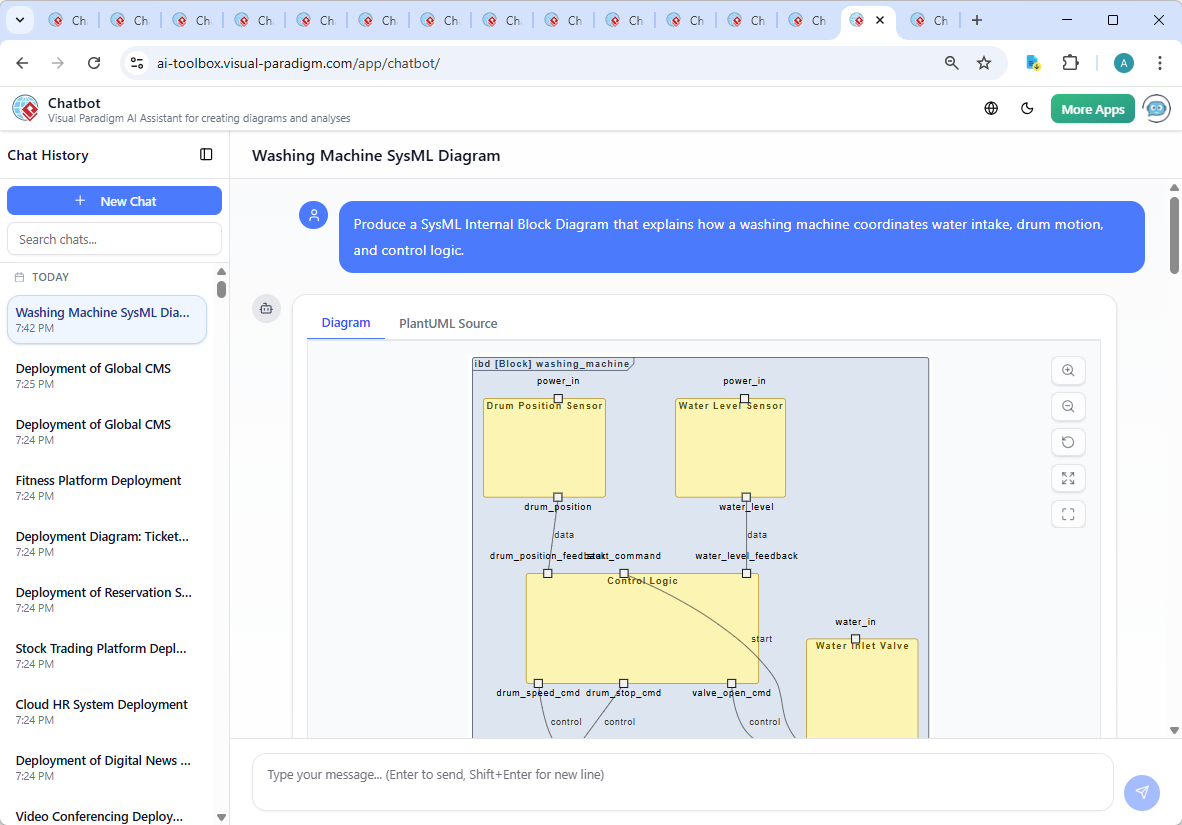
The journey began with a straightforward prompt: “Produce a SysML Internal Block Diagram that explains how a washing machine coordinates water intake, drum motion, and control logic.”
Within seconds, the Visual Paradigm AI Chatbot delivered a fully structured IBD using SysML notation, complete with components, ports, and connections. But the real power emerged in the follow-up conversation.
When the user asked, “Explain this diagram,” the AI didn’t just list components—it provided a structured breakdown, clarifying the role of each subsystem and how they communicate. It explained the significance of feedback loops, control signals, and data flow—turning a visual artifact into a learning tool.
Further refinement came when the user requested deeper insight: “Explain this branch” or “Refine the logic around water level feedback.” The AI responded with context-aware updates, adjusting the diagram’s structure and annotations to reflect real-world behavior—such as how the control logic uses sensor data to dynamically adjust valve timing.
This wasn’t a static output. It was a dialogue between human intent and AI intelligence—each exchange refining accuracy, clarity, and engineering rigor.
Decoding the System Logic: How the Washing Machine Works
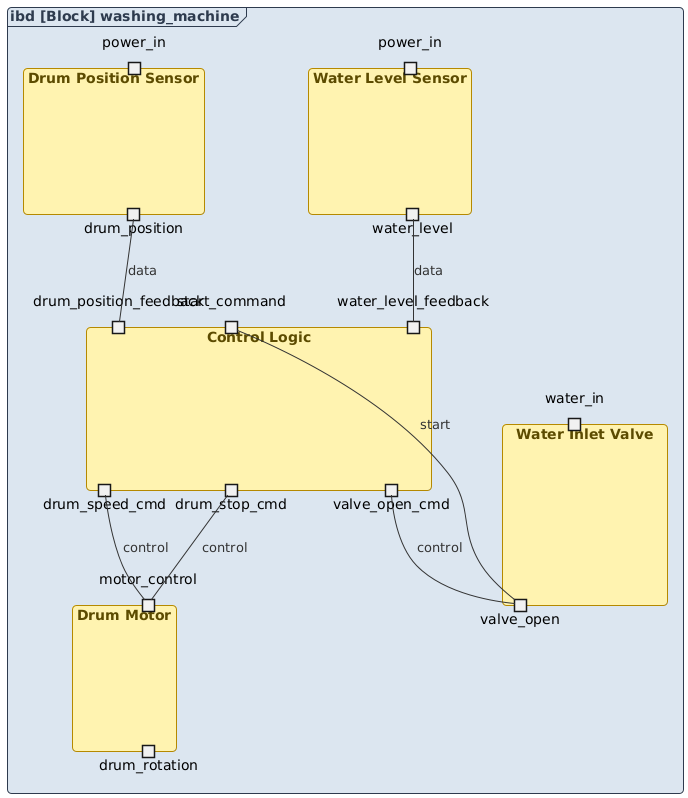
The generated SysML Internal Block Diagram reveals the core architecture of the washing machine’s operation. Let’s walk through the key elements and their interactions:
Core Components and Their Roles
- Water Inlet Valve: Acts as the gatekeeper for water. It opens only when commanded by the control logic and closes once the desired water level is reached.
- Drum Motor: Drives the washing drum. It receives speed commands and stops based on feedback from the drum position sensor.
- Control Logic: The central decision-making unit. It receives start signals and sensor feedback, then issues control commands to the valve and motor.
- Water Level Sensor: Monitors the water level in real time and sends data back to the control logic—enabling adaptive filling.
- Drum Position Sensor: Tracks the drum’s rotational state, ensuring safe operation during spin cycles and helping prevent imbalance.
Interaction Patterns
Three types of flow define the system’s behavior:
- Control Flow: The control logic sends commands such as
drum_speed_cmdandvalve_open_cmdto the actuator components. - Data Flow: Sensors feed real-time data—
water_levelanddrum_position—back to the control logic for decision-making. - Start Signal: A trigger from the user interface activates the entire sequence, initiating the cycle.
These flows form a closed-loop system: the control logic doesn’t act blindly. It adjusts based on feedback—ensuring efficiency, safety, and reliability.
Why Use an Internal Block Diagram?
Unlike sequence or activity diagrams, which focus on time-based behavior, an IBD excels at showing the static structure and internal composition of a system. In this case, it clearly illustrates:
- How components are connected via ports
- Which signals are sent and received
- How feedback enables adaptive control
This makes the IBD ideal for system design reviews, cross-team alignment, and early-stage validation—especially when integrating mechanical, electrical, and software subsystems.
Conversational Intelligence in Action
What sets Visual Paradigm apart is not just the diagram output—but the intelligence behind the conversation. The AI doesn’t just generate visuals; it acts as a modeling consultant.
For example, after the initial diagram was delivered, the user asked for an explanation. The AI didn’t respond with a generic summary. Instead, it structured the response with:
- A clear breakdown of components and their roles
- A step-by-step walkthrough of system behavior
- Contextual insights into why certain design choices were made (e.g., feedback loops)
- Open-ended suggestions for further exploration (e.g., adding error conditions)
This level of responsiveness turns the AI Chatbot into a trusted partner—not a tool.
More Than Just SysML: A Unified Modeling Platform
The Visual Paradigm AI Chatbot isn’t limited to SysML. It supports a full spectrum of modeling standards, making it a complete solution for enterprise and IT architecture:
- UML: For software design, class diagrams, sequence diagrams, and state machines
- ArchiMate: For enterprise architecture, modeling business, application, and technology layers
- C4 Model: For software architecture, visualizing containers, components, and code
- Mind Maps, Org Charts, SWOT, PEST, and Charts: For strategic planning, brainstorming, and data visualization
Whether you’re modeling a washing machine’s control system or designing a cloud-native enterprise application, the same AI-powered environment adapts to your needs—offering consistent, accurate, and collaborative modeling across domains.
Conclusion: Design Smarter, Together
The SysML Internal Block Diagram of the washing machine isn’t just a visual. It’s a living model—crafted through a dynamic conversation between human intent and AI intelligence. With the Visual Paradigm AI Chatbot, complex system designs become accessible, intuitive, and collaborative.
Whether you’re a systems engineer, a product designer, or a technical architect, you’re not just creating diagrams—you’re co-designing smarter systems, one conversation at a time.
Ready to start your next modeling journey? Explore the shared session and experience how AI transforms system design.