AI Generated SysML Internal Block Diagram: Aircraft Flight Control System Example
By
/
Designing Flight Stability: How AI Transforms Aircraft Control System Modeling
Designing a reliable aircraft flight control system demands precision in both function and architecture. The challenge lies in visualizing how internal subsystems—sensors, actuators, and control logic—interact in real time to maintain stability under dynamic flight conditions. Traditional modeling approaches often require deep domain expertise and extensive manual effort. With Visual Paradigm’s AI Chatbot, this process becomes a collaborative dialogue, where natural language prompts evolve into accurate, standards-compliant SysML models.
From Prompt to Precision: The Interactive Modeling Journey
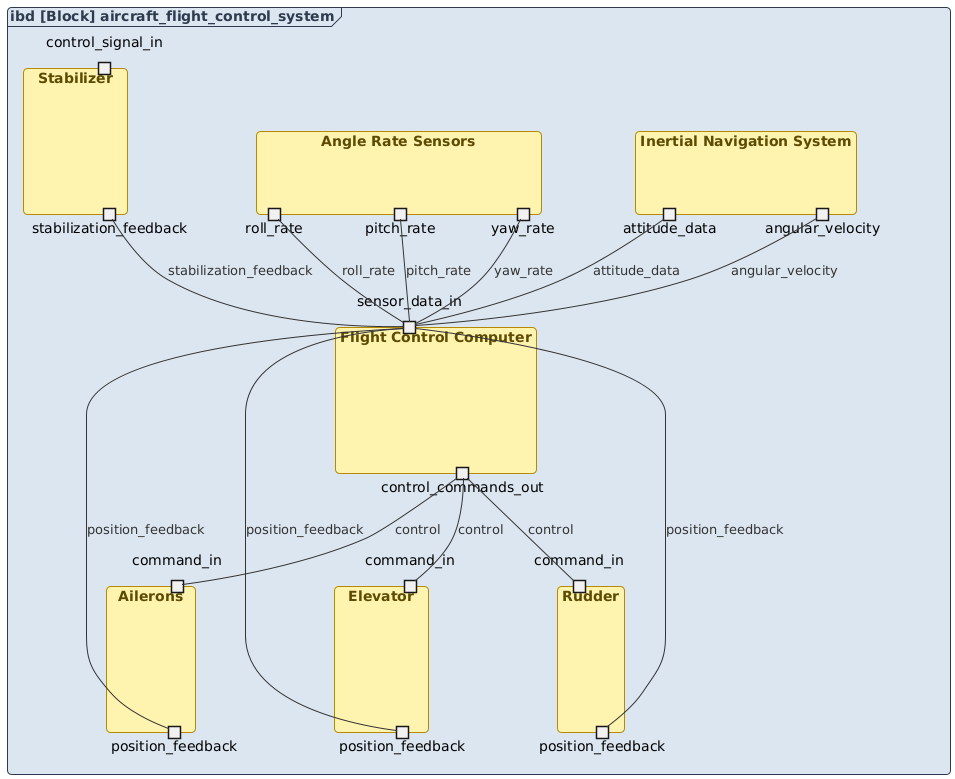
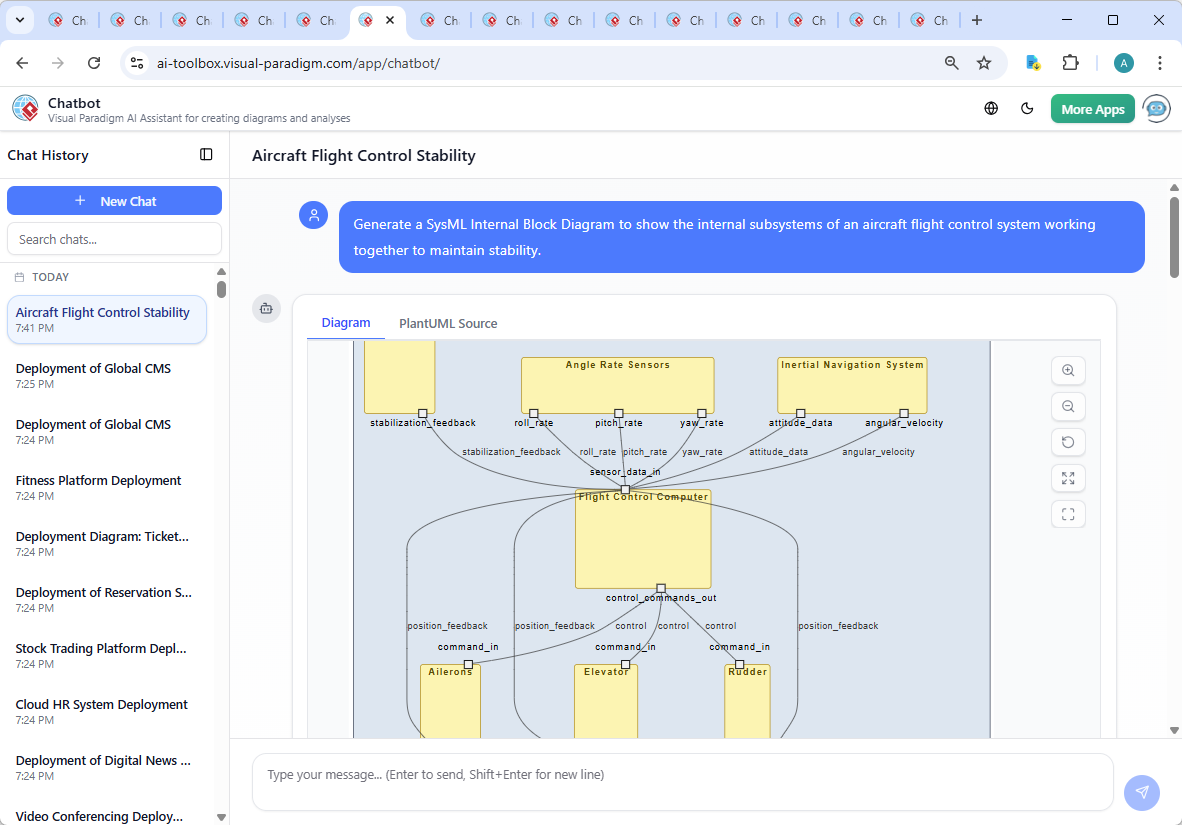
The journey began with a simple request: “Generate a SysML Internal Block Diagram to show the internal subsystems of an aircraft flight control system working together to maintain stability.” Within seconds, the Visual Paradigm AI Chatbot responded with a fully structured SysML InternalBlockDiagram in PlantUML syntax, featuring key components like the Flight Control Computer (FCC), ailerons, elevator, rudder, Inertial Navigation System (INS), and angle rate sensors.
But the real value emerged in the conversation. When the user asked, “Can you explain how the Flight Control Computer processes incoming sensor data to generate control commands?”, the AI didn’t just restate the diagram—it delivered a detailed technical breakdown. It explained how the FCC integrates attitude, angular velocity, and rate data from multiple sources, applies feedback control logic (like PID), and generates precise commands to counteract deviations in roll, pitch, and yaw.
This wasn’t a static diagram. It was a living model shaped by iterative refinement. The AI clarified the role of feedback loops, demonstrated how the FCC adjusts control surfaces in response to disturbances (e.g., wind gusts), and even provided a real-time scenario to illustrate stability in action. When the user requested further clarification—“Explain this branch”—the AI responded with targeted explanations of signal flow, control logic, and the purpose of each port connection.
AI Generated SysML Internal Block Diagram: Aircraft Flight Control System Example (by Visual Paradigm AI)
Decoding the Logic: Why This Internal Block Diagram Works
The diagram’s design follows core SysML principles for system decomposition and interaction. Each component represents a subsystem with clearly defined interfaces (ports), enabling precise modeling of data and control flow:
Flight Control Computer (FCC): Acts as the central processing unit, receiving sensor data via sensor_data_in and sending control commands via control_commands_out.
Sensor Inputs: The Inertial Navigation System (INS) and Angle Rate Sensors provide critical data on attitude, angular velocity, and rate of change—essential for detecting instability.
Actuators: Ailerons, elevator, and rudder receive commands and return position feedback, closing the control loop.
Stabilizer: An auxiliary component that contributes to pitch stability and feeds feedback to the FCC.
Connections between ports represent data and command flows. For example:
ins_attitude_data -- fcc_sensor_data_in : attitude_data shows how attitude is fed into the FCC.
fcc_control_commands_out -- ailerons_command_in : control illustrates the command path to the ailerons.
By modeling these interactions as ports and connectors, the diagram captures the system’s dynamic behavior and enables simulation, analysis, and verification—critical for safety-critical domains like aerospace.
Conversational Intelligence: The AI as a Modeling Partner
What sets Visual Paradigm apart is the depth of insight the AI Chatbot provides beyond diagram generation. The conversation wasn’t just about drawing lines—it was about understanding the system’s behavior. When the user asked for an explanation of the FCC’s role, the AI didn’t just describe the components; it walked through the control logic step-by-step, using real-world flight dynamics as context.
Each follow-up—like “Explain this branch” or “Refine the logic”—was treated as a modeling opportunity. The AI responded with structured, technically accurate explanations that deepened the user’s understanding of feedback control, stability algorithms, and real-time decision-making.
These interactions prove that the AI isn’t just a diagram generator. It’s a collaborative modeling expert—equipped with domain knowledge in systems engineering, control theory, and software architecture.
Visual Paradigm AI Chatbot: Crafting an Internal Block Diagram for AI Generated SysML… (by Visual Paradigm AI)
Beyond SysML: A Unified Platform for Enterprise Architecture
While this example focused on SysML, the Visual Paradigm AI Chatbot supports a full suite of modeling standards. Whether you’re designing enterprise IT systems with ArchiMate, modeling complex business processes with UML, or visualizing software architecture with C4 Model, the AI adapts to your needs.
From mind maps to PERT charts, organizational charts to SWOT analysis, the platform enables a consistent, AI-enhanced modeling experience across disciplines. This versatility makes Visual Paradigm not just a tool for engineers, but a strategic asset for architects, product managers, and cross-functional teams.
Conclusion: Modeling the Future, One Conversation at a Time
Creating a precise and meaningful Internal Block Diagram for an aircraft flight control system is no small task. But with Visual Paradigm’s AI Chatbot, it becomes a seamless, intelligent collaboration. The platform transforms abstract ideas into structured, standards-compliant models—and does so with the clarity and depth of a seasoned systems engineer.
Whether you’re refining control logic, exploring feedback mechanisms, or scaling your design to complex systems, the AI Chatbot is always ready to guide, explain, and improve.